At-Home Whitening Trays vs In-Office: Real Differences
23 يوليو 2026
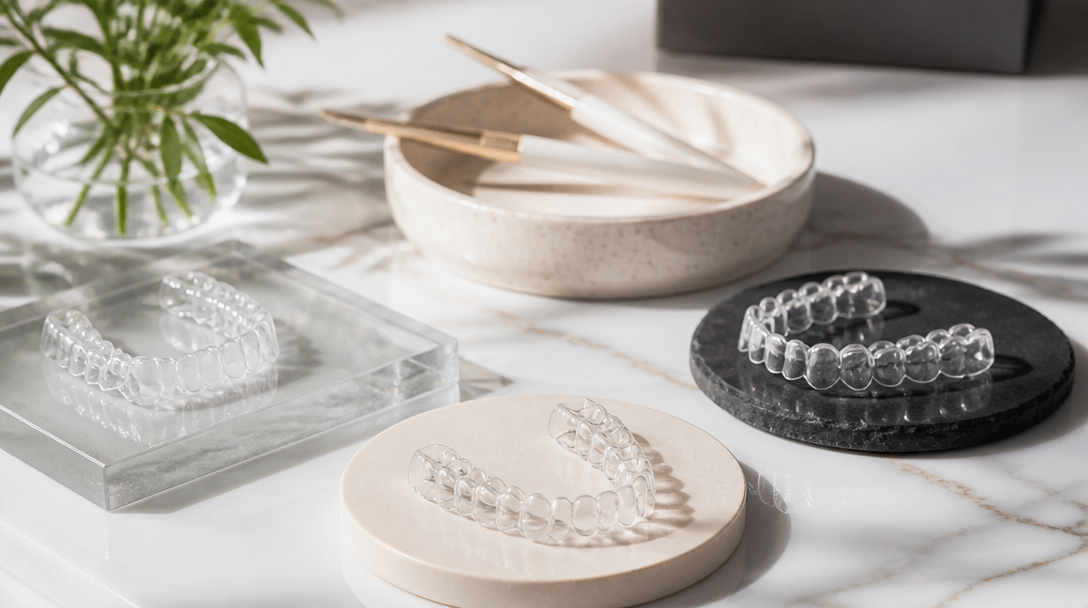
Compare at-home whitening trays vs dentist treatments on cost, speed, sensitivity and lasting results — based on peer-reviewed clinical evidence.
Why This Comparison Matters Before You Spend Anything
If you've searched at-home whitening trays vs dentist, you're trying to answer one practical question: is it worth paying significantly more for an in-office treatment, or can you get the same result at home for less? The research tells a genuinely interesting story — and it doesn't favor the more expensive option as clearly as most people expect.
Multiple peer-reviewed studies have found no clinically meaningful difference in whitening efficacy between properly followed at-home tray protocols and in-office chair treatments. That doesn't mean the two methods are identical. Cost, speed, sensitivity risk, and how long results hold all differ — sometimes significantly. This article walks through each factor honestly, based on clinical evidence.
One distinction matters before going further: this comparison focuses on custom-fitted, dentist-supervised at-home trays — not over-the-counter strips or paint-on gels. Dentist-prescribed tray whitening is a separate category from retail self-care products and should not be treated as equivalent.
What Actually Happens to Your Teeth During Each Treatment
Both methods use peroxide-based chemistry. The active agent — typically hydrogen peroxide or carbamide peroxide — diffuses through the enamel surface and breaks apart the chromogen molecules responsible for staining. The mechanism is identical whether you're in a dental chair or wearing a tray at home before bed.
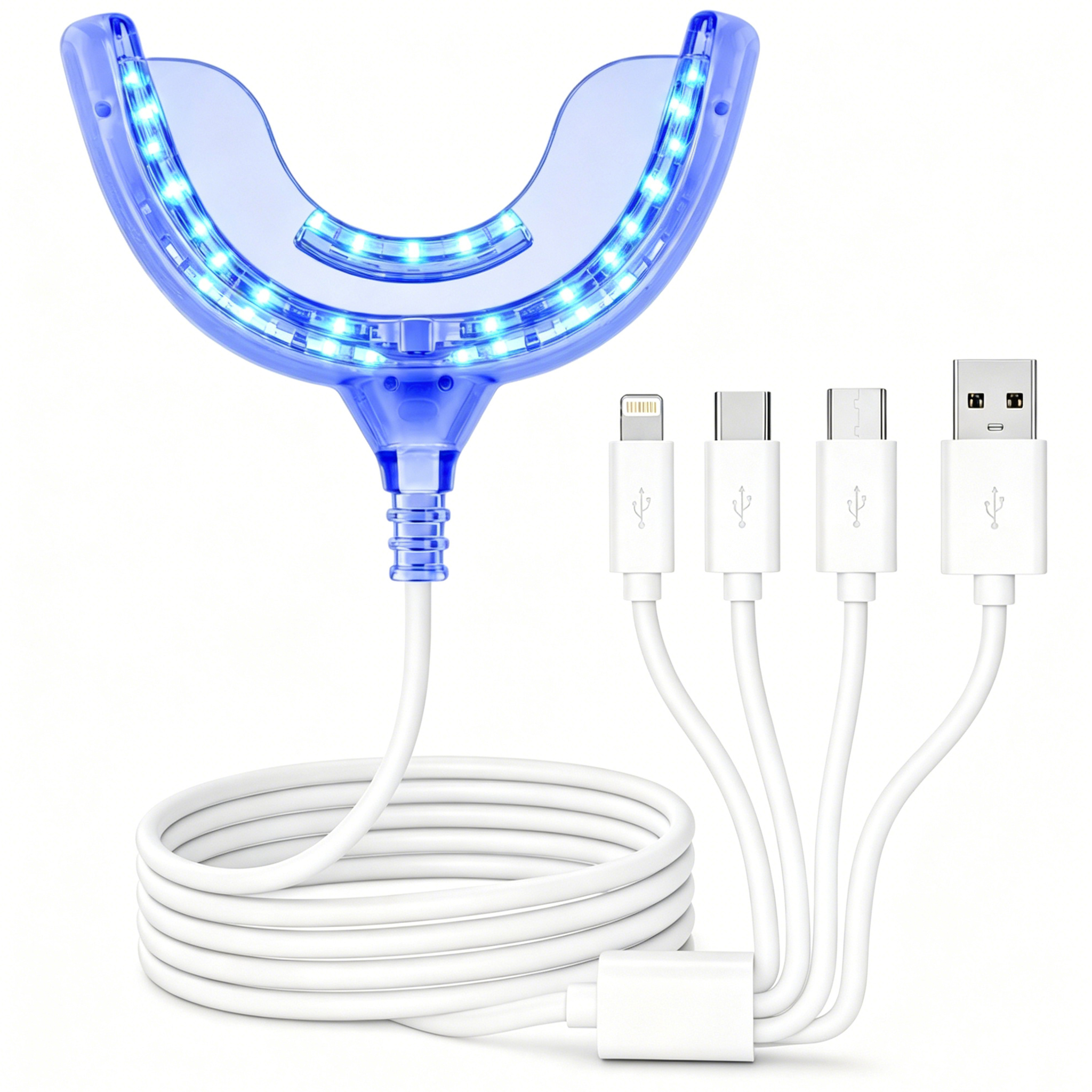
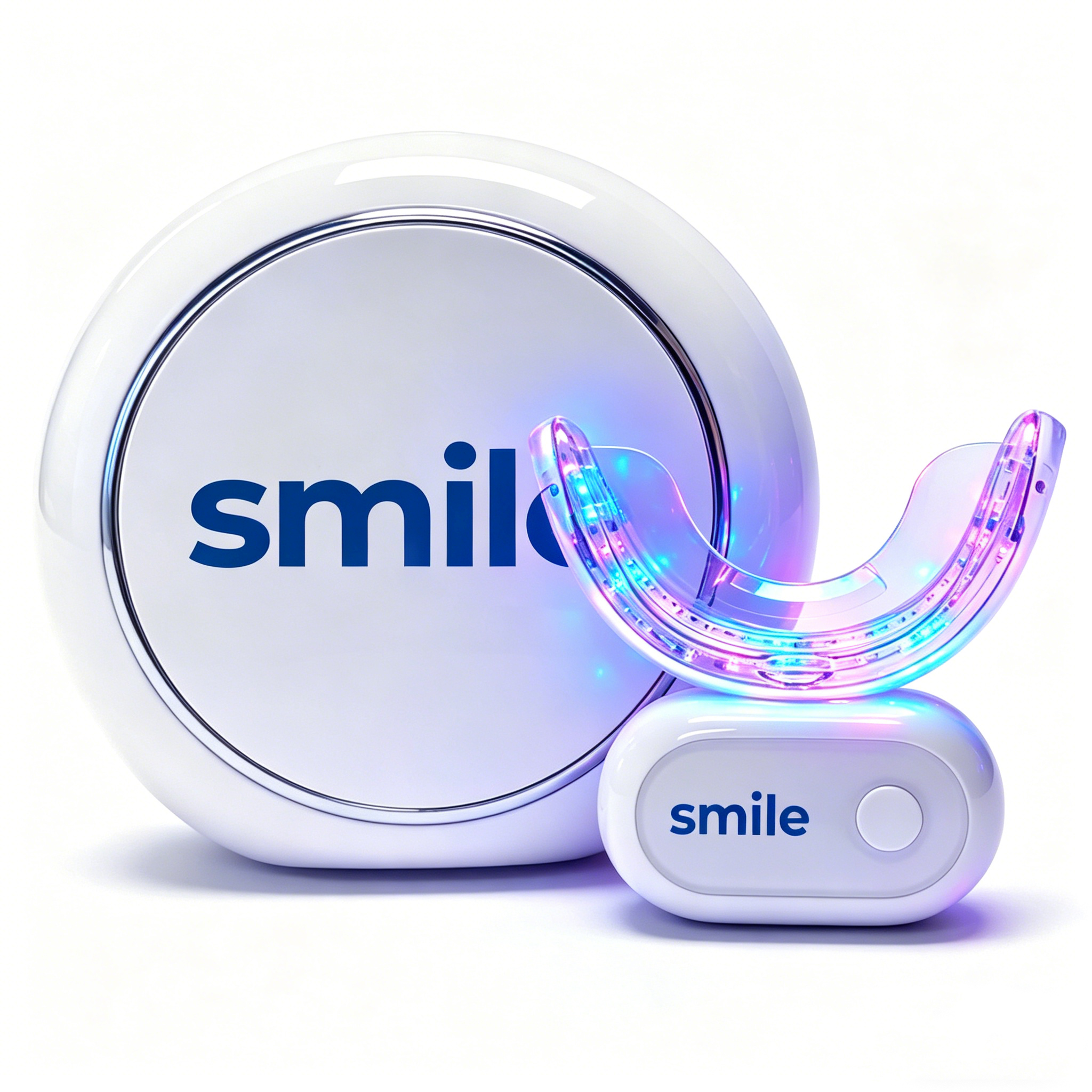
Where the methods diverge is in concentration and contact time. In-office treatments use higher peroxide concentrations applied by a clinician, often alongside a light or heat source intended to accelerate the reaction. At-home trays use lower concentrations worn over longer periods — typically overnight or for a set number of hours each day across several weeks.
The evidence for light or laser activation is worth noting here. A clinical review published in PMC found that the evidence supporting light-activated whitening as superior to non-light-activated whitening is not strong. The light may speed up the in-chair session, but it does not appear to produce meaningfully better final results.
Cost: At-Home Whitening Trays vs Dentist Chair Sessions
This is where the two approaches diverge most visibly. In-office whitening carries a higher single-session fee. Most dentists also recommend a take-home tray kit for maintenance afterward, which adds to the total cost. Dentist-prescribed at-home tray kits have a lower upfront cost but require consistent use across several weeks.
When you factor in gel refills — which both approaches eventually require to maintain results — the long-term cost difference often narrows considerably.
| Factor | In-Office Treatment | At-Home Custom Trays |
|---|---|---|
| Upfront cost | Higher (single session fee) | Lower (fitting + tray fabrication + gel) |
| Ongoing maintenance | Gel refills recommended | Gel refills recommended |
| Clinician time required | One or more appointments | Initial fitting appointment only |
| Flexibility | Fixed schedule | Use at home, on your own timeline |
The at-home tray route is generally the more accessible entry point — particularly for maintaining results after an initial in-office session. Neither option is a minor expense, but the long-term value of reusable custom trays is real.
Speed: How Fast Each Method Delivers a Shade Shift
In-office whitening is faster. That's the clearest advantage it holds. A single session can produce visible shade improvement within an hour or two, which matters if you have a wedding, a presentation, or an event coming up within the next few days.
At-home whitening trays require patience. Research published in PMC found that at-home whitening required significantly longer treatment time compared to in-office approaches — though the final whitening outcomes were strong. Most dentist-prescribed tray protocols run for two to four weeks of daily or nightly use before the full result becomes apparent.
The part most people don't expect: the final shade achieved is often comparable. A randomized clinical trial with a nine-month follow-up found no clinically significant difference in bleaching efficacy between at-home and in-office whitening at that point in time. The in-office method gets you there faster. The at-home method gets you to roughly the same place, more gradually.
If speed is the priority, in-office wins clearly. If you can plan a few weeks ahead, at-home trays deliver comparable results at a lower total cost.
Safety and Sensitivity: Where the Real Risks Sit
Tooth sensitivity is the most common side effect of peroxide-based whitening, and it occurs with both methods. The distinction is in how that sensitivity tends to present.
In-office treatments use higher peroxide concentrations over a shorter time. This can produce more acute sensitivity during or immediately after the session — a sharp, temporary response to rapid peroxide exposure. At-home trays use lower concentrations over longer periods, which tends to produce milder, more gradual sensitivity that most users find easier to manage.
A narrative review published on PubMed noted that at-home whitening may produce slightly less intense sensitivity than in-office treatment, while both methods are considered clinically safe when protocols are followed correctly. A nine-month randomized clinical trial reported no adverse events related to bleaching in either group — a reassuring finding for anyone concerned about long-term enamel damage from a supervised whitening protocol.
The risk profile changes when protocols aren't followed. Overusing at-home gels, wearing trays longer than recommended, or using trays that don't fit properly increases both sensitivity and gum irritation. A well-fitted custom tray keeps gel in contact with tooth surfaces and away from gum tissue. Poorly fitting trays — including many over-the-counter options — allow gel to seep onto the gums, which is where irritation typically starts.
For anyone with a history of sensitivity, these practical steps apply regardless of which method you choose:
- Use a sensitivity-formulated toothpaste for two weeks before starting any whitening treatment.
- Ask your dentist about potassium nitrate or fluoride gel as a buffer during tray use.
- Reduce wear time if sensitivity develops, rather than stopping treatment entirely.
- Avoid very hot or cold food and drinks on treatment days.
How Long Results Last — and What Shortens Them
Whitening results are not permanent with either method. Teeth re-stain over time because enamel is porous and continues to absorb pigment from food, drink, and other lifestyle factors. The real question is how quickly fading happens — and whether one method holds longer than the other.
A systematic review published on PubMed found that at-home trays may have lower recurrence rates and possibly better longer-term effect compared to in-office whitening alone. One explanation is that the slower, lower-concentration process may allow peroxide to work more evenly through the enamel. Another is more practical: at-home tray users can run a short top-up session the moment they notice fading beginning, without booking a clinic appointment.
The factors that shorten results are the same for both methods:
- Coffee, tea, and red wine — the most consistent re-staining agents
- Tobacco use — significantly accelerates re-staining
- Colored foods — tomato-based sauces, berries, soy sauce
- Time — natural aging of enamel continues regardless of whitening treatment
Most dentists recommend a maintenance session — typically a few nights of tray use — every three to six months to preserve results. If you've had in-office whitening, this is exactly why your dentist sends you home with a tray kit. The tray is the maintenance tool, regardless of how you started.
How to Choose Between At-Home Whitening Trays vs Dentist Treatments
There is no universally correct answer. The right choice depends on your timeline, budget, sensitivity history, and how much daily involvement you're comfortable with.
Choose in-office whitening if:
- You need visible results within a few days.
- You prefer a single supervised session over a multi-week home routine.
- You want a clinician monitoring your gum and enamel response in real time.
Choose at-home whitening trays if:
- You can plan two to four weeks ahead and want a comparable final result at lower cost.
- You have a history of acute sensitivity and want a gentler, more gradual approach.
- You want flexibility — treating on your own schedule, at home, without repeated clinic visits.
- You're maintaining results after a previous whitening treatment.
Consider a combined approach if:
- You want a fast start followed by sustained results at home. One important caveat: research found that adding an in-office phase to home whitening did not significantly improve tooth color compared to home whitening alone. A combined approach may offer speed of onset, but it does not appear to produce a meaningfully better final outcome.
What the clinical evidence consistently shows is that custom at-home trays, used correctly under dental supervision, are not a compromise. They are a validated whitening method that produces results comparable to in-office treatment over a longer timeline. The choice between them is largely practical — not a question of which one actually works.
A conversation with your dentist about your specific staining type, sensitivity history, and timeline is the most reliable first step. Whitening works best when the method matches the person using it.
References
- In-office vs at-home tooth bleaching: A narrative review of efficacy and safety — PubMed
- Evaluation of the Effectiveness of Different Types of Professional Tooth Whitening: A Systematic Review — PubMed
- A randomized clinical trial comparing at-home and in-office tooth whitening techniques: A nine-month follow-up — PubMed
- Comparison of in-office and at-home bleaching techniques — PMC / National Library of Medicine
- A Clinical Study Comparing the Efficacy and Sensitivity of Home vs Combined Whitening — Operative Dentistry
Disclaimer
This article is for general informational purposes only and is not a substitute for professional dental or medical advice. Always consult a qualified dental professional before starting any teeth-whitening or oral-care regimen. WhiteningBright makes no warranties as to the completeness or accuracy of the information, and any reliance is at your own risk.