MOQ Reality Check for Private-Label Whitening Kits
4 سبتمبر 2026
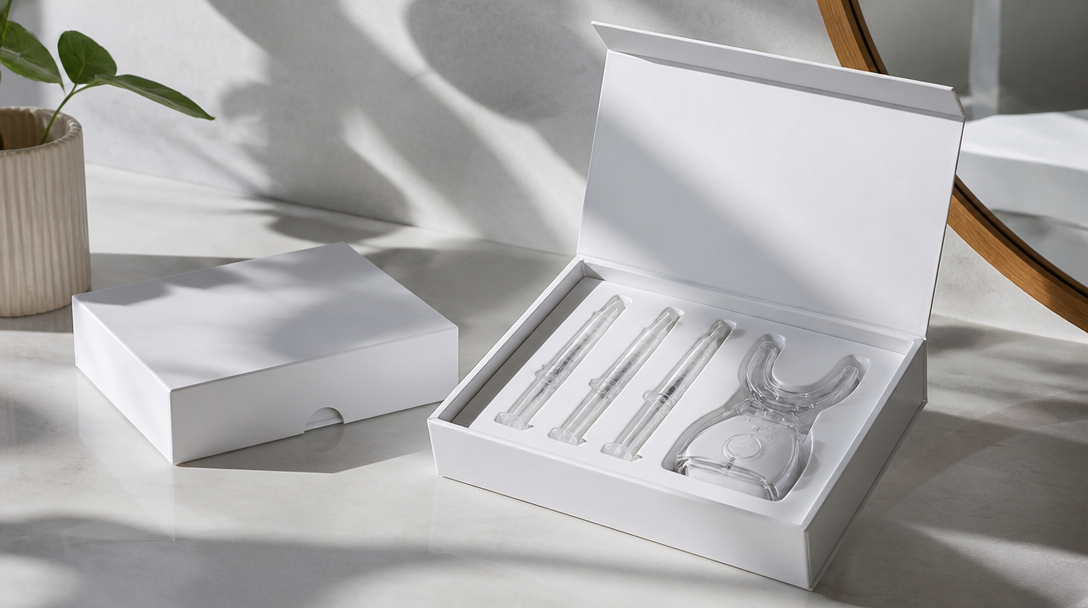
Learn how private label whitening kit MOQ varies by format, branding complexity, and compliance burden — with the sourcing questions every B2B buyer should ask first.
MOQ Reality Check: What Private Label Whitening Kit Buyers Actually Need to Know
The first number a brand owner encounters when sourcing a private label whitening kit is MOQ — and it almost never comes with a clear explanation. One supplier quotes 500 units for a gel kit. Another quotes 5,000 units for a comparable product. That gap is not a quality signal. It reflects different production models, formulation batch economics, and regulatory documentation burdens. Understanding what drives MOQ is the foundation of managing launch risk and protecting cash flow.
MOQ is structural, not arbitrary. It is determined by batch size minimums, component sourcing thresholds, filling-line setup costs, and the compliance documentation required per SKU. A peroxide-based gel destined for the U.S. market carries a different regulatory burden than a PAP-based strip registered as a cosmetic in the EU. That burden has a real cost — and suppliers amortize it across the minimum run. Buyers who treat MOQ as a negotiating chip without understanding these mechanics tend to overpay for flexibility or accept compromises they do not recognize until after launch.
Private Label Whitening Kit MOQ Ranges by Format
MOQ structures differ meaningfully across the four primary whitening formats. The ranges below reflect general market patterns — not guaranteed supplier terms — and should be used as a calibration baseline when evaluating quotes.
| Format | Typical MOQ Range | Primary MOQ Driver |
|---|---|---|
| Whitening gel (syringe or tray) | 500 – 2,000 units | Batch size, peroxide concentration documentation |
| Whitening strips | 1,000 – 5,000 units | Film substrate minimums, pouch sealing setup |
| Whitening pens | 500 – 3,000 units | Component sourcing (twist mechanism, brush tip) |
| LED accelerator bundles | 300 – 1,500 units | Electronics assembly, battery compliance (CE/FCC) |
Strips carry the highest MOQ consistently. The substrate — typically a polyethylene or hydrogel film — is purchased in rolls with their own cut minimums, and that constraint flows directly into unit pricing. A 2024 scoping review published in PubMed confirmed that whitening strips have the strongest clinical evidence base among over-the-counter whitening formats, which makes them commercially attractive. That demand does not reduce the production floor minimums.
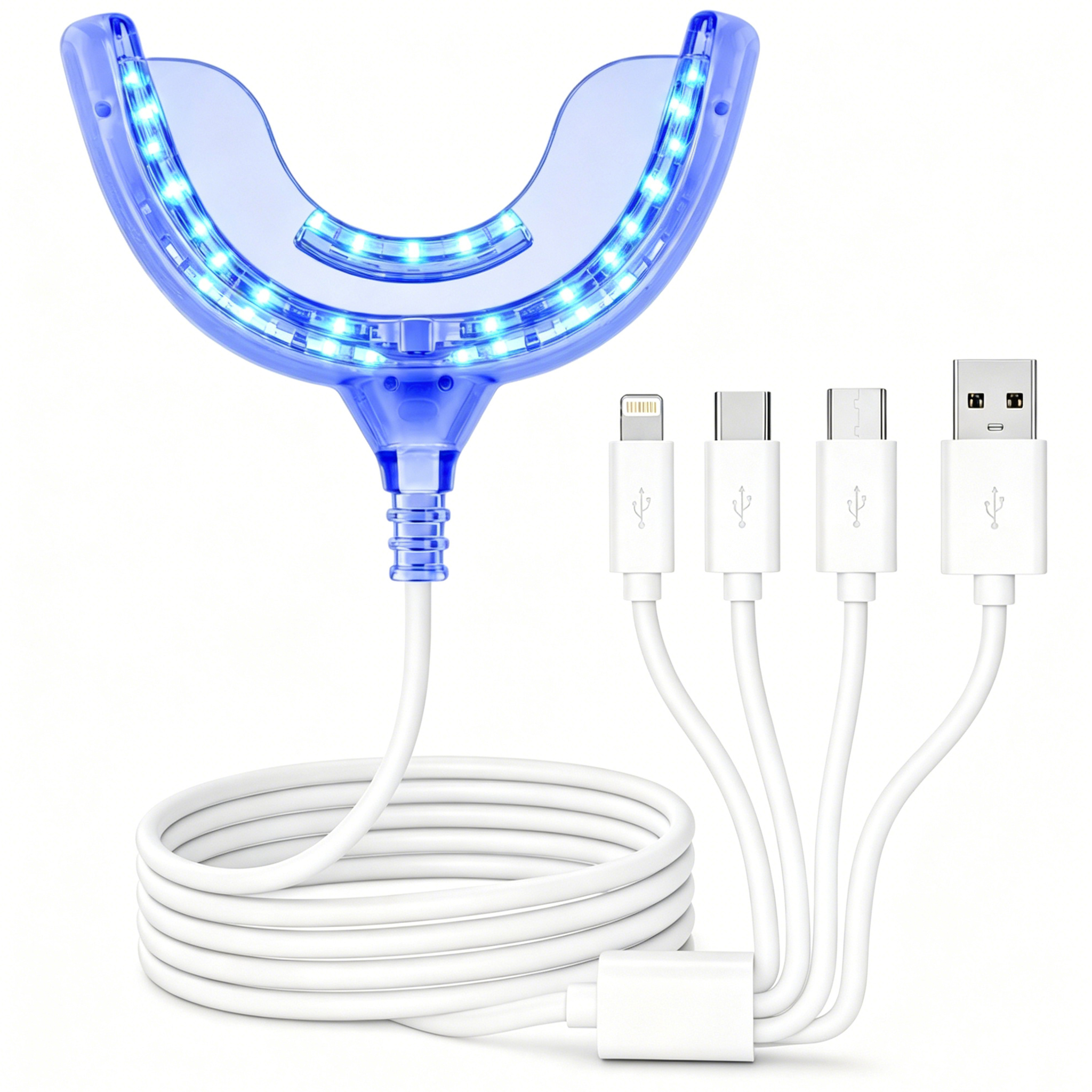
LED bundle kits present a separate dynamic. The device component may have a lower unit MOQ than strips, but electronics require CE marking for EU distribution and FCC compliance for the U.S. market. That documentation adds cost per SKU regardless of volume — a factor buyers frequently underestimate when comparing bundle quotes to single-format quotes.
How Branding Complexity Pushes Minimum Run Sizes Higher
A buyer ordering a stock-formula gel in a generic syringe with a label overlay operates under a fundamentally different cost structure than one requesting custom packaging, a co-developed formulation, and printed cartons with multi-language regulatory text. Each layer of customization carries a setup cost. Suppliers recover that cost by raising the MOQ.
The main branding variables that drive minimums up:
- Custom molded components — proprietary tray shapes or pen housings require tooling investment, typically only viable above 3,000–5,000 units.
- Printed folding cartons — offset printing plate setup makes short runs under 1,000 units economically inefficient for most printers.
- Multi-SKU kits — bundling a gel, tray, and LED device into one retail box triples component coordination requirements and forces alignment across three separate production schedules.
- Regulatory label variants — separate artwork for EU, U.S., and APAC markets means three distinct print runs, each with its own minimum.
A dental clinic launching a single in-house brand with one SKU can often work within a 500–1,000 unit first run by accepting stock packaging. A DTC wellness brand planning a full kit with custom outer cartons and three regional label versions should plan for minimums closer to 3,000–5,000 units per variant before the economics support a credible supplier relationship.
Negotiating Private Label Whitening Kit MOQ Without Compromising Formulation Standards
MOQ negotiation is legitimate — but the right leverage points are rarely price alone. Suppliers respond to buyers who demonstrate a credible growth path: a letter of intent for a follow-on order, a defined retail or clinic distribution channel, or a willingness to accept longer lead times in exchange for a smaller first run.
What should not be negotiated away is formulation integrity. The ADA's acceptance guidelines for tooth-whitening products require FDA documentation and independent clinical evidence of whitening efficacy for any product seeking ADA recognition. A supplier willing to lower the MOQ by cutting stability testing or skipping third-party efficacy data is not offering flexibility — they are shifting compliance risk directly onto the buyer.
Practical negotiation levers that do not compromise the product:
- Accept a stock formulation on the first run; co-develop a custom formula at scale on the second.
- Use digital label printing for the initial run to avoid offset plate minimums.
- Consolidate SKUs — launch one concentration, one format, one market — to keep the first run clean and compliant.
- Negotiate a blanket order with scheduled releases: commit to 5,000 units over 12 months, with the first release at 1,000.
Lead Time Realities at Different Order Volumes
MOQ and lead time move together. A supplier running a 500-unit first order for a new private-label client will typically schedule that run between larger production blocks — extending lead time relative to what the same supplier quotes for a 5,000-unit repeat order that fills a dedicated slot.
General lead time expectations by order stage:
- Sample and formulation approval: 2–4 weeks for stock formulas; 6–10 weeks for co-developed formulations requiring stability testing.
- First production run (500–1,000 units): 6–10 weeks from approved artwork and formula sign-off.
- Scaled repeat run (3,000+ units): 4–8 weeks, assuming no formulation changes and pre-approved artwork.
- LED device component lead time: Add 4–6 weeks if the device requires electronics compliance testing for a new market.
Buyers planning a seasonal launch — a Q4 retail push or a clinic promotion tied to a specific window — need to work backward from the in-store date. A 10-week production lead time plus 3–4 weeks of freight means a first-run order needs to be placed at least 14–16 weeks before launch.
What Low-MOQ Offers Usually Sacrifice
Suppliers advertising 100- or 200-unit minimums on private label whitening kits are operating a stock-and-relabel model — minimal formulation documentation, no product-specific compliance file. For a buyer testing a new channel with no efficacy claims, that may be acceptable. For any buyer selling through regulated channels or making efficacy claims, it carries real exposure.
The compliance gap is concrete. The FDA recognizes ISO 28399 / ANSI ADA 136-2022 as the consensus standard for external tooth bleaching products. A product sold in the U.S. market without conformity to that standard — or without the documentation to demonstrate conformity — is exposed to regulatory action, regardless of what the supplier's product sheet states.
The ADA identifies temporary sensitivity and gingival inflammation as the most common adverse effects of whitening. A product formulated without proper concentration controls or validated stability data is more likely to produce these effects at rates that generate consumer complaints and returns — a downstream cost that never appears in a low-MOQ pitch.
The 2024 evidence-based review published in Nature Partner Journals is direct: tooth whitening is generally safe and effective when manufacturer instructions are followed. That conditional phrase carries weight. Manufacturer instructions need to be grounded in a validated formulation — not a relabeled stock product with no supporting data file.
Questions to Ask Before Committing to a First Run
A professional buyer should be able to get clear, documented answers to the following before signing a purchase order. Vague or evasive responses to any of these are a sourcing signal worth taking seriously.
On Formulation and Compliance
- What is the active ingredient — hydrogen peroxide, carbamide peroxide, or PAP — and at what concentration?
- Does this product conform to ISO 28399 / ANSI ADA 136-2022? Can you provide the conformity documentation?
- Is there a stability study on file for this formulation, and what is the tested shelf life?
- Has this formula been evaluated for efficacy in an independent clinical or laboratory study?
On Production and MOQ Structure
- What is the minimum batch size for this formulation, and how does that translate to unit MOQ?
- If I accept stock packaging for the first run, what is the lead time difference versus custom packaging?
- What changes — to formulation, packaging, or concentration — would trigger a new MOQ reset?
On Regulatory Documentation
- What market-specific documentation is included — FDA, CE, or other — and what remains the buyer's responsibility to obtain independently?
- If ADA Seal eligibility is a future target, does this formulation meet the baseline requirements for independent efficacy evidence?
A supplier who answers these questions with documentation — not verbal assurances — is operating at a standard consistent with a credible private-label partnership. MOQ is the starting point. The formulation file, compliance documentation, and production transparency behind that number determine whether the first run becomes a scalable brand or an expensive lesson in sourcing risk.
References
- American Dental Association — Whitening (Oral Health Topics)
- American Dental Association — ADA Seal Category Requirements: Home-Use Tooth Bleaching Products (2026)
- U.S. Food and Drug Administration — Recognized Consensus Standards: ISO 28399 / ANSI ADA 136-2022 (External Tooth Bleaching)
- Over-the-counter products in tooth bleaching: A scoping review (PubMed, 2024)
- Tooth whitening: an evidence-based perspective (Nature Partner Journals, 2024)
Disclaimer
This article is for general informational purposes only and does not constitute sourcing, legal, or regulatory advice. Always conduct your own due diligence and consult qualified legal or compliance professionals before making purchasing or compliance decisions. WhiteningBright makes no warranties as to the completeness or accuracy of the information, and any reliance is at your own risk.