Strip Adhesive Specs: What Sourcing Buyers Miss
13 سبتمبر 2026
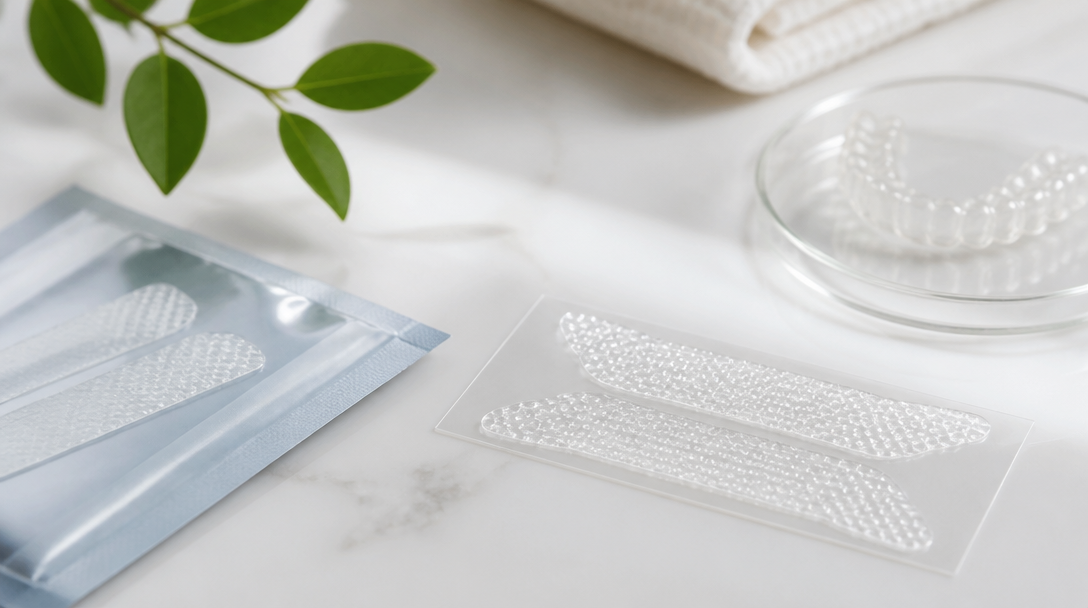
Discover what whitening strip supplier specifications buyers overlook — adhesive formulation, backing film, biocompatibility testing, and contact-time validation.
Strip Adhesive Specs: What Sourcing Buyers Miss in Whitening Strip Supplier Specifications
Most buyers evaluating whitening strip supplier specifications concentrate due diligence on active-ingredient concentration — peroxide percentage, PAP load, or carbamide equivalency. That focus is understandable. It is also incomplete. The largest driver of real-world product failure is adhesive formulation, and it is routinely left unexamined. A strip with a precisely calibrated whitening gel will still generate consumer complaints and returns if the adhesive fails to hold, migrates onto soft tissue, or releases before the contact window closes.
For clinic owners building a private-label line, spa operators sourcing retail SKUs, or distributors placing volume orders, adhesive performance is not a commodity variable. It is an engineered specification that deserves the same scrutiny as active-ingredient data.
This article identifies the specific adhesive and backing film parameters that separate a well-specified strip from one that will underperform — and the documentation gaps that signal a supplier is not equipped to support a serious brand.
Backing Film: The Structural Variable Most Buyers Never Ask About
The backing film is the structural layer of a whitening strip. It determines how the gel is supported against tooth curvature, how much flex the strip absorbs during wear, and whether the adhesive maintains consistent contact pressure across the full arch. Film selection is not a cosmetic decision — it directly affects both adhesion durability and biocompatibility, properties that recent work published in Biomaterials Science (2026) confirms must be engineered together, not treated as separate concerns.
Three film types appear most frequently in professional-grade strip products:
- PET (polyethylene terephthalate): Rigid, dimensionally stable, resistant to moisture migration. Well suited to short-contact, high-concentration formats where gel integrity during wear is the priority.
- PE (polyethylene): More flexible and conformable. Better suited to extended-wear formats where arch adaptation matters. Requires tighter adhesive viscosity control to prevent gel pooling at flex points.
- PVA (polyvinyl alcohol) or dissolvable films: Used in dissolving-strip formats. These require a completely different adhesive chemistry and are not interchangeable with standard backing specifications. Treat them as a separate product category with distinct regulatory documentation requirements.
A supplier that cannot specify film type, thickness in microns, and tensile strength data is operating without the formulation documentation a serious brand owner needs. Request these figures in writing — not as verbal assurances during a sales call.
What Active-Ingredient Concentration Data Actually Tells You — and What It Doesn't
Concentration data is often presented as a single percentage figure. That number is only meaningful alongside gel volume per strip, contact time, and formulation pH — because all three affect how the active ingredient performs against enamel and how the adhesive behaves during the wear period.
Hydrogen peroxide and PAP (phthalimidoperoxycaproic acid) have different adhesive compatibility profiles. Peroxide formulations are oxidizing agents; at higher concentrations, they can degrade certain adhesive polymers over the product's shelf life if the strip is not correctly sealed. PAP formulations are generally less reactive with adhesive layers but require tighter pH control to maintain stability.
When reviewing whitening strip supplier specifications, request the following alongside concentration data:
- Gel pH range at time of manufacture and at end of stated shelf life
- Gel load per strip in milligrams — not percentage concentration alone
- Stability data showing active-ingredient retention at 12 and 24 months
- Written confirmation that the adhesive formulation has been tested in contact with the specific active ingredient used
A supplier offering a hydrogen peroxide strip and a PAP strip from the same adhesive base — without differentiation in backing or adhesive chemistry — warrants further scrutiny. These are not interchangeable formulations.
Contact Time, Slip Resistance, and the Complaint Rates They Drive
Contact time is defined on the label. Slip resistance determines whether that contact time is actually achieved in use. For a 30-minute strip worn during routine activity — speaking, light movement, normal saliva flow — the adhesive must maintain consistent tooth contact without migrating onto the gingival margin or detaching from enamel.
Saliva management is a critical variable. Clinical protocols published by the University of Iowa document how strip adhesion behaves differently depending on oral moisture levels, noting that adhesive strips are used specifically in dry-mouth management programs where oral conditions vary significantly from patient to patient. Buyers sourcing strips for clinical settings — where patients may have medication-induced dry mouth or altered salivary flow — should ask suppliers directly how adhesive performance is validated across a range of moisture conditions.
The most common consumer complaints traceable to adhesive failure include:
- Strip detachment before recommended contact time is complete
- Gel migration onto gingival tissue, causing soft-tissue sensitivity
- Uneven whitening results from inconsistent tooth contact during wear
- Adhesive residue remaining on enamel after strip removal
Each complaint category has a corresponding adhesive specification a qualified supplier should address on paper. If technical documentation does not include peel force data, wet adhesion testing, or slip resistance parameters, those complaint rates are effectively unmanaged.
Biocompatibility: Why the Adhesive Layer Needs Its Own Test File
Biocompatibility documentation is frequently missing from strip supplier files — or conflated with active-ingredient safety data. These are not the same thing. The adhesive layer contacts oral soft tissue directly during every wear cycle, and it must be evaluated independently.
FDA clearance records for adhesive-based oral products provide a useful benchmark. The 510(k) submission for Bond-PR Universal Adhesive (K260682, cleared 2026) documents biocompatibility testing conducted under ISO 10993, with no observed cytotoxicity, irritation, sensitization, systemic toxicity, or genotoxicity. The submission for Adhese 2 (K252450) notes that while the device showed no major toxicity risks in testing, irritation and sensitization may occur in the unpolymerized state — a finding relevant to any adhesive that contacts tissue before it fully cures or sets.
These records establish what a complete biocompatibility file looks like for an adhesive material in oral contact. Buyers positioning strips for clinical or professional-grade distribution should request equivalent documentation for the adhesive layer in any product under evaluation. "Non-toxic" or "safe for oral use" without an ISO 10993-aligned test report is a marketing claim, not a compliance statement.
Certification Checkpoints Specific to Whitening Strip Supplier Specifications
Strip products occupy a regulatory position that sits between cosmetic and medical device classification in most markets, and applicable standards vary by destination. Map certification requirements before committing to a production run.
CE Marking (EU and UK)
Whitening strips with hydrogen peroxide concentrations above 0.1% are classified as cosmetic products requiring a safety assessment under EU Cosmetics Regulation (EC) No 1223/2009. Strips intended for professional use may carry higher concentration permissions. Adhesive components must be included in the product's safety data file — not assessed separately from the gel layer.
ISO 22716 — GMP for Cosmetics
ISO 22716 covers the manufacturing process, not product formulation. It confirms the facility operates under documented GMP controls. For brands distributed through pharmacy or clinical channels, this certification is a baseline expectation, not a point of differentiation. If a supplier cannot produce the certificate on request, that is a disqualifying gap.
US Market Compliance
Whitening strips sold in the US as cosmetics require ingredient declaration under INCI nomenclature and must comply with FDA cosmetic labeling regulations. Strips making specific efficacy claims — particularly drug-adjacent whitening claims — may trigger OTC drug classification and require NDC registration. Confirm permissible claim language with regulatory counsel before finalizing packaging.
Red Flags in Supplier Documentation That Buyers Routinely Overlook
Reading whitening strip supplier specifications means reading what is absent as carefully as what is present. The following documentation gaps are consistent indicators of formulation or quality control limitations:
- No adhesive specification sheet separate from the product data sheet. Adhesive formulation should be documented independently, with viscosity, pH, polymer base, and wet adhesion data.
- Stability data limited to active-ingredient retention only. A complete stability file covers adhesive performance, backing integrity, and seal quality over the stated shelf life — not just concentration at expiry.
- Biocompatibility claims without supporting test reports. As the FDA's own guidance on adhesive products in oral contact makes clear, safety claims require documented testing — not label assertions.
- A single backing film option across all formulations. A supplier offering the same film for a 10-minute strip and a 60-minute strip, or for both peroxide and PAP formats, has likely not engineered these as distinct products.
- No documented contact-time validation protocol. If a supplier cannot explain how they validate that the adhesive maintains contact for the labeled wear period under simulated use conditions, that label claim is unsubstantiated.
Specification Questions to Submit in Writing Before Approving a Run
The following questions apply whether you are co-developing a private-label formulation or sourcing an existing SKU for rebranding. Submit them in writing. Require supporting documentation — not verbal responses — before approving samples or committing to volume.
- What is the backing film material, thickness in microns, and tensile strength specification for this strip format?
- What adhesive polymer base is used, and has it been tested for compatibility with the specific active ingredient in this formulation?
- What is the gel load per strip in milligrams, and what is the pH range at manufacture and at end of shelf life?
- What wet adhesion and peel force data is available for this adhesive under simulated oral conditions?
- Does the stability file cover adhesive performance and backing integrity, or active-ingredient retention only?
- What biocompatibility testing has been conducted on the adhesive layer, and under which standard?
- What is the manufacturing facility's current GMP certification status, and is the ISO 22716 certificate available?
- For EU or UK distribution: is the full product safety assessment file available, including adhesive component data?
A supplier that responds with complete documentation is operating at the level a serious brand requires. A supplier that deflects, provides partial answers, or substitutes marketing language for technical data is signaling that the specification depth is not there — regardless of how the sample performs on first review.
Adhesive formulation is where whitening strip performance is won or lost in the field. Treating it as a sourcing variable — with the same rigor applied to active-ingredient selection — is what separates a brand built on repeat purchase from one managing a steady flow of returns. For buyers ready to evaluate strips at that level, WhiteningBright's private-label-ready strip formats are documented to the specification standards outlined here.
References
- Recent advances in oral adhesives: fabrication, properties, and applications — Biomaterials Science, PubMed (2026)
- Denture Adhesives — U.S. Food and Drug Administration (FDA)
- 510(k) Clearance Summary: Bond-PR Universal Adhesive (K260682) — FDA, 2026
- 510(k) Clearance Summary: Adhese 2 (K252450) — FDA
- The effect of using denture adhesives on patient satisfaction with complete dentures — BMC Oral Health, PubMed (2023)
Disclaimer
This article is for general informational purposes only and does not constitute sourcing, legal, or regulatory advice. Always conduct your own due diligence and consult qualified legal or compliance professionals before making purchasing or compliance decisions. WhiteningBright makes no warranties as to the completeness or accuracy of the information, and any reliance is at your own risk.