Whitening Gel Syringe Dead Volume: What Buyers Lose
31 أكتوبر 2026
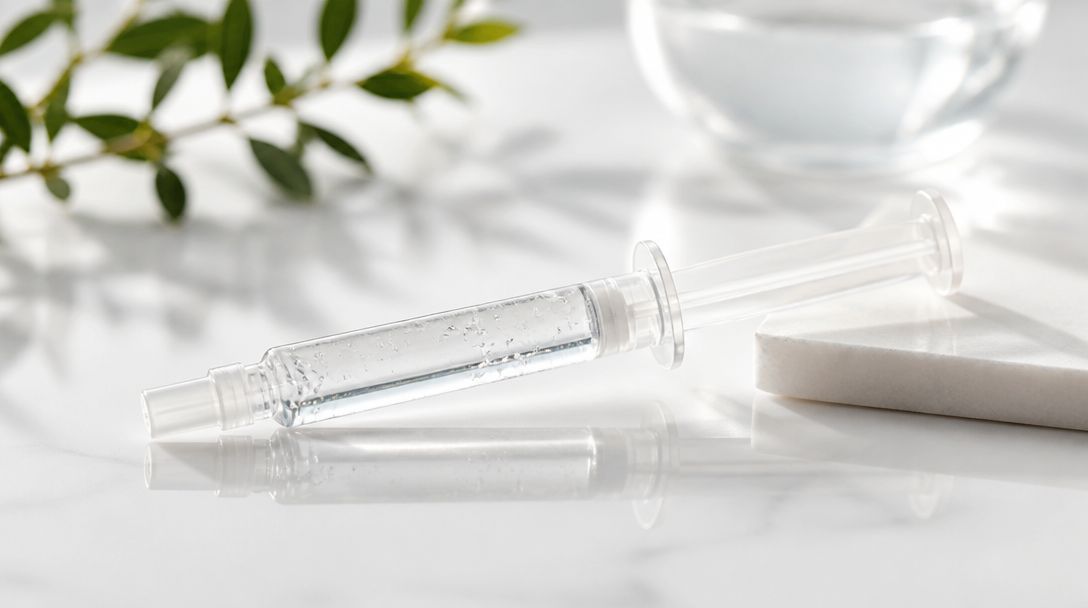
Understand whitening gel syringe dead volume, how to calculate yield loss across bulk orders, and what specification language to require from suppliers.
Whitening Gel Syringe Dead Volume: What Buyers Lose on Every Order
When you commit to a bulk order of whitening gel syringes, the fill weight on the spec sheet is not the volume your end-customer receives. The gap between labeled fill and actual dispensed gel is whitening gel syringe dead volume — gel trapped in the barrel, nozzle, or mixing tip after a normal dispensing cycle that cannot be recovered for clinical use. Most suppliers do not disclose it. Most purchase orders do not address it. And at scale, it quietly erodes per-treatment yield, kit value, and margin.
Why Whitening Gel Syringe Dead Volume Goes Undisclosed
Suppliers are not required to declare usable yield — only net fill weight. For cosmetic and OTC whitening products, no regulatory framework mandates that a manufacturer disclose how much gel a syringe actually delivers under normal dispensing conditions versus how much remains trapped after the plunger bottoms out.
A syringe labeled at 3 ml may deliver meaningfully less to the tray, depending on nozzle geometry, plunger travel, and gel viscosity. For a dental clinic ordering a few dozen units, the shortfall is manageable. For a distributor or private-label brand committing to thousands of units, it compounds into a measurable cost and customer-experience problem that never appears on the invoice.
Buyers comparing suppliers on price per unit are often comparing on an unequal basis. Two syringes at the same labeled fill weight and price can deliver substantially different usable volumes depending on how they are engineered. Without hands-on testing, that difference is invisible at the point of purchase.
The Per-Treatment Yield Problem at Scale
FDA product labeling for carbamide peroxide dental whitening gel instructs users to apply only a limited amount per tray — no more than one-third to one-half of a syringe per treatment session. That guidance assumes the full labeled fill is dispensable. When dead volume reduces actual yield, the number of usable applications per syringe drops below what the label implies.
The downstream effects are predictable. End-users either run short before completing the intended treatment course, or they over-apply to compensate. The American Dental Association notes that whitening products can cause temporary tooth sensitivity and gingival irritation — side effects that excess gel in the tray increases by raising soft-tissue contact. Precise dosing is a safety consideration, not just a cost one.
Research published in Clinical Oral Investigations (2026) found that thin, uniform gel layers can produce whitening outcomes comparable to larger applied volumes. The clinical implication for sourcing: a syringe engineered to deliver a consistent, controlled bead per plunger depression outperforms one that delivers variable volumes throughout its use cycle. Dead volume in a poorly designed nozzle often signals inconsistent dispensing across the full syringe — not only at the end.
For a private-label brand selling through a premium pharmacy or clinic channel, inconsistent yield across a production run means inconsistent patient outcomes. That translates to returns, complaints, and lost reorders — none of which appear in the unit cost calculation at the time of sourcing.
Calculating True Cost Per Application
The calculation requires data that buyers must actively request, not assume from the label.
- Confirm labeled fill volume — net weight or volume stated on the syringe, verified against the supplier's Certificate of Analysis.
- Measure usable yield per syringe — volume actually dispensed under normal use, determined by weighing the syringe before and after full dispensing cycles until no further gel is recoverable.
- Calculate dead volume per unit — the difference between labeled fill and usable yield.
- Apply your dosing protocol — use FDA-labeled guidance as a reference point and determine how many applications your program specifies per syringe.
- Recalculate application count on usable yield — not on labeled fill.
- Multiply the per-application loss across total units ordered — this is the aggregate yield deficit for the full bulk commitment.
No universal industry benchmark exists for dead volume across syringe designs. The calculation must be run on physical samples from each supplier under evaluation. A supplier that cannot provide pre-production samples for gravimetric testing before a volume commitment is a sourcing risk, regardless of price.
The cost exposure extends beyond gel loss. If your kit is built around a specific treatment count — a ten-day whitening program, for example — and dead volume reduces usable applications below that count, the product's core value proposition fails. That is a product design problem, not a packaging footnote.
Syringe Design Variables That Drive Dead Volume
Dead volume is an engineering outcome. The following design elements have the most direct influence on dispensing loss:
- Nozzle geometry and internal bore diameter: Long, narrow nozzles retain more gel after dispensing pressure is released. A shorter internal channel with a wider bore reduces residual volume at the tip.
- Plunger travel and barrel clearance: The gap between the plunger face and the barrel end at full depression determines how much gel is physically unreachable. Tight manufacturing tolerances reduce this loss directly.
- Mixing tip design for dual-chamber syringes: Attachable mixing tips used in two-component systems introduce a separate dead-volume zone. The spiral mixing element inside the tip retains gel after mixing is complete. Research from Clinical Oral Investigations (2026) specifically examined attachable syringe systems in the context of gel retained after mixing — a loss point that single-chamber syringes do not share.
- Barrel profile: A straight-walled barrel allows more predictable plunger travel. Tapered barrels can create resistance that causes users to stop applying pressure before full gel recovery.
- Material rigidity: Softer barrel materials deform under dispensing pressure, which can redirect gel backward around the plunger rather than forward through the nozzle.
Request syringe component drawings or at minimum a cross-section diagram when evaluating supplier samples. Suppliers who co-develop packaging with you on a private-label basis should be able to specify nozzle internal length and bore diameter as part of the technical brief — not as an afterthought.
Specification Language to Require Before You Commit
Generic purchase orders that reference only fill weight and active-ingredient concentration leave dead volume entirely unaddressed. The following specification clauses give buyers enforceable leverage:
- Minimum usable yield: "Syringe shall deliver a minimum of [X] ml of gel under standard dispensing conditions, measured gravimetrically after full plunger depression, with no more than [Y] ml retained in barrel, nozzle, and tip combined."
- Dispensing consistency: "Gel volume per plunger depression shall not vary by more than ±[X]% across the full dispensing cycle from first to last application."
- Mixing tip dead volume (dual-chamber units): "Mixing tip residual volume shall be declared separately from barrel residual volume in the product specification sheet."
- Sample testing rights: "Buyer retains the right to conduct gravimetric yield testing on pre-production and production-run samples. Results inconsistent with declared specifications constitute grounds for order rejection."
- CoA requirements: "Certificate of Analysis shall include net fill weight, declared usable yield, and active-ingredient concentration at time of fill."
Suppliers operating under ISO 13485 quality management systems are more likely to have documented process controls that make these clauses enforceable. CE-marked whitening devices sold into European markets face labeling accuracy requirements under applicable device regulations — a compliance framework that indirectly supports yield accuracy claims. Confirm which regulatory pathway applies to your target market before finalizing specification language.
Testing Dead Volume on Samples Before You Order
Gravimetric testing is the most practical method for buyers without laboratory infrastructure. It requires only a precision scale accurate to 0.01 g, a standard tray or dispensing surface, and a controlled dispensing protocol.
Weigh the full, sealed syringe. Dispense gel using your standard protocol — the number of depressions and force level your end-user would apply. Weigh the syringe again after dispensing is complete. That weight difference is your usable yield. Cut the syringe open, remove all remaining gel manually, and weigh the empty syringe. The difference between post-dispensing weight and post-extraction weight is your measured dead volume.
Run this test across a minimum of five units from the same production batch. Single-unit testing is insufficient because fill weight variation between units can obscure the dead volume signal and produce a misleading result.
One sourcing implication from the literature: a study published in Operative Dentistry (2023) examined mixed bleaching gels stored for up to one week, finding that leftover gel should not be assumed safe or effective for reuse without specific validation. FDA device classification records identify certain whitening gel syringes as single-use or non-reusable after application. Dead volume is a true loss — it cannot be credited as a recoverable resource in your yield calculation.
Viscosity, Formula, and Dead Volume: A Co-Design Variable
Gel viscosity is the formulation variable most directly linked to dead volume behavior. Higher-viscosity gels — typically carbamide peroxide formulas thickened with agents such as carbopol or HEC — resist flow at the nozzle tip after dispensing pressure releases. This increases residual volume per depression and raises total dead volume across the full use cycle.
Lower-viscosity formulas, including some PAP-based gels engineered for brush or strip application, introduce a different problem: gel that flows back into the barrel under negative pressure when the plunger is released, producing inconsistent dosing on subsequent depressions.
The interaction between formula viscosity and nozzle bore is a co-design variable. A nozzle geometry validated for a 15% carbamide peroxide gel at a specific viscosity range may perform poorly with a reformulated PAP gel at a different viscosity. When transitioning between active-ingredient systems — for example, moving from a peroxide-based line to a peroxide-free PAP formula for markets with concentration restrictions — dead volume performance must be retested on the new formula, not assumed to carry over from prior validation.
Buyers co-developing private-label formulas should require viscosity specifications and syringe compatibility to be validated together as part of the product development brief. A gel that behaves predictably in a bulk container may perform differently once filled into a specific syringe geometry under production fill-line pressure and temperature conditions.
The bottom line for sourcing decisions: whitening gel syringe dead volume is a quantifiable loss that most buyers absorb silently because they lack the specification language to prevent it and the test protocol to detect it. Both are within reach before any volume commitment is signed.
References
- Do bleaching gels supplied in attachable syringes maintain their bleaching efficacy 72 hours after mixing? Clinical Oral Investigations, 2026 — PubMed Central
- Bleaching gels used after 1 week of mixing: efficacy, hydrogen peroxide penetration, and physical-chemical properties. Operative Dentistry, 2023
- Whitening — Oral Health Topics. American Dental Association
- Drug Facts — Carbamide Peroxide Dental Whitening Gel. DailyMed, U.S. National Library of Medicine / FDA
Disclaimer
This article is for general informational purposes only and does not constitute sourcing, legal, or regulatory advice. Always conduct your own due diligence and consult qualified legal or compliance professionals before making purchasing or compliance decisions. WhiteningBright makes no warranties as to the completeness or accuracy of the information, and any reliance is at your own risk.