Bulk Whitening Gel: Shelf Life and Cold-Chain Checklist
31 de julio de 2026
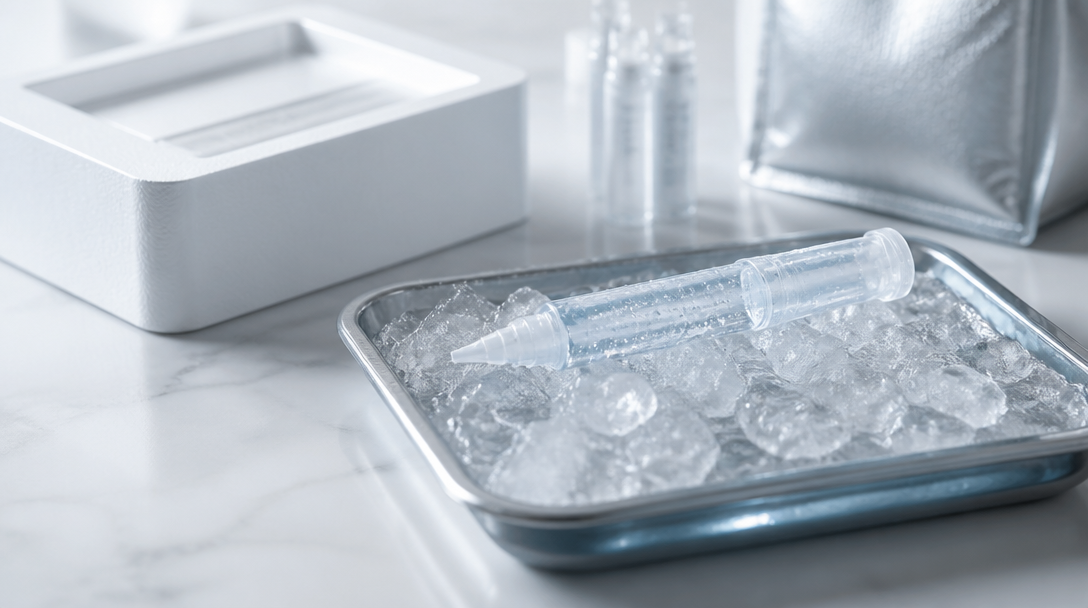
Verify bulk whitening gel shelf life before you order. A professional checklist covering CoA documentation, viscosity specs, pH stability data, and cold-chain requirements.
Why Bulk Gel Orders Fail After Delivery — and Who Bears the Cost
When a bulk whitening gel order arrives degraded, off-viscosity, or outside its labeled active concentration, the financial exposure rarely stays with the supplier. The clinic, distributor, or retailer holding the stock absorbs the loss — in product write-offs, patient complaints, and reorder delays. Understanding bulk whitening gel shelf life is not a logistics footnote. It is a sourcing decision with direct clinical and commercial consequences.
The most common failure points are not manufacturing defects. They are documentation gaps, unstated storage assumptions, and cold-chain breaks that occur between production and your warehouse. This checklist addresses each of them before your purchase order is signed.
Shelf Life Documentation: What a Compliant Certificate of Analysis Must Show
A Certificate of Analysis (CoA) is the primary document confirming that a batch of bulk whitening gel meets its specification at the time of release. For active peroxide or PAP-based formulations, a CoA that only lists appearance and pH is insufficient.
Compliant documentation for professional buyers should include:
- Active ingredient assay result — the measured concentration of hydrogen peroxide, carbamide peroxide, or PAP at batch release, expressed as a percentage with an acceptable tolerance range
- Manufacture date and assigned expiry date — not a shelf life duration statement; an actual calendar date tied to the specific batch number
- Storage condition statement — the temperature and humidity range under which the stated shelf life was determined
- Stability study reference — confirmation that the shelf life claim is supported by real-time or accelerated stability data, not an assumed industry standard
- Period After Opening (PAO) — particularly relevant for bulk gel supplied in multi-use containers or syringes that will be repackaged downstream
Peer-reviewed research confirms that expiration date and PAO labeling are foundational to safe cosmetic product use — and that these values must reflect actual stability testing, not generic assumptions. A supplier who cannot provide a stability study reference on request is a supplier whose shelf life claims cannot be verified.
Under FDA cosmetic labeling guidance, products making specific performance claims carry additional documentation obligations. If your private-label gel will be sold with whitening efficacy claims, the CoA and supporting stability data become part of your own compliance file — not just the supplier's paperwork.
Viscosity Tolerance Windows: How to Read Supplier Spec Sheets
Viscosity is one of the most operationally significant physical properties of whitening gel. It determines how the gel behaves in a tray, how it dispenses from a syringe, and how uniformly it contacts enamel during treatment. A gel that has drifted outside its viscosity specification — even with its active concentration intact — will underperform clinically.
Supplier spec sheets should state viscosity as a range, not a single value. A professional-grade gel specification will express viscosity in centipoise (cP) or millipascal-seconds (mPa·s) with an upper and lower tolerance. When reviewing a spec sheet, ask:
- What viscosity measurement method was used — Brookfield spindle or rotational rheometer?
- At what temperature was viscosity measured, and does that match your storage and dispensing environment?
- What does out-of-spec viscosity indicate about the formulation's broader stability status?
Published stability research identifies viscosity as a key physical property affected by temperature and humidity exposure during storage. Accelerated stability studies demonstrate that gels stored outside their specified conditions can exhibit measurable changes in physical properties — including viscosity — before any change in active concentration becomes detectable. A gel can fail in use before it fails on paper.
For buyers ordering in volume — a distributor placing a large tray-gel run, for example — request viscosity data from at least two time points in the supplier's stability study: at batch release and at a midpoint in the stated shelf life. Divergence between those readings signals a formulation that may not hold through your full distribution cycle.
pH Stability Data: The Range That Protects Efficacy and Patient Safety
pH is not a secondary specification. In whitening gel, pH directly affects the rate of peroxide decomposition and the product's safety profile at the tissue level. A gel that acidifies during storage becomes more aggressive on enamel and soft tissue. A gel that shifts alkaline may lose whitening efficacy before its labeled expiry.
Peer-reviewed dental literature consistently identifies pH as a core variable in bleaching gel performance and safety. Formulations with stabilizers engineered to maintain pH within a defined range demonstrate superior storage stability compared to unstabilized equivalents. When reviewing supplier data, the pH specification should include:
- The target pH value and acceptable tolerance range (for example, ±0.3 units)
- pH readings at multiple stability time points — not only at batch release
- Confirmation that the pH range is appropriate for the intended delivery system: tray, strip, or paint-on
For PAP-based formulations, pH behavior differs from peroxide systems. PAP gels are typically formulated at near-neutral pH, which is part of their clinical positioning for sensitivity-prone patients. Buyers transitioning a dental clinic's protocol from peroxide to PAP should verify that the supplier's pH stability data covers the full intended shelf life under specified storage conditions — not only the initial formulation profile.
Bulk Whitening Gel Shelf Life by Formulation Type: Cold-Chain Requirements
Not all whitening gel formulations carry the same cold-chain sensitivity. Treating peroxide, carbamide peroxide, and PAP gels as equivalent during transit and storage is one of the most common bulk procurement errors. The table below summarizes cold-chain considerations by formulation type, based on published stability research.
| Formulation Type | Primary Stability Risk | Typical Storage Guidance | Cold-Chain Priority |
|---|---|---|---|
| Hydrogen Peroxide Gel | Rapid active concentration loss at elevated temperature | Cool, dark storage; temperature range supplier-specified by concentration | High — especially at concentrations above 10% |
| Carbamide Peroxide Gel | Temperature and humidity both degrade stability; significant variation across formulations | Refrigerated storage commonly specified; humidity control critical | High — research confirms large stability differences across formulations under varying conditions |
| PAP-Based Gel | Lower oxidative instability than peroxide; pH drift and excipient degradation are primary risks | Cool, dry storage; refrigeration less commonly required but must be supplier-confirmed | Moderate — verify against supplier's actual stability data |
Published research on carbamide peroxide formulations confirms that storage conditions produce significantly different shelf life outcomes across formulations. A carbamide gel that performs well under refrigerated conditions may degrade substantially faster at ambient warehouse temperatures. This is not a theoretical risk — it is a documented formulation variable that belongs in your supplier agreement.
For international shipments, cold-chain continuity across customs clearance and last-mile delivery is the most common break point. A supplier who can document factory-to-port cold handling but cannot confirm port-to-warehouse conditions is providing incomplete assurance.
Storage and Transit Red Flags: Questions to Put to Every Supplier in Writing
Before committing to a bulk whitening gel supplier, the following questions must be answered in writing — not verbally, and not in generic terms.
- What stability study supports your stated shelf life? Request the study type (real-time vs. accelerated), the storage conditions tested, and the time points measured. Accelerated stability data, while useful, should be supported by ongoing real-time data for shelf life claims beyond 12 months.
- What is the active concentration tolerance at end of shelf life? A gel labeled at a given peroxide percentage should specify the minimum acceptable concentration at expiry — not only at batch release.
- How is the product packaged for bulk transit? Thermal insulation, desiccant inclusion, and secondary packaging integrity all affect whether cold-chain specifications are maintained in practice.
- What is your documented temperature excursion policy? If a shipment is delayed in a non-refrigerated environment, does the supplier have a protocol for assessing and documenting the impact on remaining shelf life?
- Can you provide batch-specific CoAs, not template documents? A CoA that does not reference a specific batch number and manufacture date is not batch-specific documentation.
Pre-Order Vetting Checklist: Protect Your Bulk Whitening Gel Shelf Life Before You Commit
Consolidating the above into a structured pre-order process protects your inventory investment and your downstream customers — whether those are dental clinics, premium pharmacies, or DTC consumers receiving your private-label product. Use this checklist at the supplier qualification stage, before any volume commitment is made.
Documentation Requirements
- Batch-specific CoA with active assay result, manufacture date, expiry date, and storage condition statement
- Stability study summary: study type, conditions tested, time points, active concentration and pH readings at each interval
- PAO statement for multi-use or bulk-fill formats
- Regulatory compliance documentation — ISO, CE, or FDA cosmetic registration as applicable to your target market
Formulation Specification Verification
- Viscosity range with measurement method and temperature reference
- pH range with tolerance and stability time-point data across the full shelf life
- Active concentration tolerance at both batch release and end of shelf life
- Confirmation of stabilizer system and its documented effect on storage stability
Cold-Chain and Logistics Confirmation
- Supplier's stated storage temperature range and humidity limits
- Packaging specification for bulk transit: thermal protection, desiccant use, secondary containment
- Temperature excursion documentation policy and corrective action protocol
- Cold-chain continuity confirmation from production through to port of export
A supplier who satisfies this checklist is demonstrating that their bulk whitening gel shelf life claims are grounded in documented evidence — not production-floor assumptions. For buyers co-developing a private-label whitening line, this documentation also forms the foundation of your product compliance file from day one.
References
- Effect of accelerated stability on the physical, chemical, and colorimetric properties of whitening gels — PubMed
- Stability and Influence of Storage Conditions on Nanofibrous Carbamide Peroxide Formulations — PubMed Central
- Dental Whitening Gels: Strengths and Weaknesses of Different Formulations — PubMed Central
- Rampant online marketing of teeth whitening products — PubMed Central
- Cosmetics Labeling Guide — U.S. Food and Drug Administration
Disclaimer
This article is for general informational purposes only and does not constitute sourcing, legal, or regulatory advice. Always conduct your own due diligence and consult qualified legal or compliance professionals before making purchasing or compliance decisions. WhiteningBright makes no warranties as to the completeness or accuracy of the information, and any reliance is at your own risk.