Is Baking Soda Safe to Whiten Teeth Every Day?
16 de julio de 2026
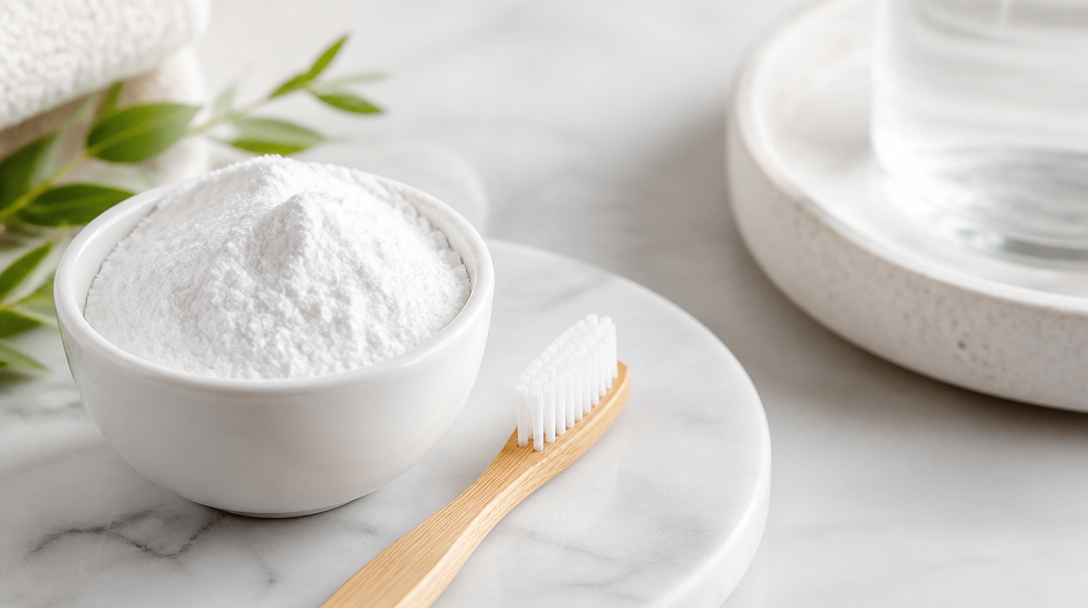
Is baking soda teeth whitening safe for daily use? Learn what science says about enamel, fluoride gaps, gum risks, and smarter whitening alternatives.
What Baking Soda Actually Does Inside Your Mouth
If you're asking whether baking soda teeth whitening is safe for daily use, you're asking a better question than most articles bother to answer honestly. Sodium bicarbonate has earned a genuine place in oral care — but "it's natural" is not a safety claim, and frequency changes everything.
Two things happen when baking soda contacts your teeth. It creates a mildly alkaline environment that helps neutralize the acids bacteria produce. That's useful. Its fine crystalline particles also act as a gentle abrasive, physically scrubbing surface stains — the kind left by coffee, tea, and pigmented foods — from enamel.
What it does not do is change the color of your teeth from the inside. According to the American Dental Association, baking soda removes surface stains but does not bleach underlying tooth structure. That distinction matters when you're setting expectations — and when you're deciding how often to use it.
RDA Scores and the Real Abrasivity Picture
Every abrasive dental product carries a Relative Dentin Abrasivity (RDA) score — a standardized measure of how aggressively it wears tooth structure. Lower scores mean gentler action. Baking soda scores notably low on this scale, which explains its strong safety record in formulated dentifrices.
A peer-reviewed review published in the Journal of the American Dental Association found that baking soda-based dentifrices are effective and safe for stain removal and whitening — and are clinically more effective than some non-baking soda dentifrices that actually carry higher abrasivity scores. That finding reframes the conversation: baking soda, used in a properly formulated toothpaste, is not the enamel-destroyer it is sometimes portrayed as.
The critical word is formulated. That research covers dentifrice products, not raw powder applied directly from a kitchen box. Those are meaningfully different scenarios. A formulated product controls particle size, concentration, and contact time. Loose baking soda mixed with water at home does none of those things — and that gap is where daily risk begins to accumulate.
Is Baking Soda Teeth Whitening Safe Every Day? Here Is What the Evidence Shows
The honest answer: current evidence supports occasional use as low-risk for most people. Daily standalone use introduces problems that most quick-read guides don't address.
The most significant problem is fluoride — or the absence of it. Baking soda contains none. The University of Colorado School of Medicine has noted that while baking soda toothpaste is safe and effective for daily tooth care, it is not an ADA-approved substitute for standard fluoride toothpaste, precisely because fluoride is an essential cavity-fighting ingredient baking soda cannot replicate.
Replace your fluoride toothpaste with baking soda every day and you remove a critical layer of cavity protection from your routine. Over weeks and months, that absence compounds. Enamel that isn't being remineralized by fluoride becomes more vulnerable — not necessarily from baking soda's abrasion alone, but from the bacterial acid attacks your toothpaste is no longer defending against.
A practical breakdown by frequency:
- Occasional use (a few times per week at most): Generally low-risk when used alongside a fluoride toothpaste, not as a replacement for it.
- Daily use as a standalone product: Eliminates fluoride protection entirely and may contribute to enamel vulnerability through cumulative abrasive contact over time.
- Daily use in a formulated baking soda toothpaste that contains fluoride: A distinct scenario — the formulation controls abrasivity and preserves the fluoride benefit.
No peer-reviewed research from any period confirms that daily DIY baking soda use — from the box, as a standalone practice — is safe over the long term.
What Baking Soda Cannot Do That Whitening Actives Can
Understanding the ceiling is as important as understanding the risks. Surface stain removal is real and measurable. But if your teeth are naturally yellow or have darkened from aging, certain medications, or internal factors, baking soda cannot address that.
Intrinsic discoloration — color that originates within the tooth structure itself — requires a bleaching agent. Hydrogen peroxide and carbamide peroxide penetrate enamel and break apart chromogen molecules responsible for deeper staining. PAP (phthalimido-peroxy-caproic acid), a newer peroxide-free whitening active, works through a comparable oxidative mechanism without releasing free radicals in the same way.
Baking soda has no bleaching chemistry. It cannot reach inside the tooth. When someone reports their teeth "got so much whiter" from baking soda alone, what they observed was the removal of accumulated surface staining — a visible improvement, but not the same as whitening the tooth itself. Spending months on baking soda while expecting a bleaching result delays effective treatment and adds unnecessary abrasive exposure in the process.
Gum and Soft Tissue: The Overlooked Risk
Almost every discussion of baking soda focuses on enamel. Gum tissue and oral soft tissue receive far less attention — and that gap is worth closing.
Baking soda's alkalinity is generally well-tolerated by oral tissue in small amounts. Prolonged or repeated direct contact with gum tissue — especially applied with pressure — can cause irritation. People with existing gum sensitivity, recession, or inflammation tend to notice discomfort sooner than others.
The ADA's guidance on DIY and natural whitening methods raises safety concerns specifically around limited clinical evidence for these approaches. That caution extends to soft tissue contact. Formulated products undergo safety testing that includes gum tissue compatibility. A paste mixed at home does not.
Discuss baking soda use with your dentist before starting — regardless of frequency — if you have any of the following:
- Gum recession that exposes root surfaces
- Active gum disease or inflammation
- Canker sores or open tissue anywhere in the mouth
- A history of sensitive or bleeding gums after brushing
How to Use It Safely If You Choose To
Use a formulated product, not loose powder
A dentifrice listing sodium bicarbonate as an ingredient has been tested for abrasivity, particle size, and ingredient compatibility. It is a more controlled delivery method than kitchen powder mixed with water. If the product also contains fluoride, cavity protection stays intact.
Treat it as an addition, not a replacement
If you want to use plain baking soda at all, use it occasionally — a few times per week at most — alongside your regular fluoride toothpaste, not instead of it. The fluoride toothpaste handles what baking soda structurally cannot.
Apply with light pressure
Abrasive damage depends on force as much as on material. A soft-bristled brush with gentle circular motion reduces mechanical stress on both enamel and gums, regardless of what you're brushing with.
Rinse thoroughly
Baking soda residue left on teeth or along the gumline continues to contact tissue after brushing ends. A thorough rinse removes residual particles and helps restore a neutral oral environment.
Never mix with acidic ingredients
Some DIY recipes combine baking soda with lemon juice or vinegar. Avoid these entirely. The acid immediately neutralizes baking soda's alkalinity and introduces its own erosive chemistry — citric acid and acetic acid can soften enamel in ways that compound, not reduce, damage.
When to Stop — and What to Use Instead
Stop using baking soda directly on your teeth if you notice any of the following:
- Increased sensitivity to temperature or pressure
- Gum soreness, redness, or recession that wasn't present before
- A rough or chalky texture on the tooth surface after brushing
- No visible improvement after several weeks of consistent use
These signals indicate the practice is working against you. Continuing is unlikely to change that outcome.
For surface stain removal with a better-controlled safety profile, look for toothpastes carrying the ADA Seal of Acceptance — independently reviewed for both safety and efficacy. For intrinsic discoloration, evidence-based options include:
- At-home whitening products formulated with hydrogen peroxide or carbamide peroxide at concentrations appropriate for consumer use
- PAP-based whitening systems, which deliver an oxidative whitening mechanism without peroxide — often preferred by people with sensitivity concerns
- Professional in-office whitening, which provides the most controlled and clinically supervised results
Each of these options carries its own considerations — peroxide concentration, contact time, and application method all affect both results and safety. But all three address intrinsic discoloration in a way that baking soda is chemically incapable of doing.
Baking soda is a legitimate, low-abrasivity ingredient with a real role in oral care. Used occasionally, in a formulated product, alongside fluoride toothpaste, it is not dangerous for most people. Used daily as a standalone whitening treatment, it creates a fluoride gap, delivers no bleaching benefit, and accumulates risks that a better-chosen product eliminates entirely. Matching the tool to the goal is how you get results without trading one problem for another.
References
- Gonzalez-Cabezas C, et al. "Baking Soda Dentifrices and the Oral Environment." Journal of the American Dental Association. PubMed, National Library of Medicine.
- American Dental Association. "Whitening." ADA Oral Health Topics.
- American Dental Association. "Toothpastes." ADA Oral Health Topics.
Note: No peer-reviewed primary research published between 2023 and 2026 specifically addressing daily baking soda use for teeth whitening was available in authoritative scientific databases at the time this article was prepared. The sources cited above represent the highest-quality peer-reviewed and regulatory guidance currently accessible on this topic. Readers are encouraged to consult their dental professional for individualized guidance.
Disclaimer
This article is for general informational purposes only and is not a substitute for professional dental or medical advice. Always consult a qualified dental professional before starting any teeth-whitening or oral-care regimen. WhiteningBright makes no warranties as to the completeness or accuracy of the information, and any reliance is at your own risk.