Whitening Kit Supplier Gaps That Cost You at Launch
22 de octubre de 2026

Identify the formulation, compliance, and lead-time gaps in your private label whitening kit supplier relationship before they derail your launch.
Why Private Label Whitening Kit Supplier Failures Happen After the Sample Stage
The sample looks right. The shade guide matches. The gel consistency passes your internal review. You sign the contract, place your first production order — and the problems begin. For buyers working with a private label whitening kit supplier, the sample stage is the easiest part of the relationship. Production, compliance, and reorder phases are where supplier capability is actually tested.
This article identifies the operational and formulation gaps that derail launches after contracts are signed. Each section gives you a concrete area to pressure-test before your first shipment leaves the facility.
Formulation Lock-In: What Your Private Label Whitening Kit Supplier Must Commit to in Writing
Whitening gel formulations are not interchangeable. Whether your product is built on hydrogen peroxide, carbamide peroxide, or a peroxide-free PAP (phthalimidoperoxycaproic acid) system, the active concentration and supporting ingredients define both the clinical outcome and the regulatory classification of your product.
The American Dental Association confirms that hydrogen peroxide and carbamide peroxide are the established whitening agents, and that adverse effects — including temporary tooth sensitivity and gingival inflammation — are directly tied to concentration and exposure duration. A supplier who quietly adjusts your peroxide concentration between batches is not just changing a formula. They are changing your product's risk profile and potentially invalidating your safety documentation.
Secure each of the following in writing before production begins:
- Formula reference number locked to your brand's SKU, not shared across other client accounts
- Active ingredient concentration with a defined tolerance range (for example, ±0.1% on a 6% hydrogen peroxide gel)
- Ingredient substitution clause requiring written approval before any excipient change
- pH range specification, relevant to both enamel safety and regulatory filing
- Shelf-life validation data tied to your specific formula, not a generic category claim
If a supplier cannot provide a formula reference number unique to your account, treat that as a structural risk. Co-developed formulations should be documented as yours — not borrowed from a shared production pool running the same gel under multiple brand names.
Artwork and Component Lead Times That Buyers Routinely Underestimate
Most buyers budget for gel production time. Few budget accurately for the full component chain: custom trays, LED device tooling, outer carton printing, insert cards, and serialized labeling required for pharmacy or clinical-channel compliance.
A whitening kit is not a single SKU. It is an assembly of multiple components, each with its own supplier, tooling timeline, and minimum order quantity. When one component is delayed, the entire kit stalls in warehouse. This is one of the most consistent causes of missed launch windows in the private-label channel.
Build these benchmarks into your project plan:
- Custom tray tooling: 25–45 days for new mold creation, depending on material and complexity
- Printed outer carton: 18–30 days from approved artwork, longer for specialty finishes
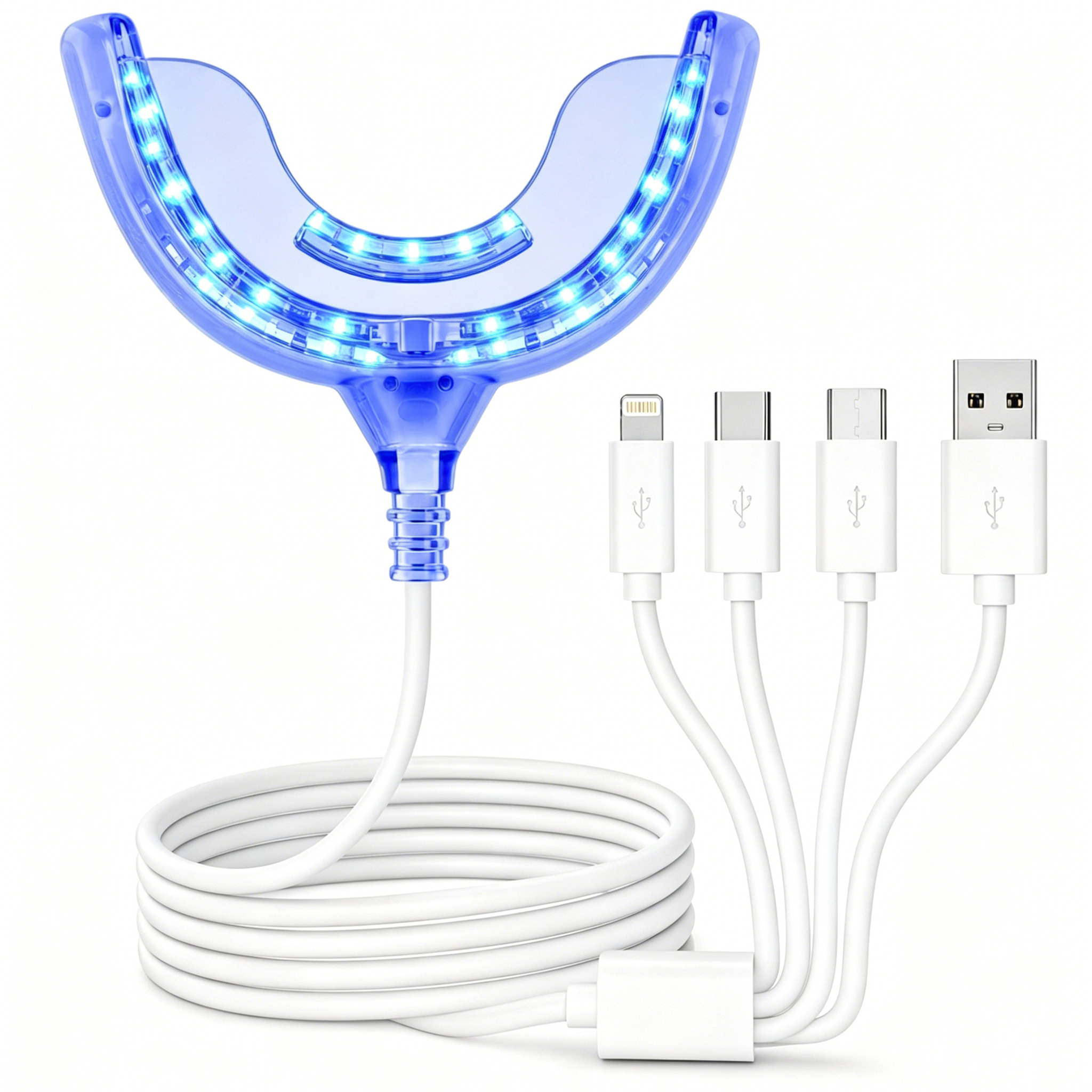
- LED device or accelerator light: 30–60 days if sourced separately from your gel supplier
- Gel production and fill: 10–21 days once raw materials are confirmed in stock
- Assembly and QC: 5–10 days for kit-level inspection before palletization
Ask your supplier for a component-level Gantt chart, not just a production completion date. If they cannot produce one, you are managing their timeline — which means you are absorbing their operational risk.
Compliance Hand-Off: Who Owns the Documentation at Customs
This is the gap that stops shipments at the border. Regulatory classification of a whitening product varies by market: in the United States, concentration thresholds determine whether a product files as a cosmetic or an over-the-counter drug. In the EU, the Cosmetics Regulation caps hydrogen peroxide at specific percentages for consumer use. In some GCC markets, additional Ministry of Health registration is required before retail sale.
The ADA's tooth bleaching acceptance criteria establish that product safety claims must be substantiated with documented evidence — ingredient safety data, clinical or in vitro support for efficacy claims, and adverse-effect disclosures. That documentation burden does not disappear because you are the brand owner rather than the formulator. It transfers to you at the point of import.
Before signing any supply agreement, establish in writing:
- Which party holds the Safety Data Sheet (SDS) and product safety report
- Whether the supplier provides a Certificate of Analysis (CoA) per batch, and in what format
- Who is responsible for country-specific registration — for example, FDA cosmetic facility registration or EU Responsible Person designation
- Whether the supplier's facility holds ISO 22716 (GMP for cosmetics) or an equivalent certified standard
- How CE or FDA compliance letters are structured — and whether they cover your specific formula and concentration, not just a broad product category
A supplier who provides a generic CE certificate covering a product category is not the same as one who provides documentation tied to your specific formulation. Customs authorities and retail channel buyers increasingly require the latter.
Reorder Consistency: The Batch-to-Batch Tests That Protect Your Brand
Your launch batch performs well. Your second order arrives and customer complaints spike. This pattern is more common than buyers expect, and it is almost always a quality-control documentation failure rather than a deliberate reformulation.
The ADA's reviewed evidence confirms that whitening efficacy and adverse-effect profiles — including sensitivity and gingival irritation — are directly tied to active ingredient concentration and formulation stability. A gel that loses potency between batches delivers a different clinical result. A gel that shifts in acidity over its shelf life creates a different risk profile. Neither change will be visible on the label.
The batch-level tests your supplier should run and share on every production order:
| Test | What It Confirms | Acceptable Documentation |
|---|---|---|
| Active ingredient assay | Peroxide or PAP concentration within specification | Third-party lab CoA or in-house HPLC report |
| pH measurement | Formulation acidity within safe and stable range | Batch record with instrument calibration date |
| Viscosity check | Gel consistency for tray retention and dispensing | Batch record with rheometer or viscometer reading |
| Microbial testing | No contamination above regulatory limits | Third-party lab report per ISO 17516 or USP standards |
| Stability data | Product performance at end of declared shelf life | Accelerated or real-time stability study on file |
If a supplier cannot provide batch-level CoAs as a standard deliverable, require it as a contractual term. Without this documentation, your brand has no defensible position if a retailer or regulator challenges product consistency across shipments.
Red Flags in Supplier Communication That Signal Operational Risk
Operational risk in a private label whitening kit supplier relationship often shows up in communication patterns before it appears in product quality. Track these signals from the first inquiry.
Vague answers to specific technical questions
Ask for the active concentration range in a formula. If you receive a marketing description rather than a specification sheet, that is a process gap. Suppliers with documented production systems answer technical questions with technical data.
Resistance to formula exclusivity
A supplier unwilling to assign a unique formula reference to your brand may be running the same gel under multiple private-label accounts. This creates competitive exposure and makes batch-to-batch traceability harder to enforce — or dispute.
Single point of contact for all functions
When one account manager handles sales, QC questions, compliance documentation, and logistics, the supplier has not separated operational functions. That structure holds together at low volume. At scale, it breaks down in ways that affect your shipment windows and your documentation.
Compliance documents not tied to your brand or formula
Generic safety documentation that references a product category rather than your brand name, formula reference, and active concentration is a liability at customs and during retailer onboarding. A capable supplier produces brand-specific documentation as a standard deliverable, not a premium add-on.
No written procedure for complaints or recalls
Ask directly: what is the procedure if a batch fails post-shipment? If the answer is informal or undocumented, your exposure in a recall or adverse-event scenario is significant and largely unmanaged.
The Pre-Launch Checklist Every Private Label Whitening Kit Supplier Relationship Needs
Use this as a final gate before releasing payment on your first production order. Each item should be confirmed in writing — not verbally, not in a chat thread.
- Formula specification sheet signed by both parties, with active concentration, pH range, and full excipient list
- Formula exclusivity clause in the supply agreement, or written acknowledgment of shared-formula terms if exclusivity is declined
- Component-level production timeline with named milestones for each kit element
- Batch CoA template reviewed and approved before production begins
- Regulatory documentation package confirmed for each target market: SDS, product safety report, facility certifications
- Artwork approval workflow documented, with version control and written sign-off requirements
- Reorder lead time in writing, including the raw material procurement window
- Complaint and recall procedure reviewed, documented, and accepted by both parties
- Third-party lab relationship confirmed — either supplier-side or buyer-appointed for incoming inspection
- Payment milestone structure tied to production gates, not calendar dates
A supplier who pushes back on providing any of these items before production is communicating something important about how they will operate after your money is committed.
Formulation integrity, lead-time accuracy, compliance ownership, and batch consistency are the four dimensions where supplier gaps most reliably convert into brand damage. Pressure-testing each one before your launch order ships is the work that separates a functional private-label program from an expensive lesson in supplier selection.
References
- American Dental Association — Whitening (Oral Health Topics)
- American Dental Association — Experts Weigh In on Teeth Whitening
- American Dental Association — Risks of Frequent Teeth Whitening
- American Dental Association — Tooth Bleaching: ADA Seal Category Requirements
Disclaimer
This article is for general informational purposes only and does not constitute sourcing, legal, or regulatory advice. Always conduct your own due diligence and consult qualified legal or compliance professionals before making purchasing or compliance decisions. WhiteningBright makes no warranties as to the completeness or accuracy of the information, and any reliance is at your own risk.