Does Whitening Gel Absorb Through Enamel or Stay on Top?
24 июля 2026 г.
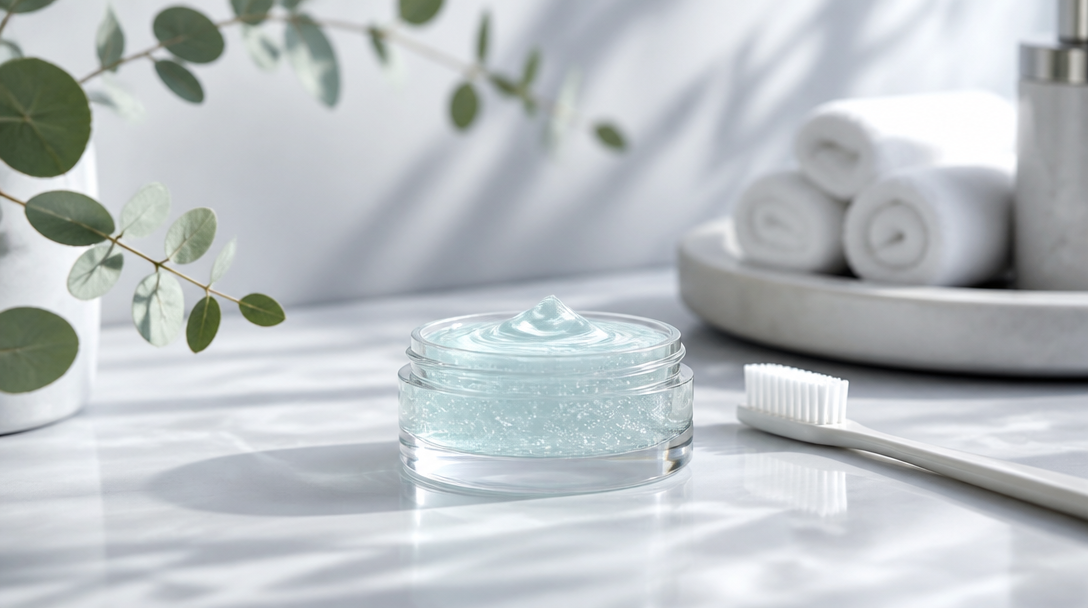
Does whitening gel sit on top or absorb through enamel? Learn how whitening gel works on enamel, why contact time matters, and what drives real results.
What Happens the Moment Whitening Gel Touches Your Tooth
Most people assume whitening gel works like paint — it coats the surface, brightens things up, and washes away. That assumption explains both the disappointment when results fall short and the confusion when sensitivity strikes. Understanding how whitening gel works on enamel changes how you use it, and how well it works for you.
The moment a peroxide-based gel contacts your tooth, chemistry begins. The active ingredient — hydrogen peroxide, or carbamide peroxide that breaks down into hydrogen peroxide — starts to diffuse. It does not rest on the enamel surface. It moves through it.
This diffusion-based mechanism is the foundation of how whitening gel works on enamel, and it explains nearly every practical question about contact time, tray fit, concentration, and sensitivity.
Enamel Is Porous — and That Porosity Is the Point
Enamel looks solid, but at a microscopic level it has a porous, crystalline structure. It is composed largely of hydroxyapatite crystals arranged in rods, with small channels running between them. Those channels allow molecules — including whitening agents — to pass inward.
The porosity of your enamel is not fixed. It varies by age, diet, prior dental work, and natural mineral density. Teeth with greater surface porosity tend to allow faster diffusion, which can mean quicker results but a higher likelihood of sensitivity.
Pre-treatment matters for this reason. Teeth that are clean and free of heavy plaque or pellicle allow the gel to make direct, consistent contact with the enamel surface — which is the necessary starting point before any diffusion can occur.
How Deep Peroxide Actually Travels Into the Tooth
Research confirms that hydrogen peroxide does not stay on the enamel surface. In vitro studies have demonstrated that hydrogen peroxide from whitening products diffuses through both enamel and dentin, and that longer application times and light activation increase the extent of that diffusion.
In one study, peroxide was detected in the pulp chamber after use of whitening strips and gels — meaning the active ingredient had traveled through the full thickness of enamel and dentin to reach the innermost part of the tooth. This is the mechanism by which whitening agents reach deeply embedded stain molecules. It also carries meaningful implications for safety.
Gel viscosity plays a distinct role here. Research has shown that lower-viscosity gels produce greater peroxide penetration into the pulp chamber, while whitening efficacy at the same concentration and contact time remains broadly similar across gel types. A thicker gel may be easier to keep seated in a tray, but a thinner gel moves more freely through enamel structure.
How PAP Differs from Peroxide in How Whitening Gel Works on Enamel
PAP (phthalimidoperoxycaproic acid) is a non-peroxide oxidizing agent that acts primarily at or near the enamel surface. Because PAP is a larger molecule, its diffusion depth is more limited compared to hydrogen peroxide.
This makes PAP-based formulas a practical option for people with existing sensitivity. The trade-off is depth of reach: stains located deeper within dentin may respond less fully to PAP than to peroxide-based treatments. The right choice depends on where your stains originate — which the next section covers directly.
Extrinsic vs. Intrinsic Stains: Why Location Determines Results
Not all tooth discoloration sits at the same depth, and that distinction determines which approach works.
- Extrinsic stains — deposits on or just below the enamel surface, caused by coffee, tea, red wine, tobacco, and certain foods.
- Intrinsic stains — discoloration within the dentin layer or deeper, caused by aging, certain medications such as tetracycline, trauma, or fluorosis.
For extrinsic stains, a whitening agent that penetrates only into the outer enamel layer can be highly effective. The oxidizing molecules break apart chromogen compounds — the colored molecules responsible for staining — through oxidation. The stain molecules are not scrubbed away; they are chemically altered so they no longer absorb visible light in the same way.
Intrinsic stains require the active ingredient to travel further — into dentin — to have a meaningful effect. Severe intrinsic discoloration often responds poorly to standard at-home concentrations and may require professional-strength treatment under clinical supervision.
Why Contact Time and Tray Fit Are Not Optional Details
Because whitening is a diffusion process, contact time is a primary variable — not a minor one. A gel applied for five minutes reaches a different depth than the same gel applied for thirty minutes. More contact time allows more peroxide molecules to move further into enamel and dentin, reaching more stain molecules along the way.
Tray fit matters for exactly the same reason. A poorly fitting tray allows saliva to dilute the gel, reducing its effective concentration and limiting how long it maintains contact with the enamel surface. Saliva contains enzymes that begin breaking down hydrogen peroxide almost immediately. A well-fitted tray — whether custom-made by a dentist or a well-designed universal tray — creates a sealed environment that preserves gel concentration throughout the treatment period.
Practical steps for better results:
- Follow the recommended wear time. Shorter sessions are not safer — they are simply less effective.
- Apply the correct amount of gel. Overfilling a tray causes gel to contact the gums; underfilling reduces enamel coverage.
- Avoid eating or drinking immediately before treatment. Food residue and active saliva flow both compromise contact.
- If using strips, press them firmly and evenly so the gel layer maintains consistent contact across the full tooth surface.
When Penetration Goes Too Deep: Sensitivity Explained
Sensitivity is the most commonly reported side effect of whitening, and the diffusion mechanism explains exactly why it occurs. As peroxide moves through enamel and into dentin, it can reach the dentinal tubules — microscopic channels that run from the dentin surface toward the pulp. Fluid movement within those tubules triggers the nerves inside the pulp, producing the sharp, temporary sensitivity many people experience during or after treatment.
Research has found that even lower concentrations of carbamide peroxide or hydrogen peroxide can alter enamel and increase oxidative stress in dental cells. Higher-concentration products amplify this effect. This does not mean whitening is inherently unsafe — the literature supports that whitening is generally safe when manufacturer directions are followed — but concentration and exposure time are variables that need to be respected, not maximized.
If you have sensitive teeth, thin enamel, exposed dentin near the gumline, or existing cracks in enamel, the diffusion pathway is shorter and the sensitivity response is likely to be stronger. In those situations:
- Choose a lower-concentration product used over a longer period rather than a high-concentration formula used intensively.
- Consider a PAP-based formula, which has more limited diffusion depth.
- Space out whitening sessions to allow the pulp to recover between treatments.
- Consult a dentist before starting any whitening regimen if you have known sensitivity or recent dental work.
One reassuring finding from the research: a confocal laser scanning microscopy study found no significant micromorphologic changes in subsurface enamel, the dentin-enamel junction, or dentin after whitening — suggesting that diffusion can occur without causing obvious structural damage under the conditions studied. Sensitivity, in most cases, is a temporary physiological response, not a sign of permanent harm.
How to Use This Knowledge to Whiten More Effectively
Understanding how whitening gel works on enamel gives you a practical framework for every decision in your whitening routine.
Match concentration to your stain type
Extrinsic stains from coffee or tea respond well to standard at-home concentrations used consistently over time. Deep intrinsic stains — from medications or developmental factors — may not respond to at-home products at all and are better addressed with a dental professional who can tailor both concentration and method.
Respect the chemistry of contact time
Diffusion takes time. A well-formulated gel used for the recommended duration will outperform a stronger gel used for half the time. Consistency across multiple sessions matters more than intensity in any single session.
Apply precisely, not generously
Gel that contacts the gumline causes temporary irritation. The goal is precise application — enough to cover the visible tooth surface evenly, not enough to overflow onto soft tissue. This is a fit and application issue, not a reason to reduce gel coverage on the teeth themselves.
Plan for maintenance
Whitening is not permanent. Stain molecules continue to accumulate from diet and daily habits. Once you reach your target shade, periodic maintenance sessions — shorter and less frequent — are far more effective than waiting until significant discoloration returns and starting from scratch.
Know when to stop
Prolonged or excessive whitening does not produce proportionally better results. The literature notes that whitening should be carefully evaluated in people with pre-existing sensitivity, and that overuse increases oxidative stress on dental tissues. Better results come from the right approach applied correctly — not from more sessions or higher concentrations than necessary.
The science of how whitening gel works on enamel comes down to one core principle: this is a diffusion process, not a surface treatment. That single fact reframes everything — why some products work better than others, why sensitivity happens, and why the details of application matter as much as the gel itself.
References
- Hydrogen Peroxide Diffusion through Enamel and Dentin — PMC / National Institutes of Health
- Spectrophotometric Evaluation of Peroxide Penetration into the Pulp Chamber from Whitening Strips and Gel: An In Vitro Study — PubMed / National Library of Medicine
- Tooth Whitening: What We Now Know — PMC / National Institutes of Health
- Effect of Bleaching Gel Viscosity on Tooth Whitening Efficacy and Pulp Chamber Penetration: An In Vitro Study — Operative Dentistry
- Compromised Dental Cell Viability Following Teeth-Whitening with Concentrated Whitening Agents — Scientific Reports / Nature
Disclaimer
This article is for general informational purposes only and is not a substitute for professional dental or medical advice. Always consult a qualified dental professional before starting any teeth-whitening or oral-care regimen. WhiteningBright makes no warranties as to the completeness or accuracy of the information, and any reliance is at your own risk.