How Teeth Stains Form and What Can Remove Them
12 июля 2026 г.
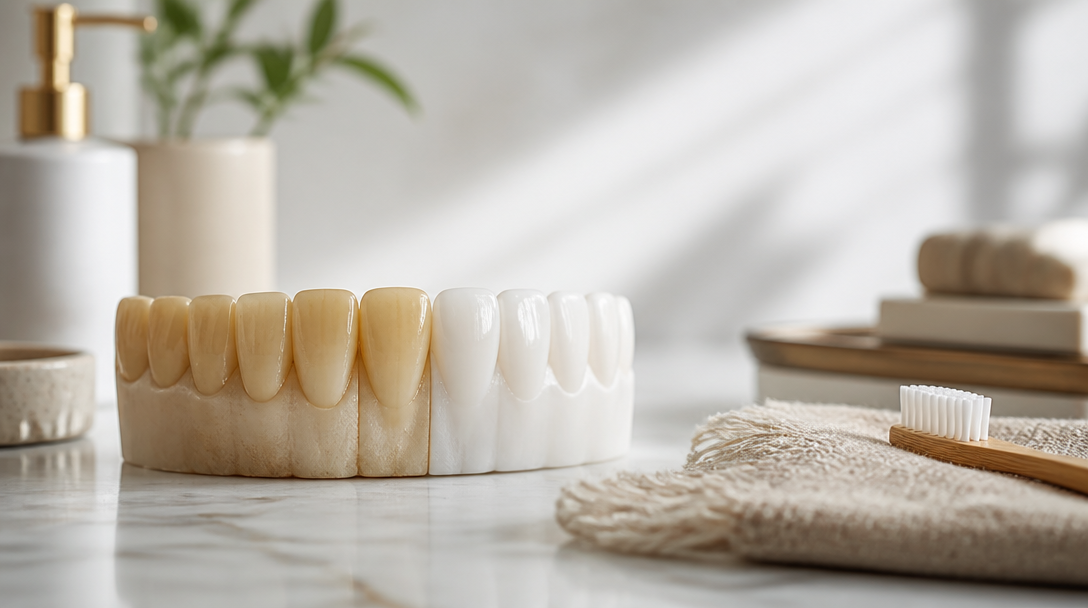
Learn what causes teeth stains at a biological level, which types respond to whitening agents, and which require professional or restorative care.
What Causes Teeth Stains — And Which Type Whitening Can Actually Fix
Most whitening disappointments trace back to a single misunderstanding: not every discoloration responds to the same treatment. Knowing what causes teeth stains at a biological level — specifically, whether a stain sits on the enamel surface or is locked inside the tooth structure — determines whether any whitening product can realistically help. This guide covers the science behind stain formation, how active whitening agents work at the chemical level, and which stain types fall outside the reach of at-home products entirely.
Two Categories of Staining: What Causes Teeth Stains to Behave Differently
Dental science places tooth discoloration into two distinct categories: extrinsic and intrinsic. The National Institute of Dental and Craniofacial Research (NIDCR) defines extrinsic stains as surface pigments deposited from external sources — coffee, tea, tobacco, red wine — while intrinsic stains originate within the tooth structure itself, caused by factors such as tetracycline use during tooth development, dental trauma, or the natural aging process.
Extrinsic stains sit on or just beneath the enamel surface. Intrinsic stains are embedded in dentin, the mineralized layer beneath enamel. A whitening agent can reach both layers to varying degrees, but the concentration, contact time, and formulation required differ substantially depending on stain depth.
This is the most common reason people feel let down after whitening. Gray or blue-gray banding caused by tetracycline, for example, will not respond to an over-the-counter strip or tray. That outcome is not a product failure — it reflects a biological reality the product was never designed to address.
How Chromogens Bind to Enamel Over Time
The colored compounds responsible for extrinsic staining are called chromogens — organic molecules found in food, beverages, and tobacco. On their own, many chromogens would simply wash away. The problem is that they rarely act alone.
Tannins, found in tea, coffee, and red wine, function as binding agents. They help chromogen molecules adhere to the protein-rich pellicle — the thin film that naturally coats enamel. With repeated exposure, pigment accumulates within enamel surface irregularities and gradually penetrates into the subsurface enamel and, eventually, into dentin.
Acidic diets accelerate the process. Dietary acid erodes enamel, producing a rougher surface texture that traps chromogens more readily. The damage is compounding: acid weakens enamel structure and increases its susceptibility to staining by raising surface porosity.
Intrinsic staining follows an entirely different pathway. Tetracycline antibiotics taken during tooth development incorporate directly into the dentin matrix and oxidize over time into dark pigment compounds. Dental trauma can cause internal bleeding, leaving hemoglobin breakdown products embedded inside dentin. Aging gradually thins enamel, allowing the naturally yellow dentin beneath to show through more prominently. None of these processes involve surface chromogens — and none respond to surface-targeting oxidation.
What Peroxide Does to a Stain Molecule
The American Dental Association confirms that hydrogen peroxide and carbamide peroxide are the only proven active ingredients for tooth whitening. Both work through the same fundamental mechanism: oxidation.
When hydrogen peroxide contacts the tooth, it breaks down into water and reactive oxygen species — highly unstable molecules that attack the double-bond chains within chromogen structures. Those double bonds are what give chromogens their color. When the bonds are broken, the molecule either becomes colorless or fragments into smaller compounds that diffuse out of the enamel.
The ADA notes that this process targets stain molecules specifically rather than altering physical tooth structure. However, a 2023 study published in the Journal of Dentistry found that high-concentration hydrogen peroxide causes transient enamel softening and increased surface roughness, raising susceptibility to demineralization. Concentration and contact time directly affect the safety profile — they are not incidental details.
Carbamide peroxide works through the same oxidation pathway but releases hydrogen peroxide more slowly. This makes it well suited to overnight tray systems: the lower release rate extends contact time while reducing the risk of acute sensitivity.
What PAP Does Differently
Phthalimidoperoxycaproic acid — PAP — is a peroxide-free whitening agent formulated as a sensitivity-conscious alternative. A 2024 study in Clinical Oral Investigations confirmed that PAP reduces lipophilic stain molecules and breaks down protein-bound chromogens through oxidation — the same fundamental mechanism as hydrogen peroxide.
The key difference is selectivity. PAP is a more stable oxidizing molecule designed to react preferentially with chromogen compounds rather than with the organic components of enamel or dentin. In practical terms, it whitens through oxidation without generating the same level of free radical activity that contributes to post-treatment sensitivity in peroxide-based systems.
PAP does not penetrate as deeply into dentin as high-concentration hydrogen peroxide. It performs best on extrinsic and mild intrinsic staining. For moderate-to-severe intrinsic discoloration, peroxide — typically at professional concentrations — remains the more clinically effective option.
Stain Types That Respond Well to At-Home Whitening
At-home whitening products — strips, trays, pens — are formulated for a specific and realistic range of staining. Understanding that range sets accurate expectations before you commit.
- Dietary extrinsic staining: Coffee, tea, and red wine chromogens are surface-bound or lightly embedded in enamel. Both peroxide and PAP-based systems reach them effectively at standard at-home concentrations.
- Tobacco staining: Nicotine and tar-based deposits are more stubborn than dietary chromogens but remain extrinsic. They respond to whitening, typically more slowly and with consistent use over time.
- Mild age-related yellowing: Gradual yellowing has both an extrinsic component (accumulated chromogens) and an intrinsic component (increased dentin visibility through thinning enamel). At-home whitening addresses the extrinsic layer effectively; the intrinsic component responds more modestly.
- Post-orthodontic surface staining: Staining that develops around bracket areas during treatment is typically extrinsic and responds well to whitening once orthodontic hardware is removed.
Stains That Require Professional Intervention — or Cannot Be Removed
Tetracycline Staining
The NIDCR identifies tetracycline as a primary cause of intrinsic discoloration. The antibiotic binds to calcium in developing dentin and oxidizes into dark gray or brown bands. Mild cases may show some improvement with extended professional whitening. Moderate-to-severe cases typically require restorative options — veneers or dental bonding. No at-home product produces meaningful results here.
Fluorosis
Dental fluorosis results from excessive fluoride exposure during tooth development. It presents as white spots, streaks, or — in more severe cases — brown pitting. The white-spot form represents an intrinsic structural change, not a chromogen deposit. Whitening cannot remove it. It may temporarily reduce the visual contrast by lightening the surrounding enamel, but the affected areas remain.
Trauma-Related Discoloration
A tooth that has experienced trauma may darken progressively over months as internal tissue breaks down — an intrinsic process involving the pulp and dentin. Professional assessment is essential before any whitening is attempted, as endodontic treatment may be required first.
Crowns, Veneers, and Composite Restorations
Peroxide and PAP act on organic chromogens in natural tooth structure. They have no effect on ceramic, composite resin, or porcelain. Whitening natural teeth while leaving existing restorations untreated can create visible color mismatches — a practical reason to consult a dentist before starting any whitening regimen.
Setting Realistic Expectations Before You Start
Whitening outcome depends on starting shade, stain type, enamel translucency, product formulation, and consistency of use. Here is a practical framework before you begin.
- Identify your stain type. Yellowish discoloration linked to dietary habits or tobacco is a reasonable candidate for at-home whitening. Gray, banded, or event-specific discoloration warrants a dental consultation before any product purchase.
- Understand the baseline limit. Whitening moves teeth toward their natural shade ceiling — it does not produce a shade lighter than your teeth have ever naturally been. Teeth with naturally thick, opaque enamel respond more visibly than teeth with thin or translucent enamel.
- Factor in sensitivity history. If peroxide products have caused sensitivity before, a PAP-based formula is a more comfortable starting point. The 2023 Journal of Dentistry findings on transient enamel softening reinforce why high-concentration peroxide warrants careful use without professional supervision.
- Plan for maintenance. Whitening results are not permanent. Chromogens from diet and lifestyle continue to accumulate after treatment ends. Periodic maintenance — rather than a single intensive course — is the more realistic model for sustained results.
- Consult before committing to professional treatment. For intrinsic staining, a dentist can determine whether in-office bleaching, microabrasion, or a restorative approach is appropriate. Spending months on at-home products for a stain type they cannot address is both frustrating and avoidable.
The FDA regulates over-the-counter whitening products as cosmetics and has issued warnings about unregulated products that may contain harmful abrasives or unapproved chemicals capable of damaging enamel. Choosing a product that meets recognized regulatory standards — whether FDA, CE, or ISO compliance — is a meaningful step, not a formality.
Understanding what causes teeth stains at a biological level changes how you evaluate every whitening option. Extrinsic chromogen staining is genuinely responsive to well-formulated oxidizing agents. Intrinsic discoloration is a different biological problem that requires a different clinical solution. Knowing which applies to you is the most useful piece of information you can have before you start.
References
- American Dental Association — Tooth Whitening (Oral Health Topics)
- U.S. Food and Drug Administration — Cosmetic Dental Products
- Journal of Dentistry (Elsevier) — 2023 research on hydrogen peroxide and enamel microstructure
- Clinical Oral Investigations (Springer) — 2024 research on PAP whitening mechanism
Note: The NIDCR findings cited in this article are drawn from the National Institute of Dental and Craniofacial Research's published oral health resources. A direct URL was not available in the research sources provided for this article; readers are encouraged to search the NIDCR site at nidcr.nih.gov for current guidance on tooth discoloration and development.
Disclaimer
This article is for general informational purposes only and is not a substitute for professional dental or medical advice. Always consult a qualified dental professional before starting any teeth-whitening or oral-care regimen. WhiteningBright makes no warranties as to the completeness or accuracy of the information, and any reliance is at your own risk.