Does Charcoal Actually Whiten Teeth or Just Scratch Them
8 يوليو 2026
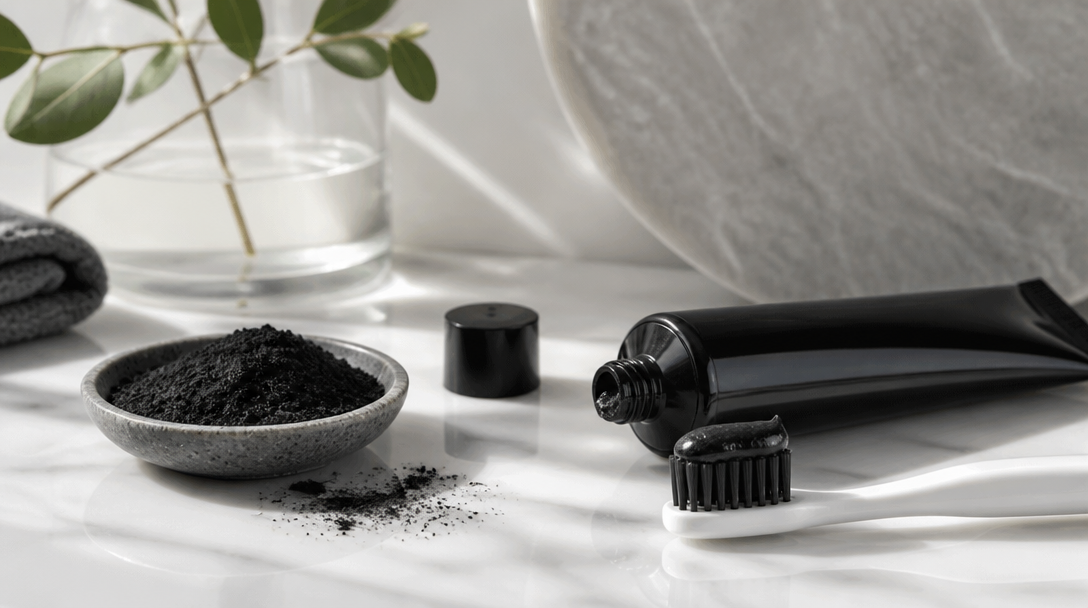
Is charcoal toothpaste safe? See what research says about charcoal teeth whitening safety, enamel abrasion risk, and what genuinely whitens teeth.
Does Charcoal Actually Whiten Teeth or Just Scratch Them
Activated charcoal toothpaste became one of the most photographed oral-care products on social media, largely because the jet-black paste looks dramatic and the before-and-after claims sound convincing. But charcoal teeth whitening safety is a legitimate concern that deserves a direct answer. The core question is this: does charcoal actually change the color of your teeth, or does it scrub the surface harder than regular toothpaste? That distinction matters far more than most product labels acknowledge.
What Activated Charcoal Is and How It Entered Oral Care
Activated charcoal is a form of carbon processed at high temperatures to produce an extremely porous surface structure. That porosity creates a large surface area, which is why it has legitimate medical applications — including binding certain toxins in emergency poisoning treatment.
Its path into toothpaste was driven by marketing logic rather than dental science. The premise was that the same adsorptive properties that bind toxins in the gut could pull stain molecules off tooth enamel. It sounds plausible. The problem is that the mouth is not a stomach, and tooth staining is not a toxin-binding problem.
Charcoal particles are abrasive by nature. When added to toothpaste, they physically scrub the tooth surface — often more aggressively than conventional formulas. That scrubbing is where the apparent whitening comes from, and it is also where the risk begins.
The Difference Between Whitening and Polishing Away Surface Stains
This distinction is the most important thing to understand about any whitening claim. Tooth discoloration falls into two distinct categories.
- Extrinsic stains sit on or just below the outer enamel surface. Coffee, tea, red wine, and tobacco leave these deposits. Abrasion or chemical agents that break down stain molecules can reduce them.
- Intrinsic discoloration exists inside the tooth structure itself — within the dentin layer beneath the enamel. This is what gives teeth a naturally yellow or gray base tone. Scrubbing cannot reach it.
True whitening means changing intrinsic color. That requires a bleaching agent — typically hydrogen peroxide or carbamide peroxide — that penetrates enamel and chemically alters pigment molecules inside the dentin. Charcoal has no bleaching chemistry. It does not do this.
Charcoal polishes away extrinsic stains through mechanical abrasion. Teeth may look brighter after use, but that is surface cleaning — not whitening. Resume normal eating and drinking habits, and those extrinsic stains return. The underlying tooth color has not changed.
What the Research Confirms About Charcoal Teeth Whitening Safety
The scientific literature is consistent. A systematic review confirmed that charcoal whitening is essentially abrasive removal of extrinsic stains, not intrinsic color change, and that the high abrasion involved carries real risks of enamel erosion.
A peer-reviewed study published in a leading biomedical journal found that charcoal-based toothpastes are less effective at producing measurable color change than peroxide-based agents — while posing greater risk to enamel surfaces. A separate review examining fifty charcoal toothpaste products, published in the British Dental Journal, found them ineffective for whitening and linked them to enamel erosion and an elevated risk of tooth decay.
The American Dental Association has stated that insufficient evidence exists to support the efficacy or safety of charcoal-based dental products, and it specifically warns about unknown abrasiveness levels across different formulations. No charcoal toothpaste has received ADA approval.
How Enamel Wears — and Why That Cannot Be Reversed
Enamel is the hardest tissue in the human body. It does not regenerate. Repeated abrasive contact wears it down gradually, and once it thins, the yellower dentin beneath becomes more visible.
A review cited by the Journal of the American Dental Association found that multiple studies failed to demonstrate charcoal's safety or efficacy — and specifically noted that its abrasive action can expose yellow dentin by wearing away the enamel covering it. Aggressive charcoal use can produce the opposite of the intended result over time: teeth that appear darker, not lighter.
The abrasiveness of charcoal toothpastes also varies widely between products, with no reliable way for a consumer to assess that from a label alone. That unpredictability is a core part of the safety concern.
Why Charcoal Cannot Reach the Stains Inside Your Tooth
If teeth still look yellowish after consistent brushing, the cause is almost certainly intrinsic color — the base tone from dentin sitting beneath a translucent enamel layer. No amount of surface scrubbing changes it.
Peroxide-based whitening agents work because hydrogen peroxide and carbamide peroxide molecules are small enough to diffuse through enamel and reach the dentin. Once there, they initiate an oxidation reaction that breaks apart the chromogen molecules responsible for yellow and brown discoloration. The tooth lightens from the inside out.
Charcoal particles are physically too large to penetrate enamel. Their action stops at the surface. For coffee or tea stains, charcoal may temporarily improve appearance. For teeth that are naturally darker or have yellowed with age, charcoal will not help — and may make the underlying color more visible by thinning the enamel layer above it.
When Charcoal Products Carry the Most Risk
Not every charcoal product carries identical risk. The concern scales with how abrasive the formula is, how frequently it is used, and the current condition of enamel and gums. Charcoal use is most likely to cause harm in these situations:
- Enamel is already thin or worn from acid erosion, grinding, or previous aggressive whitening.
- Existing tooth sensitivity is present — a sign that enamel may already be compromised.
- It replaces regular fluoride toothpaste daily. Many charcoal formulas contain no fluoride, removing a critical layer of decay protection.
- Dental restorations such as veneers, crowns, or composite bonding are present. Charcoal abrasion can scratch these surfaces and degrade their finish.
- Gum recession exposes the softer root surface, which is far more vulnerable to abrasive damage than enamel.
Occasional use on otherwise healthy teeth with intact enamel carries lower risk. Even so, the British Dental Journal review and the ADA's position both reflect that this cannot be fully endorsed without standardized safety data across formulations.
What Actually Whitens Teeth — and What to Look For Instead
For surface stains, look for toothpastes carrying the ADA Seal of Acceptance. These have been evaluated for both safety and efficacy, and some contain low concentrations of hydrogen peroxide or use mild, standardized abrasives that polish without excessive enamel wear.
For intrinsic discoloration — the actual base color of the tooth — a peroxide-based whitening system is required. The two main options are:
- Hydrogen peroxide formulas, which act quickly and are used in professional and at-home whitening strips, trays, and pens. Concentration and contact time determine the degree of color change.
- Carbamide peroxide formulas, which release hydrogen peroxide more slowly and are often used in overnight or extended-wear tray systems.
A newer category worth knowing is PAP (phthalimidoperoxycaproic acid)-based whitening. PAP is a non-peroxide oxidizing agent that has shown efficacy for intrinsic stain removal with a lower sensitivity profile than peroxide in some formulations. It is increasingly used in at-home whitening products designed for people with sensitive teeth.
For anyone with sensitive teeth, significant enamel wear, or active gum recession, the right first step is a conversation with a dentist before starting any whitening regimen. A professional assessment identifies which approach suits the specific enamel condition and stain type.
Charcoal Teeth Whitening Safety: What the Evidence Shows
The marketing around charcoal products often obscures a simple set of facts. Here is what the current body of peer-reviewed research supports:
- Charcoal removes extrinsic surface stains through abrasion. It does not chemically whiten teeth.
- It cannot alter intrinsic tooth color — the primary driver of how white or yellow teeth appear.
- Multiple peer-reviewed studies and systematic reviews have found charcoal toothpastes less effective than peroxide-based alternatives for measurable color change.
- High abrasivity is a documented risk. Enamel wear, increased sensitivity, and elevated decay risk are all associated with regular charcoal toothpaste use.
- The American Dental Association has not approved any charcoal dental product and cites insufficient evidence for both safety and efficacy.
The appeal of charcoal toothpaste is understandable — it looks effective, it carries a natural-ingredient story, and short-term results on surface stains can be visible. But the risk-to-benefit ratio, compared to evidence-based alternatives, does not favor it. For genuine, lasting whitening that does not trade enamel for brightness, peroxide or PAP-based systems are the evidence-supported choice.
References
- PubMed — Activated charcoal toothpastes: lower whitening efficacy and higher abrasive potential (National Center for Biotechnology Information)
- American Dental Association — Whitening: Oral Health Topics (ADA official position)
- ScienceDirect / Elsevier — Charcoal-based toothpastes: efficacy and enamel surface risk compared with peroxide agents (peer-reviewed)
Disclaimer
This article is for general informational purposes only and is not a substitute for professional dental or medical advice. Always consult a qualified dental professional before starting any teeth-whitening or oral-care regimen. WhiteningBright makes no warranties as to the completeness or accuracy of the information, and any reliance is at your own risk.