Switching Whitening Actives: What Clinics Lose and Gain
7 سبتمبر 2026
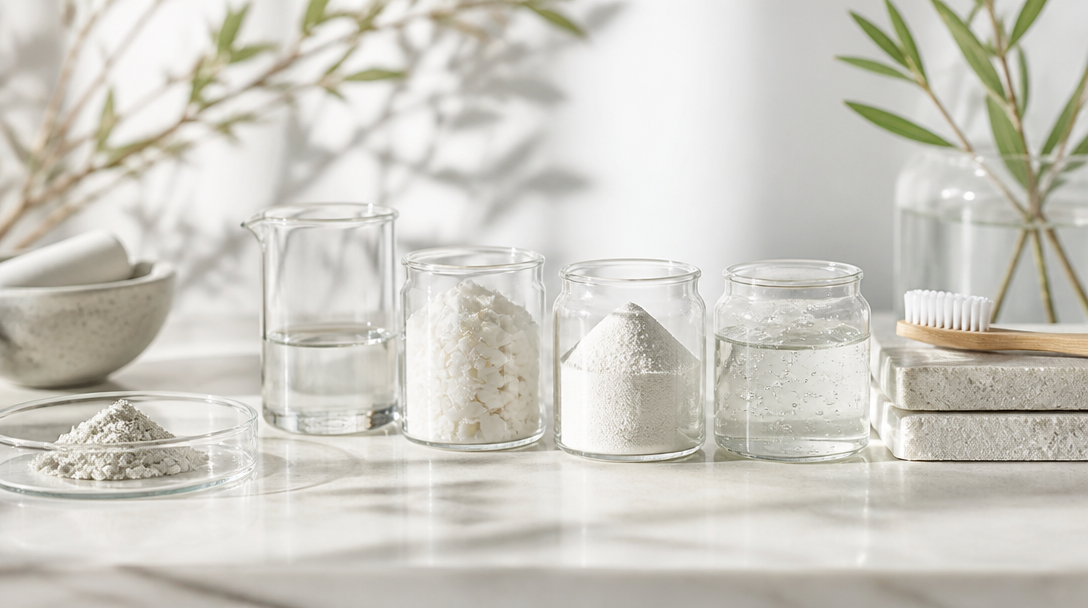
A practical framework for switching whitening active ingredients at the clinic level — covering PAP vs. peroxide, regulatory compliance, and inventory tradeoffs.
Why Clinics Are Reconsidering Their Core Whitening Active in 2026
Switching whitening active ingredients at the clinic level is no longer a fringe procurement question. Regulatory updates across the EU, evolving patient sensitivity profiles, and a maturing PAP market have moved the conversation from exploratory to operational. For clinic owners and distributors managing whitening SKUs, the decision now carries direct revenue and compliance consequences.
The core tension is clear: hydrogen peroxide and carbamide peroxide remain the most clinically validated actives for intrinsic tooth whitening, yet both carry concentration-dependent risks that regulators and patients are increasingly unwilling to absorb. PAP (phthalimidoperoxycaproic acid) has entered professional channels as the primary non-peroxide alternative, but its evidence base and shade-stability profile differ in ways that matter operationally. This article provides a structured framework for evaluating the switch — or the dual-stack — based on patient mix, regulatory exposure, and inventory economics.
What Each Whitening Active Actually Delivers
Hydrogen peroxide and carbamide peroxide work through oxidative diffusion into enamel and dentine, breaking chromogen bonds at the molecular level. Published research confirms they remain the most effective agents for intrinsic whitening — the kind of shade change that goes beyond surface stain removal. Carbamide peroxide releases hydrogen peroxide as it degrades, making it better suited to extended-wear tray protocols where a slower, controlled release is clinically advantageous.
The tradeoff is well-documented. Higher peroxide concentrations are associated with measurable enamel microhardness reduction, increased surface alteration, and elevated cytotoxicity risk, particularly in in-vitro models. Efficacy and safety are not independent variables. Concentration decisions are formulation decisions, not just label decisions.
PAP operates through a different oxidative mechanism — without free radical release — which is why it produces less pulpal sensitivity in most patient populations. Shade results are real, but the depth of whitening and durability of results over a multi-week period differ from peroxide-based outcomes. For surface and extrinsic staining, PAP performs competitively. For deep intrinsic discoloration — tetracycline staining, fluorosis, aging-related yellowing — peroxide protocols continue to hold the clinical advantage.
Hydroxyapatite is also entering the conversation as a non-peroxide option, with emerging evidence suggesting potential for surface-level whitening alongside enamel-support properties. The current evidence base for hydroxyapatite as a standalone whitening active remains limited, however, and it is not yet a direct substitute for either peroxide or PAP in professional whitening protocols.
Patient Profiles That Drive the Switching Decision for Whitening Active Ingredients at the Clinic Level
The decision to switch whitening active ingredients is rarely about chemistry alone. Patient demographics determine which active your protocol can realistically deliver.
Profiles that favor a PAP migration or dual-stack approach:
- Patients with documented peroxide sensitivity or a history of post-treatment pulpal discomfort
- Patients with gingival recession, exposed root surfaces, or compromised enamel where oxidative stress is a clinical concern
- Younger adults or wellness-oriented patients where a preference for peroxide-free formulations is a purchasing driver
- Practices positioned around a health-and-wellness brand identity where non-peroxide options reinforce the clinical narrative
Profiles that support maintaining peroxide-based protocols:
- Patients presenting with moderate-to-severe intrinsic discoloration where surface-active agents will not achieve the required shade change
- Patients with no contraindications to peroxide use who have completed a full clinical assessment and hold realistic outcome expectations
- High-volume whitening practices where single-session results and treatment speed are core to the service model
A clinic operating across multiple patient segments will often find that neither a full migration nor a single-active protocol is the right answer. The practical question is whether your inventory and staff training can support two distinct whitening pathways without creating operational drag.
Regulatory Constraints That May Force the Decision Before You Do
Regulatory pressure is the factor most likely to accelerate your timeline regardless of clinical preference. The EU Cosmetics Regulation establishes concentration thresholds for hydrogen peroxide in tooth-whitening products, with higher concentrations restricted to dental professional use only. Clinics operating in or distributing into EU markets need to verify that current formulations are compliant at the point of application — not just at the point of manufacture.
In markets where peroxide concentration limits are tightly enforced, PAP-based formulations offer a regulatory pathway that avoids the professional-use classification entirely. For distributors managing cross-border SKUs, this simplifies channel strategy in a meaningful way.
OTC bleaching products show wide variation in ingredients, concentrations, and compliance status across jurisdictions, making product-by-product regulatory review essential before restocking or introducing a new active. A supplier's blanket compliance claim is not a substitute for jurisdiction-specific documentation.
FDA-regulated markets apply their own classification logic to whitening actives, and the distinction between cosmetic and drug-classified products affects labeling, permitted claims, and distribution channel eligibility. If your clinic or distribution network spans multiple regulatory zones, active ingredient choices may need to be made market-by-market rather than as a single global protocol decision.
Stocking One Active vs. Two: Inventory and Margin Tradeoffs
Running a single-active whitening protocol simplifies procurement, staff training, and patient communication. It also concentrates your regulatory and clinical risk in one formulation. If a concentration threshold changes or a patient segment shifts, your entire whitening revenue line is exposed.
Stocking both peroxide-based and PAP-based formulations introduces SKU complexity but creates a segmented offering that can be priced differently. PAP-based kits typically carry a premium positioning in patient-facing retail and take-home categories, supporting higher per-unit margin even when the underlying formulation cost is comparable. Peroxide-based in-chair systems remain the higher-revenue single-treatment option in most clinic models.
For distributors placing volume orders across a whitening range, the dual-active model means managing minimum order quantities across two formulation types, two sets of regulatory documentation, and potentially two supplier relationships. The margin case for carrying both needs to be modeled against that operational overhead before committing to a dual-stack inventory position.
A practical middle position: maintain peroxide-based in-chair product as the clinical core, and introduce PAP-based take-home kits as an add-on SKU. This captures the sensitivity-conscious patient segment without displacing primary treatment revenue, and it generates real-world reorder data on PAP performance before you make a larger inventory commitment.
What to Ask a Supplier Before Switching Whitening Active Ingredients for Your Clinic
Switching whitening active ingredients means your supplier relationship needs to carry more technical weight than a standard reorder. These are the questions that separate a capable formulation partner from a commodity vendor.
- What is the exact active concentration, and how is it validated? Request the certificate of analysis and, where relevant, third-party lab confirmation. Supplier-stated concentrations and independently verified concentrations are not always the same number.
- Which regulatory markets is this formulation cleared for? EU Cosmetics Regulation compliance, FDA cosmetic vs. drug classification, and jurisdiction-specific registrations are not interchangeable. A blanket "internationally compliant" claim is not documentation.
- What stability data supports the active at the stated concentration? Both PAP and peroxide degrade over time. Shelf-life claims should be supported by stability testing data, not estimated from category norms.
- Is private-label reformulation available, and what is the minimum viable run? Building a clinic brand or a distributor-exclusive line requires a co-developed formulation from a partner with genuine R&D capability — not label-swap capacity alone.
- What clinical or safety documentation supports the formulation's efficacy and adverse-effect profile? Published research confirms that safety and efficacy comparisons across OTC bleaching products are highly formulation-specific. Generic category data does not substitute for formulation-level documentation.
Managing the Transition Without Disrupting Existing Whitening Revenue
Switching whitening active ingredients mid-cycle is a sourcing and operations challenge as much as a clinical one. Clinics that have built patient loyalty around a specific protocol need a transition plan that protects reorder continuity while the new active is introduced.
A phased introduction reduces disruption. Introduce the new active in one treatment category first — take-home maintenance kits are a lower-stakes starting point than in-chair treatment product — and track patient feedback and reorder rates over a defined period before expanding. This generates real-world performance data without betting the full whitening revenue line on a formulation not yet validated in your patient population.
Staff training is a transition cost that is frequently underestimated. If your clinical team has been explaining peroxide-based whitening to patients for years, introducing PAP requires updated patient communication, revised consent language, and clear guidance on what outcome expectations are realistic for each active. Budget for that transition, not just for the product changeover.
For distributors managing clinic accounts, the transition period is a retention opportunity. Clinics actively reconsidering their whitening protocol are open to supplier input. Distributors who provide formulation-level guidance, regulatory documentation, and a structured introduction plan — rather than simply swapping one SKU for another — deepen the account relationship rather than just fulfill a reorder.
The clinics that navigate this transition most effectively are not the ones that move fastest. They are the ones that define their patient profile clearly, verify their regulatory position market by market, and introduce the new active with enough operational structure to measure whether it is actually performing.
References
- Tooth-Whitening Agents and Polymer-Based Carriers — PubMed (NCBI)
- Tooth Whitening with Hydroxyapatite: A Systematic Review — PubMed (NCBI)
- Effectiveness and Safety of Over-the-Counter Tooth Bleaching Products — PubMed (NCBI)
- Over-the-Counter Products in Tooth Bleaching: A Scoping Review — PubMed (NCBI)
Disclaimer
This article is for general informational purposes only and does not constitute sourcing, legal, or regulatory advice. Always conduct your own due diligence and consult qualified legal or compliance professionals before making purchasing or compliance decisions. WhiteningBright makes no warranties as to the completeness or accuracy of the information, and any reliance is at your own risk.