Whitening Kit Supplier Contracts: What to Lock In First
October 6, 2026
Secure your private label whitening kit contract with the right formulation, stability, MOQ, and exit terms before production starts. A trade buyer's guide.
Why the Private Label Whitening Kit Contract Conversation Starts Too Late
Most brand owners finalize packaging design, confirm flavor profiles, and lock in a launch timeline before a single contractual term is in writing. By that point, leverage is largely gone. A private label whitening kit contract is not an administrative formality — it is the document that determines whether your formulation performs as specified, your reorders arrive on schedule, and your brand retains meaningful control over the product bearing its name.
The gaps that cost money rarely surface during sampling. They appear at batch three, when a consistency issue emerges, or at month eight, when a supplier quietly substitutes a raw material. What follows maps the terms worth securing before production begins.
Formulation Ownership: What You Actually Control
The first question in any private label whitening kit contract is deceptively simple: who owns the formulation? Many brand owners assume that because they paid for development, they control the formula. That assumption is frequently wrong unless it is written into the agreement.
Formulation ownership clauses should specify:
- Whether the formula is exclusive to your brand or shared across the supplier's client base
- Who holds the master formula document and under what conditions you can access it
- Whether you retain the right to transfer production to a second-source supplier
- What happens to the formula if the supplier discontinues the product line
The active agent — hydrogen peroxide or carbamide peroxide — and its concentration are the core of any whitening formulation. The American Dental Association identifies these as the principal whitening agents, and clinical evidence confirms that concentration and delivery method directly affect both efficacy and adverse-effect risk, including tooth sensitivity and gingival inflammation. Your contract must specify the exact concentration range — not just the agent name.
If you are building a peroxide-free line formulated with PAP (phthalimidoperoxycaproic acid) or other alternative oxidants, the same principle applies. The active ingredient, its concentration, and its delivery vehicle must be defined numerically in the agreement — not described in marketing language.
Stability and Batch Consistency Guarantees Worth Demanding
A whitening gel that performs at month one may not perform at month ten. Peroxide-based formulas degrade over time, and the rate of degradation depends on packaging, storage conditions, and gel pH. Peer-reviewed clinical research confirms that whitening color stability shifts over time and that certain combined protocol approaches can extend result longevity. That means your shelf-life claims need grounding in actual stability data — not supplier estimates.
Demand the following in writing before signing any agreement:
- Accelerated stability testing results for the specific formulation and packaging combination you are ordering
- Declared shelf life with the storage conditions under which that shelf life was validated
- Batch-to-batch concentration tolerance — the acceptable variance range for active ingredient concentration across production runs
- Certificate of Analysis (CoA) requirements for every batch, including the specific parameters tested and the pass/fail thresholds
Gel pH is another parameter that belongs in the contract. Research on in-office bleaching outcomes identifies pH as a variable that directly affects both efficacy and safety. A supplier who cannot provide pH specifications for each production batch cannot support your product claims under regulatory scrutiny.
Peer-reviewed systematic reviews of tooth bleaching also indicate that sensitivity profiles differ meaningfully across concentration levels and product types. If your positioning depends on a low-sensitivity claim, that claim must be tied to a specific concentration and formulation specification in the contract — not left as a general assertion.
Lead Time Commitments That Hold Under Volume Pressure
Sample lead times and production lead times are not the same number. A supplier who delivers samples in three weeks may quote eight to twelve weeks for a first production run — and that window can extend further when raw material availability tightens or when the supplier's production calendar fills with larger orders.
Your contract should define lead times at multiple production volumes, not just the opening order. Specify:
- Lead time for the initial production run at your agreed MOQ
- Lead time for reorders at the same volume
- Lead time for scaled orders if you double or triple volume
- The notice period required to hold a production slot
- What constitutes a force majeure event and how it affects committed timelines
Build a penalty or credit structure for missed lead times that exceed a defined threshold. Without a financial consequence, a missed window is an inconvenience for the supplier and a lost sales cycle for your brand. If you supply dental clinics or retail chains with planogrammed shelf space, a late shipment carries a direct revenue cost — the contract should reflect that reality.
MOQ Structures and Reorder Flexibility in Your Private Label Whitening Kit Contract
Minimum order quantities are negotiable more often than suppliers initially indicate. The figure presented at first contact is typically a production floor, not fixed policy. What matters more than the opening MOQ is the structure of reorder minimums and how they interact with your growth trajectory.
Three scenarios worth addressing in negotiation:
- Launching into a single retail channel: Negotiate a reduced first-order MOQ with a committed reorder volume within a defined window — six months is a common structure — to validate sell-through before scaling.
- Supplying dental clinics across multiple locations: Clinic operators often order by the case. Confirm whether the supplier can fulfill split-SKU orders across multiple formulations or concentrations at a combined MOQ, rather than requiring separate minimums per SKU.
- Building a DTC subscription model: Subscription velocity is predictable but not always high-volume at launch. Negotiate quarterly reorder commitments rather than per-order minimums, and confirm the supplier can accommodate consistent smaller runs.
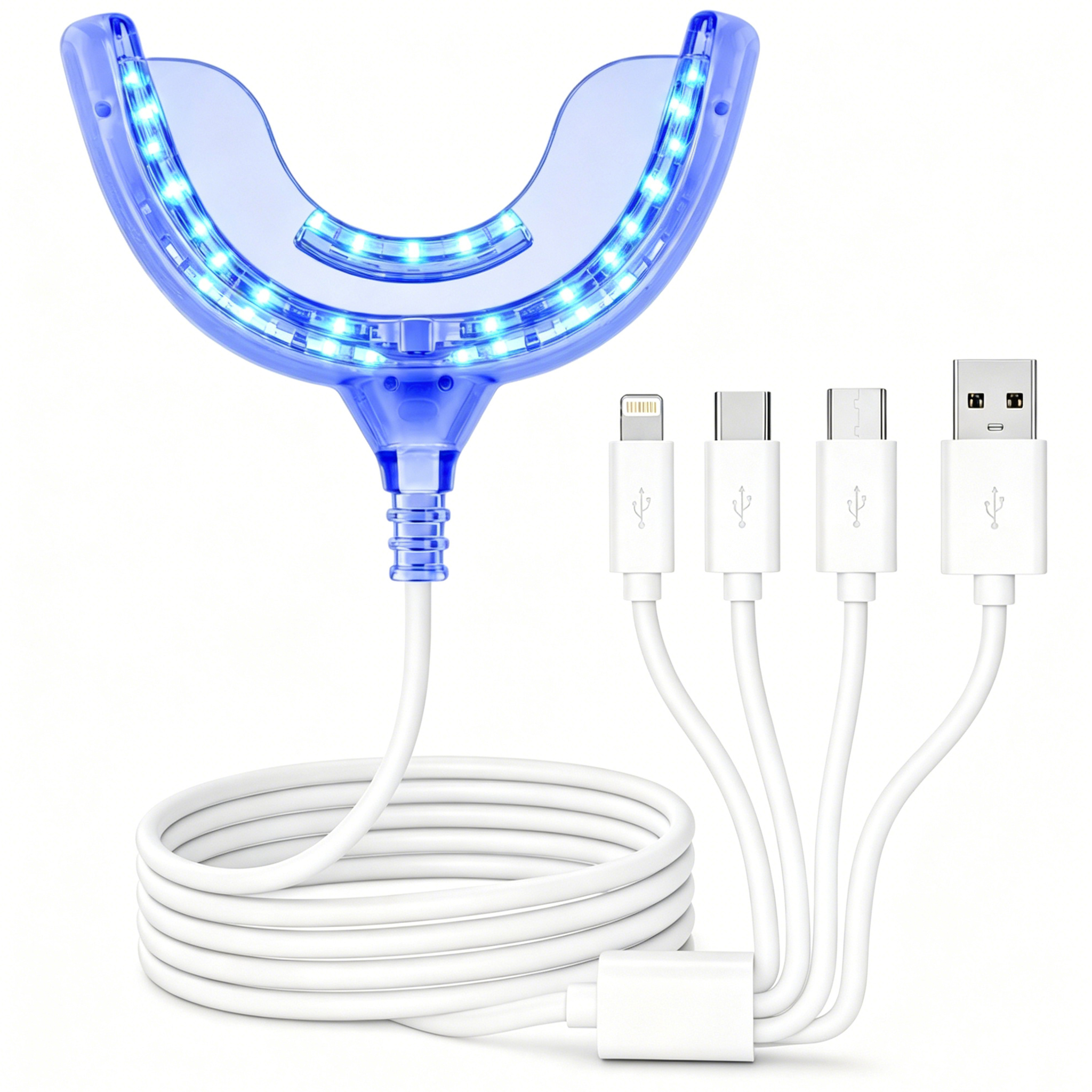
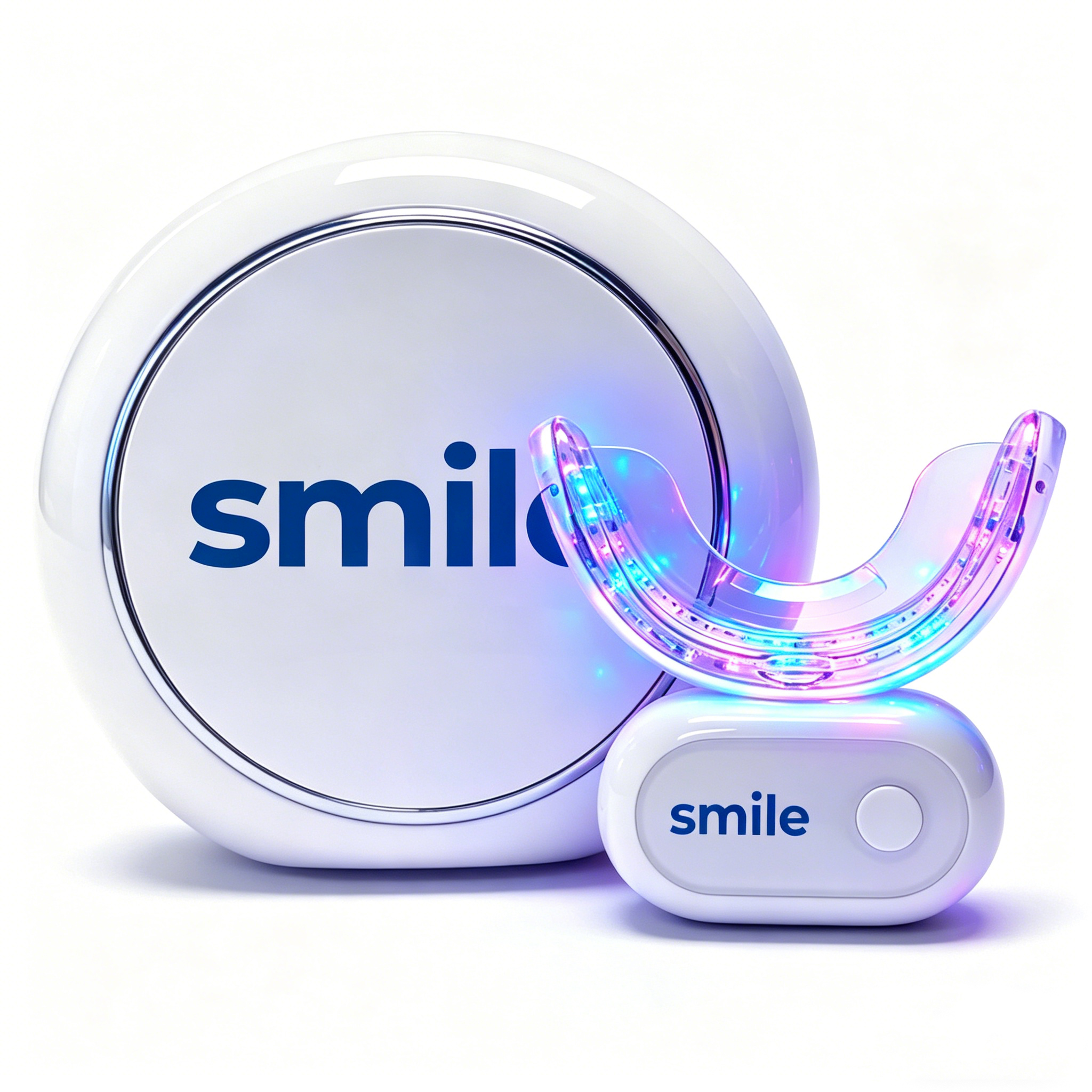
The contract should also address component MOQs separately from gel fill MOQs. Custom-molded trays, branded LED devices, and specialty packaging often carry independent minimum production runs. Misaligned component and fill MOQs are a common source of inventory imbalance that surfaces only after the first order ships.
Branding Scope: Artwork, Components, and Exclusivity Clauses
Branding scope in a co-developed whitening kit covers more than a logo on a box. It defines every touchpoint your end customer sees — and every element the supplier can legally replicate for another brand.
Clarify the following in writing:
- Artwork ownership: Does your brand own the dieline, the print-ready files, and the component tooling? Or does the supplier retain ownership and license them back to you?
- Component exclusivity: If you have specified a custom tray shape, a particular LED device design, or a proprietary gel syringe format, confirm in writing that the supplier will not offer the same component to competing brands.
- Formulation exclusivity by market: Some suppliers will grant geographic exclusivity — they will not sell the same formulation under another brand in your primary sales territory. Define the territory precisely: country, region, or channel.
- Labeling compliance responsibility: Specify who is responsible for ensuring that label claims, ingredient lists, and regulatory statements meet the requirements of your target markets. In the United States, this includes FDA cosmetic labeling rules; in the EU, the Cosmetics Regulation (EC) No 1223/2009. Never accept a contract that leaves this point ambiguous.
A scoping review of OTC whitening products published in peer-reviewed dental literature notes that evidence quality varies significantly across product formats — strips carry the strongest clinical support, while many tray-based and other formats rely primarily on laboratory evidence. If your brand makes efficacy claims, those claims must be supportable by the evidence tier your product format actually occupies. The contract should define what clinical or laboratory validation the supplier provides, and in what format.
Exit Terms, Reformulation Rights, and What Happens at Renewal
The terms that govern the end of a supplier relationship are as important as those that govern the beginning. Brand owners who neglect exit provisions often discover, precisely when they need them, that they have no practical ability to switch suppliers without losing their formulation, their tooling, or their regulatory documentation.
Build the following into every private label whitening kit contract:
- Reformulation notification: The supplier must notify you in writing — with a defined minimum notice period — before making any change to the formulation, including raw material substitutions. Clinical research confirms that concentration tolerances and pH directly affect both efficacy and safety outcomes; a substitution that shifts either parameter without notice can invalidate your product claims.
- Reformulation rights: If a regulatory change requires a concentration adjustment — for example, a jurisdiction lowers its permitted peroxide ceiling — specify whether the supplier reformulates at their cost, your cost, or a shared cost, and what timeline governs the transition.
- Documentation transfer: At contract end, you are entitled to receive all regulatory documentation, stability data, CoAs, and formulation records associated with your product. This must be explicit. Suppliers do not volunteer this transfer unless the contract requires it.
- Tooling and mold ownership: Any tooling produced for your custom components — trays, packaging, devices — should be owned by your brand upon payment. Confirm this in writing, including the physical location of the tooling and the process for transferring custody.
- Renewal terms: Automatic renewal clauses with price escalation provisions are common. Set a defined review window — ninety days before renewal is standard — and confirm that pricing, MOQ, and lead time terms are renegotiable at each cycle.
The Compliance Dimension: Regulatory Clauses That Protect Your Brand
Regulatory standards for whitening products are not static. Bibliometric analysis of over four hundred tooth-bleaching clinical studies published through 2024 reflects a field where evidence standards are rising and regulatory scrutiny of product claims is intensifying. A supplier relationship built on verbal assurances does not hold up when a market authority requests documentation.
Your contract should address compliance at the production level:
- ISO/GMP certification: Confirm the manufacturing facility holds current ISO 22716 (cosmetics GMP) or equivalent certification. Request a copy, not a verbal confirmation.
- Adverse event reporting: Define who is responsible for monitoring post-market safety signals — sensitivity reports, gingival irritation complaints — and what the notification obligation is if a pattern emerges across batches.
- Regulatory change monitoring: Specify that the supplier will notify you within a defined period if a regulatory body in your target markets issues new guidance affecting peroxide concentrations, PAP claims, or device classifications relevant to your kit.
Brands that supply dental clinics, premium pharmacies, or regulated retail channels face additional documentation requirements at the point of sale. Those requirements flow upstream to the supplier. A contract that does not formalize the supplier's compliance obligations leaves your brand absorbing the risk of their omissions.
References
- American Dental Association — Whitening (Oral Health Topics)
- Over-the-counter products in tooth bleaching: A scoping review — PubMed
- Scientific trends in clinical trials on tooth bleaching: A bibliometric and altmetric review — PubMed / Journal of Dentistry
- Clinical decision-making in tooth bleaching based on current evidence — PubMed
- Evaluation of the Effectiveness of Different Types of Professional Tooth Whitening: A Systematic Review — PubMed
Disclaimer
This article is for general informational purposes only and does not constitute sourcing, legal, or regulatory advice. Always conduct your own due diligence and consult qualified legal or compliance professionals before making purchasing or compliance decisions. WhiteningBright makes no warranties as to the completeness or accuracy of the information, and any reliance is at your own risk.