What Practitioners Order When PAP Fails to Perform
25 de octubre de 2026
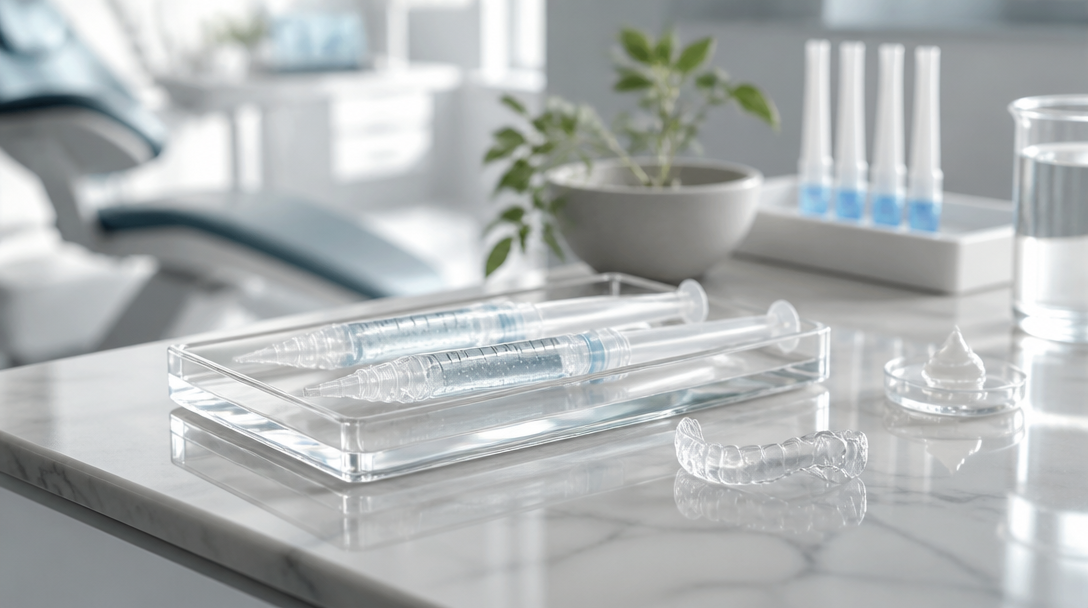
Why clinics that switched to PAP-only kits are reintroducing peroxide — and what reorder data reveals about matching the active ingredient to the treatment setting.
PAP vs Peroxide Professional Whitening: Why Clinics Are Reordering Both
The pivot to PAP-only whitening kits made sense on paper. Sensitivity complaints were real, peroxide ceilings were tightening in key markets, and the "gentler chemistry" narrative moved product. What reorder behavior now reveals is that the PAP vs peroxide professional whitening decision was never binary — and clinics that treated it as one are correcting course. A measurable segment of accounts that converted entirely to PAP formulations are quietly adding peroxide SKUs back to their orders. Not because PAP failed as an ingredient, but because it was stocked for treatment settings where it was never the right tool.
This article addresses the sourcing decision directly: which active ingredient belongs in which clinical context, what practitioner feedback actually indicates, and how buyers can structure a product range that stops generating reorder reversals.
Why PAP Adoption Moved Faster Than the Clinical Evidence
Phthalimidoperoxycaproic acid entered professional whitening on the strength of its safety narrative. It does not release free radicals through the same mechanism as hydrogen peroxide, which made it attractive in markets where peroxide concentration limits were tightening and for practitioners managing patients with documented sensitivity histories.
The adoption curve outpaced the clinical literature. PAP's efficacy on intrinsic staining — particularly tetracycline-related discoloration and deep dentin staining — was not established at the same pace as its safety profile. Clinics ordered based on the ingredient story, not on matched treatment indications. That gap is now visible in reorder data.
PAP is a legitimate active ingredient with a defensible safety profile. It is not a universal replacement for peroxide. Stocking it as a standalone solution leaves practitioners without a clinical fallback when it underperforms on specific stain types or treatment protocols.
Where PAP Delivers — and Where It Does Not
PAP performs consistently in a defined set of conditions. For extrinsic staining — surface deposits from coffee, tea, and tobacco — PAP-formulated strips, trays, and paint-on gels produce results that satisfy the majority of patients in spa, wellness, and cosmetic-dental settings. It is also the appropriate choice where regulatory ceilings on peroxide make professional-strength hydrogen peroxide impractical or non-compliant.
Where PAP underperforms is consistent across clinical feedback:
- Intrinsic staining of moderate to severe depth — PAP's oxidative mechanism does not penetrate dentin at the same rate or depth as hydrogen peroxide under professional activation conditions.
- Single-session in-chair whitening — Clinics running 60- to 90-minute protocols with light or heat activation report lower shade lift with PAP compared to equivalent peroxide concentrations.
- Developmental discoloration — Fluorosis banding and tetracycline staining require sustained oxidative exposure that currently available PAP formulations do not reliably deliver.
Practitioners are not abandoning PAP. They are identifying where it belongs in the treatment menu — and sourcing the rest of the protocol accordingly.
Hydrogen Peroxide vs Carbamide Peroxide: The Treatment Window Decides
When a clinic reintroduces peroxide, the next sourcing question is which peroxide. The answer is determined almost entirely by treatment window length.
Hydrogen peroxide releases active oxygen quickly. That makes it the correct formulation for in-chair, professionally supervised treatments where contact time is controlled and the practitioner is present. The fast-release profile means results accumulate within the session — which is precisely what justifies the appointment cost.
Carbamide peroxide breaks down more slowly, releasing hydrogen peroxide over an extended period. This makes it the formulation of choice for take-home tray systems worn for one to eight hours. The slower release reduces peak tissue exposure while maintaining cumulative efficacy across multiple sessions.
Buyers sourcing for clinics that run both in-chair and take-home protocols need both formulations on the shelf. A clinic stocked only with carbamide peroxide gel cannot run an efficient single-session in-chair treatment. A clinic stocked only with high-concentration hydrogen peroxide cannot safely send patients home with an unsupervised tray system.
The Dual-Protocol Model Clinics Are Actually Running
The most operationally efficient clinics in the professional whitening segment run a tiered protocol that assigns the active ingredient to the treatment context:
- In-chair session: Hydrogen peroxide gel at professional concentration, applied by the practitioner, with or without light activation. Delivers the immediate shade change that justifies the visit.
- Take-home maintenance: Carbamide peroxide tray gel or PAP-based strips dispensed at the end of the in-chair appointment. Extends and stabilizes results between visits.
- Sensitivity-managed patients: PAP-only formulations for patients with documented peroxide sensitivity or in markets where peroxide is consumer-restricted. These patients receive a longer treatment timeline with adjusted outcome expectations communicated upfront.
This model carries a direct implication for buyers. A clinic running a dual-protocol program is not a single-SKU account — it is a multi-SKU account that reorders across two or three product categories on different cycles. Distributors and private-label brand owners who recognize that structure can build account relationships around a complete protocol range rather than a single product placement.
Sensitivity Complaints as a Sourcing Signal
When a clinic reports elevated sensitivity complaints after switching whitening products, the instinct is to treat it as a patient management problem. In sourcing terms, it is more useful as a formulation signal.
Sensitivity in peroxide-based whitening is driven primarily by two variables: concentration and contact time. A clinic experiencing complaints after transitioning to a new hydrogen peroxide gel should examine whether the concentration matches the treatment duration, and whether the gel's viscosity is keeping it on enamel rather than migrating to soft tissue.
Sensitivity complaints that persist after PAP adoption — which does occur — typically indicate one of two things: the PAP formulation contains co-ingredients, such as certain surfactants or flavoring agents, that are the actual irritant, or the patient's baseline sensitivity is structural and not ingredient-dependent. In either case, the sourcing response is to evaluate the full formulation, not just the active-ingredient label.
For buyers building a private-label range, this is an argument for requesting full ingredient disclosure from your formulation partner — not just the active-ingredient specification sheet. Sensitivity liability follows the brand on the label.
What Reorder Patterns Tell Buyers About Active Ingredient Fit
Reorder data from professional whitening accounts carries more diagnostic value than initial purchase data. An initial order reflects purchasing intent and marketing influence. A reorder reflects clinical experience.
Accounts that ordered PAP-only kits and are now adding hydrogen peroxide SKUs are communicating a specific clinical gap: they have patients or treatment protocols that PAP cannot serve at the expected outcome level. That is not a failure of PAP — it is a signal that the original product selection did not map to the full scope of the clinic's treatment menu.
Accounts that ordered high-concentration hydrogen peroxide gel and are now adding PAP-based take-home products are typically responding to sensitivity feedback or expanding their patient base to include individuals who are not candidates for peroxide treatment.
Buyers and distributors who track reorder composition — not just reorder volume — can use this data to anticipate account needs, reduce churn, and position themselves as a protocol partner rather than a product vendor.
PAP vs Peroxide Professional Whitening Across Regulatory Markets
Regulatory environment is not a secondary consideration in the PAP vs peroxide professional whitening decision — in some markets, it is the primary one. Active ingredient selection must be mapped to the compliance ceiling in each market before any clinical discussion is relevant.
- EU Cosmetics Regulation: Hydrogen peroxide above 0.1% in consumer products requires dispensing by a dental professional. Products containing 0.1% to 6% hydrogen peroxide are restricted to professional use only. PAP-based products positioned as consumer take-home items avoid this restriction entirely — a meaningful commercial advantage in EU-distributed ranges.
- US market: The FDA does not currently regulate cosmetic teeth whitening under the same framework as drug products for most OTC applications, but professional-use labeling and concentration thresholds still apply to products sold through dental channels. Appropriate channel controls are required for hydrogen peroxide and carbamide peroxide at professional concentrations.
- Developing regulatory markets: In several Southeast Asian and Middle Eastern markets, frameworks for whitening actives are still forming. Buyers sourcing for these markets should document the compliance status of each product at the point of import, as enforcement posture can shift without extended notice.
PAP's regulatory advantage is real where peroxide is restricted. Its clinical limitation is equally real in treatment settings that require deep oxidative action. A well-structured product range does not choose between them — it carries both, with clear protocol documentation that tells the practitioner which product belongs in which setting.
Building the Range to Match the Protocol
Buyers who treat active ingredient selection as a binary PAP-versus-peroxide decision will continue to see reorder reversals. Buyers who treat it as a protocol architecture question — matching chemistry to treatment window, patient profile, and compliance ceiling — build accounts that reorder with consistency and expand across SKUs over time.
The clinics driving the most predictable whitening revenue are not the ones that committed to a single ingredient. They are the ones that built a tiered treatment menu and stocked accordingly. The sourcing strategy that supports that menu looks the same: one professional-strength hydrogen peroxide gel for in-chair use, one carbamide peroxide or PAP-based take-home option, and clear documentation on which product belongs at which step.
WhiteningBright's professional whitening range is structured to support exactly that model — with private-label ready options across PAP and peroxide formulations, designed for buyers who are building protocol-complete accounts rather than single-product placements.
References
The following sources informed the regulatory and clinical context referenced in this article. No external trade publications, competitor brand pages, or marketplace listings are cited.
- BMC Oral Health — Oral Appliance Therapy for OSA: Umbrella Review Protocol (PubMed, 2023)
- Journal of Dental Anesthesia and Pain Medicine — Perioperative Management of OSA Patients: Narrative Review (2023)
- PubMed — Oral Appliance Efficacy and Practitioner Experience (2024)
Note: The regulatory thresholds cited for EU and US markets reflect publicly available guidance from the European Commission Cosmetics Regulation and FDA OTC labeling frameworks. Buyers should verify current compliance requirements with qualified regulatory counsel in each target market.
Disclaimer
This article is for general informational purposes only and does not constitute sourcing, legal, or regulatory advice. Always conduct your own due diligence and consult qualified legal or compliance professionals before making purchasing or compliance decisions. WhiteningBright makes no warranties as to the completeness or accuracy of the information, and any reliance is at your own risk.