Does Whitening Work on Crowns and Veneers?
18 juillet 2026
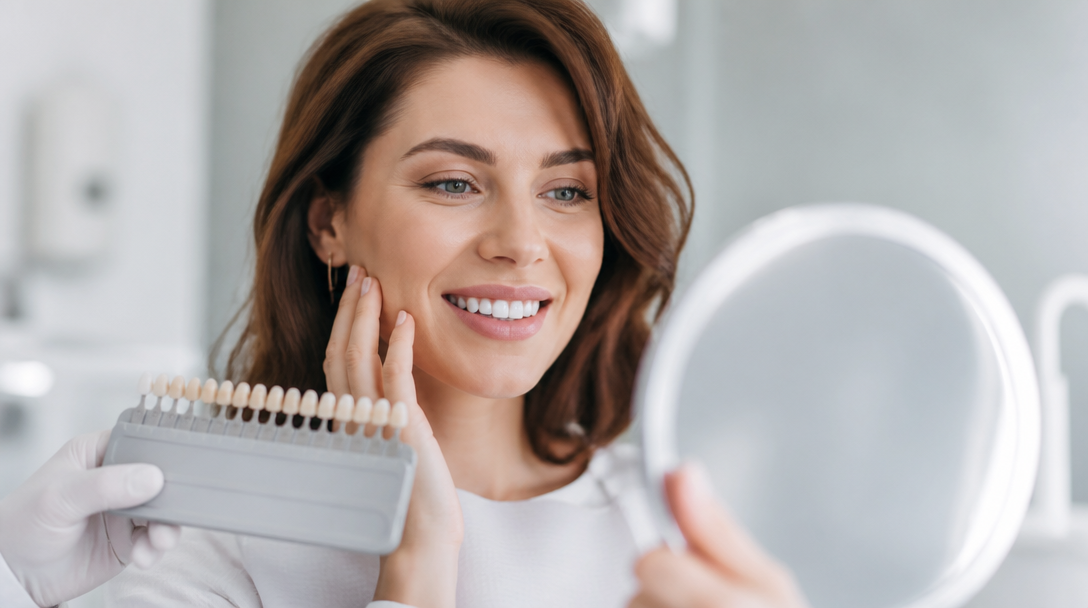
Whitening crowns and veneers is not possible — here's the science behind why, and what people with dental restorations can actually do for a brighter smile.
Whitening Crowns and Veneers: Why It Does Not Work — and What Actually Does
If you have a crown, veneer, or composite bonding and you are considering a whitening treatment, one fact matters before anything else: whitening crowns and veneers is not possible. Not with hydrogen peroxide gels, not with PAP strips, not with any whitening toothpaste currently available. The shade of your restoration was fixed at the dental lab, and no bleaching chemistry changes it. Understanding why — and what options you actually have — will save you frustration, money, and a visibly uneven smile.
Why Whitening Crowns and Veneers Is Not Chemically Possible
Teeth whitening depends on a specific oxidation reaction. Hydrogen peroxide or carbamide peroxide penetrates the outer layer of natural tooth enamel and breaks apart organic stain molecules trapped within it. The entire mechanism rests on one condition: enamel must be present.
Crowns, veneers, and ceramic restorations are made from inorganic materials — porcelain, ceramic, or zirconia. These materials contain no organic stain molecules for a bleaching agent to oxidize. The chemistry has nothing to react with. The American Dental Association states this directly: only natural teeth can be whitened, and tooth-colored restorations do not respond to whitening treatments.
Peer-reviewed research published through NIH/PubMed Central confirms the same mechanism: whitening agents perform their oxidizing reaction on enamel, but they do not alter the color of inorganic dental materials, which retain their original lab-mixed shade permanently.
Natural Enamel vs. Dental Porcelain: A Structural Difference
Natural tooth enamel is a semi-porous biological structure. Over time, pigmented compounds from food, beverages, and tobacco penetrate its microscopic surface layer. Peroxide molecules are small enough to enter that structure and chemically break down those pigments.
Dental porcelain is engineered to be the opposite. Once glazed and fired in a kiln, porcelain and zirconia crowns are non-porous and fully sealed. Their shade is determined entirely by the ceramic powder mixture selected before fabrication — a decision made in the lab, not reversible at home. Research published in the Journal of Prosthodontic Research confirms that whitening gels and toothpastes do not change the shade of porcelain; they can only remove surface debris on natural tooth structure.
This is not a limitation of any particular whitening product. It is a fundamental property of the materials themselves.
Which Restorations Are Affected
The same principle applies across the full range of common dental restorations. None respond to whitening chemistry — though the reasons differ slightly by material.
- Porcelain crowns: Fully ceramic, non-porous, and color-stable once fired. Will not whiten under any bleaching agent.
- Zirconia crowns: Among the densest materials used in dentistry. Completely unaffected by whitening chemistry.
- Porcelain veneers: Thin ceramic shells bonded to the front surface of natural teeth. Their shade is permanent once placed.
- Composite bonding: Made from resin, not ceramic. Also does not respond to bleaching agents — though surface staining may accumulate over time and can sometimes be polished away by a dentist.
- Implant crowns: The crown portion is typically porcelain or zirconia. Whitening has no effect on the crown itself, regardless of product used.
- Tooth-colored fillings: Composite resin will not whiten. These restorations may appear noticeably darker if the surrounding natural teeth are treated.
In every case, the restoration's color was set at the point of manufacture. No at-home or professional whitening product changes that.
What Happens When You Whiten Around Existing Restorations
This is where the problem becomes visible. Whitening your natural teeth while leaving crowns or veneers in place will lighten your enamel — but your restorations will stay exactly the shade they were when placed.
The result is a mismatched smile. Teeth adjacent to a crown or veneer may become noticeably brighter, making the restoration appear darker or more yellow by comparison. Multiple peer-reviewed studies published through NIH/PubMed Central note this outcome directly: restorations appear darker next to newly whitened natural teeth, creating an inconsistent appearance across the smile.
There is a secondary concern with aggressive bleaching near ceramic restorations. Research published in the Journal of Prosthodontic Research found that high-concentration bleaching agents can chemically interact with the surface of ceramic and composite restorations — potentially increasing surface roughness or causing minor material degradation — without producing any whitening effect on the restoration. This is not a reason to avoid whitening altogether, but it is a reason to approach the process with accurate expectations.
How to Plan Whitening When You Have Dental Restorations
Having existing restorations does not take whitening off the table entirely. It means the timing and strategy matter significantly more than they would for someone with an all-natural dentition.
Whiten before new restorations are placed
The standard clinical approach is to complete any whitening treatment before a crown, veneer, or bonding procedure — not after. Once your target shade has been reached and stabilized (this typically requires a few weeks for the shade to settle fully), your dentist can match the new restoration to your whitened natural teeth. This sequencing is the most reliable path to a consistent, uniform result.
Consider shade-matching if replacing existing restorations
If an existing crown or veneer is significantly older and no longer matches your natural teeth — whether because your surrounding teeth have darkened over time or because you have already whitened them — replacement may be the only path to visual consistency. A dentist or prosthodontist can assess whether the mismatch is pronounced enough to warrant that conversation.
Use maintenance whitening carefully around restorations
If your restorations are currently well-matched to your natural teeth and you want to preserve that balance, aggressive whitening of your remaining natural teeth will create a mismatch over time. A low-concentration whitening product used periodically as maintenance can help preserve your current shade without shifting your natural teeth significantly lighter than your restorations.
Ask about professional composite polishing
For composite bonding or resin fillings that have picked up surface staining, professional polishing by a dentist can restore a cleaner, more uniform appearance without any bleaching chemistry. It does not change the underlying shade of the restoration — but it can make a genuine visible difference when surface discoloration is the issue.
When to Speak With a Dentist Before Starting Any Whitening Routine
A conversation with your dentist before starting is particularly important if any of the following apply to you:
- You have crowns or veneers on front teeth that are currently well-matched to your natural smile
- You are planning to get new dental work within the next few months
- You have composite bonding on teeth in your visible smile zone
- You have implant crowns in or near the front of your mouth
- You are not certain which of your teeth are natural and which are restored
A dentist can chart exactly which teeth are natural and which are restored, assess the current shade match across your smile, and advise whether whitening your natural teeth is likely to create a visible mismatch. This is not overly cautious — it is straightforward planning for a predictable outcome.
Setting Realistic Expectations for a Mixed Smile
The goal of any whitening treatment is a smile that looks natural and consistent. When natural teeth and restorations are present in the same mouth, achieving that result requires a clear understanding of what each material can and cannot do.
Whitening crowns and veneers is not achievable through any product currently available. That is not a gap in technology — it reflects the fundamental chemistry of how bleaching agents interact with biological enamel versus inorganic dental ceramics. The ADA's position is unambiguous: only natural teeth respond to whitening treatments.
What is achievable is a well-sequenced approach. Whiten first, then restore. Or maintain carefully to preserve an existing shade match. Or consult a prosthodontist about replacing a restoration that no longer fits your smile's current appearance. None of these paths require elaborate treatment — they require accurate information before you begin.
For people exploring at-home whitening options formulated for natural teeth, WhiteningBright's product range covers both peroxide-based and PAP-based formats, each designed for use on natural tooth enamel. If restorations are part of your picture, start with a dental consultation to establish the right sequence before reaching for any whitening product.
References
- American Dental Association — Oral Health Topics: Whitening
- NIH/PubMed Central — Bleaching Agents and Dental Restorations (Peer-reviewed)
- NIH/PubMed Central — Effects of Bleaching Gels on Composite and Ceramic Restorations (Peer-reviewed)
- NIH/PubMed Central — Dental Aesthetics and Color Consistency in Restored Dentitions (Peer-reviewed)
- Journal of Prosthodontic Research — Whitening Agents and Porcelain Surface Effects (2024)
Disclaimer
This article is for general informational purposes only and is not a substitute for professional dental or medical advice. Always consult a qualified dental professional before starting any teeth-whitening or oral-care regimen. WhiteningBright makes no warranties as to the completeness or accuracy of the information, and any reliance is at your own risk.