LED Mouthpiece Battery Specs That Affect Reorder Timing
28 octobre 2026
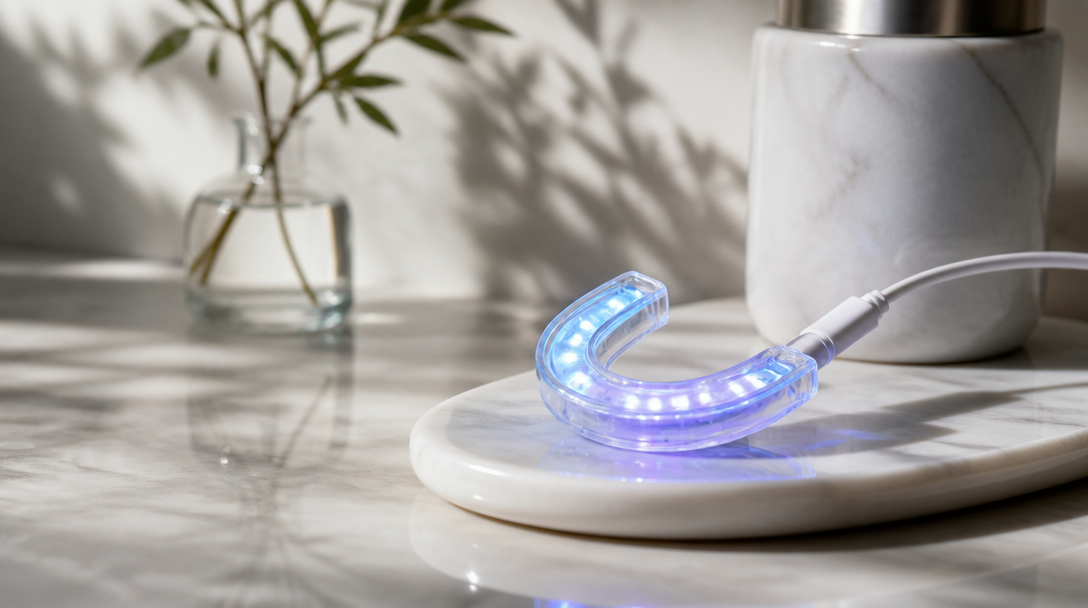
Understand how LED whitening mouthpiece battery specs — capacity, cycle life, and port type — determine reorder timing for B2B buyers and private-label brands.
LED Whitening Mouthpiece Battery Specs Are a Reorder Variable, Not a Hardware Detail
When professional buyers evaluate LED whitening mouthpiece battery specs, the conversation usually stops at voltage and capacity. That is the wrong place to stop. Battery specification determines how long a device performs at clinical intensity, how quickly end clients report degraded results, and — most directly — how fast your reorder cycle moves. For distributors and private-label brand owners building recurring revenue around take-home whitening kits, battery decisions made at sourcing carry downstream consequences that surface in customer service queues and repurchase rates months later.
This is not a consumer maintenance question. It is a product architecture decision that belongs in your sourcing brief before production starts.
Rechargeable vs. Single-Use: What Each Format Signals
Single-use battery formats position the device as a disposable treatment accessory — appropriate for entry-level retail price points or single-session spa kits where the mouthpiece is bundled with a gel sachet and not expected to outlast the whitening course. The reorder model is straightforward: the device goes with the consumable.
Rechargeable lithium-ion cells signal a different product category. They communicate durability, clinical intent, and a longer relationship between the end client and the brand. FDA 510(k) clearance filings for cleared home-use LED light-therapy devices consistently document rechargeable lithium-ion configurations — with capacities ranging from 650 mAh through 2,500 mAh across cleared devices — reflecting where the regulated market has standardized.
For private-label brand owners supplying dental clinics or premium direct-to-consumer wellness channels, rechargeable is the expected format. The reorder model shifts accordingly: the device carries a defined cycle life, and replacement timing becomes a predictable, manageable variable rather than an immediate consumable trigger.
Cycle Life Claims: What Suppliers State vs. What to Verify
Cycle life — the number of full charge-discharge cycles a lithium cell delivers before capacity degrades below a usable threshold — is where supplier spec sheets and real-world performance diverge most often. A stated cycle life figure means little without knowing the test conditions: discharge rate, ambient temperature, depth of discharge, and whether the figure represents capacity at 80% retention or full depletion.
When reviewing supplier documentation, request the following:
- Test standard referenced: IEC 62133-2 is the applicable international safety standard for portable rechargeable lithium batteries and appears in multiple FDA 510(k) filings for cleared LED light-therapy devices. If a supplier cannot reference this standard, treat the cycle life claim as unverified.
- Capacity retention threshold: At what percentage of original capacity does the stated cycle count end? Eighty percent is a widely used industry threshold, but confirm it in writing before treating it as a contract term.
- Test discharge rate: A cell cycled at a low discharge rate produces a higher cycle count than one tested under the actual power draw of an active LED array. Confirm the test mirrors real device operating conditions.
Cycle life claims that cannot be tied to a named test standard and a documented retention threshold should not anchor a reorder timeline or a warranty period. Request the battery cell's own datasheet from the supplier, separate from the device spec sheet.
USB-C vs. Proprietary Charging: How Port Choice Affects LED Whitening Mouthpiece Battery Specs and Returns
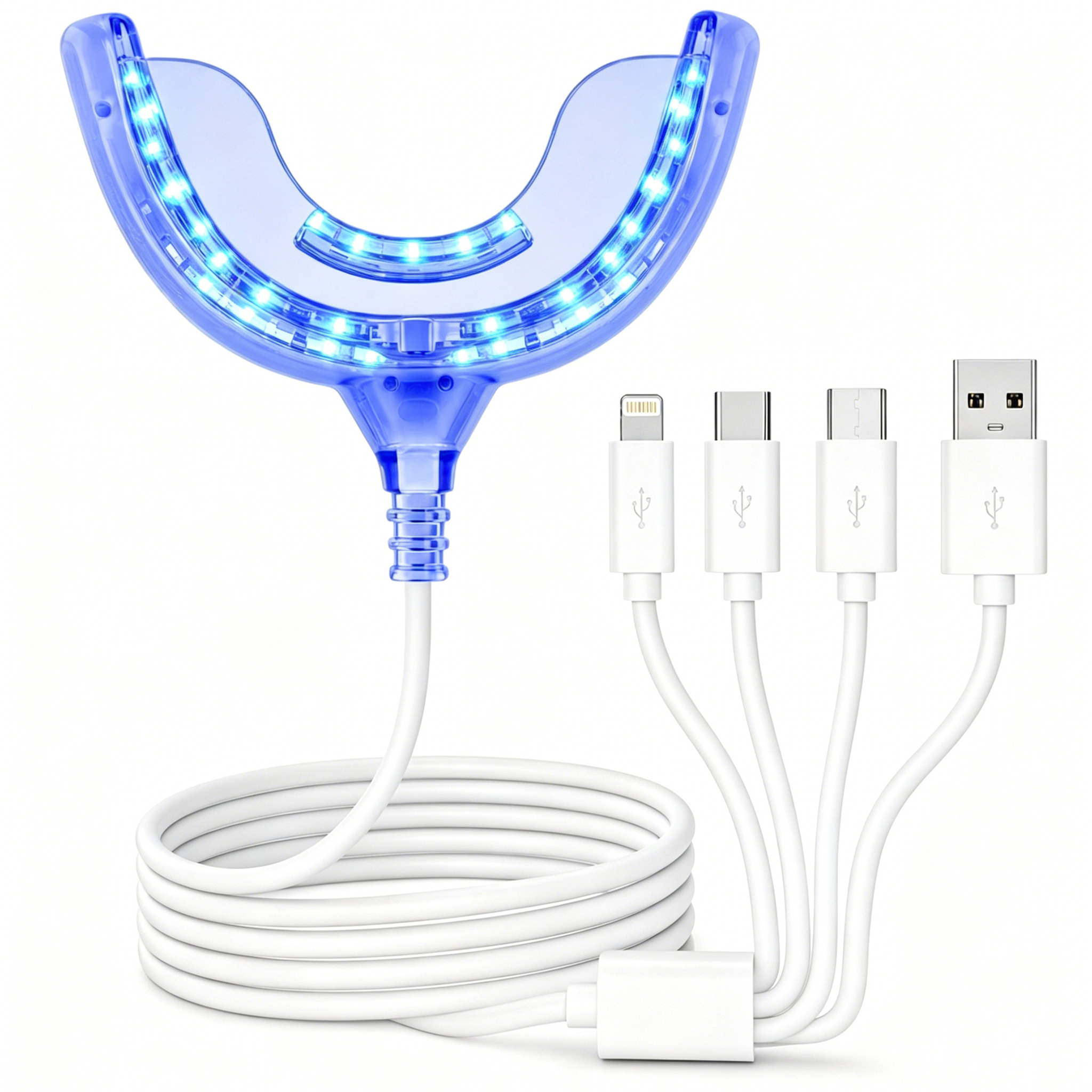
Charging port selection is a sourcing decision with direct customer service consequences. Proprietary charging cables are among the most common causes of post-sale complaints on LED whitening devices: cables are lost, damaged, or incompatible with replacement units when a client reorders. Each complaint represents a support cost and a friction point against repurchase.
USB-C has become the standard charging interface for regulated home-use LED devices. FDA filings for cleared LED light-therapy devices document 5 V/1 A input specifications — a profile fully compatible with standard USB-C power delivery. Designing your private-label device around USB-C eliminates cable dependency, reduces return rates tied to charging failures, and aligns with regulatory direction in both the EU — where USB-C is mandated for portable electronics under the Common Charger Directive — and the US market.
If a supplier proposes a proprietary port on cost grounds, calculate the downstream cost in returns and replacement cable fulfillment before accepting that trade-off. For professional channels — dental clinic retail, premium pharmacy, or direct-to-consumer subscription — the support overhead of a proprietary cable typically exceeds the unit-cost saving at volume.
Battery Capacity and Session Length: Matching mAh to Treatment Protocol
Capacity — measured in milliampere-hours (mAh) — determines how much energy the battery stores and, combined with the LED array's power draw, how many sessions a full charge delivers. FDA 510(k) filings for cleared LED light-therapy devices document a range of rechargeable lithium-ion configurations: 650 mAh, 1,000 mAh, 1,300 mAh, 2,500 mAh, and other capacities appear across cleared devices, illustrating the breadth of design choices available at the sourcing stage.
For LED whitening mouthpiece battery specs, the practical calculation works as follows:
- Establish session duration: Most at-home whitening protocols run between 10 and 20 minutes per session. Confirm the treatment protocol your end client or clinical partner recommends before finalizing capacity requirements.
- Confirm LED power draw: The mouthpiece LED array's wattage, combined with any onboard electronics, determines current draw per session. This figure should appear in the device engineering file.
- Calculate sessions per charge: Divide usable capacity — applying a conservative efficiency factor — by per-session energy consumption. This produces a realistic sessions-per-charge figure, not a marketing number.
- Map to treatment course length: A standard whitening course may span 7 to 14 consecutive days. A device that requires recharging mid-course creates a compliance gap. Capacity should support the full course on a single charge or a clearly communicated charging schedule.
A 1,300 mAh cell and a 2,500 mAh cell are not interchangeable decisions. The higher-capacity cell supports longer courses without recharging and degrades more slowly under frequent use — both factors that shape how quickly an end client perceives the device as underperforming and initiates a replacement conversation.
Regulatory Checkpoints: Lithium Cell Compliance for EU, US, and Cross-Border Shipments
Lithium batteries in consumer-facing devices carry regulatory obligations that affect import clearance, air freight eligibility, and market authorization. Buyers sourcing LED mouthpiece devices for cross-border distribution need compliance verified at the cell level, not just the finished-device level.
Key compliance checkpoints:
- IEC 62133-2: The international safety standard for portable sealed secondary lithium cells and batteries. Multiple FDA 510(k) clearance filings for LED light-therapy devices cite IEC 62133-2 testing as part of the safety evaluation. This certification should be documented for any lithium cell used in your private-label device.
- IEC 60601-2-83: Referenced in FDA filings for home light-therapy equipment, this standard covers particular requirements for home healthcare equipment. Relevant when the device is positioned for clinical recommendation or professional retail.
- ISO 10993-1: Biocompatibility evaluation standard cited in FDA filings for wearable LED devices. For a mouthpiece in contact with oral tissue, biocompatibility documentation is non-negotiable on both FDA and CE pathways.
- UN 38.3: Transport testing for lithium batteries, required for air freight of lithium-containing devices. Confirm this certification before committing to an air-freight logistics model.
- EU Common Charger Directive: Mandates USB-C for portable electronic devices sold in the EU. Proprietary charging ports create a direct compliance barrier for EU distribution.
Request copies of all test reports — not declarations of conformity alone — before finalizing a sourcing agreement. A declaration without a supporting test report is not a compliance document.
Locking LED Whitening Mouthpiece Battery Specs Into Your Private-Label Agreement
Battery specification drift is a documented sourcing risk. A supplier may substitute a lower-capacity cell, switch battery manufacturers, or alter the charging circuit between your approval sample and full production run — without notification — when the agreement does not explicitly prohibit it. For private-label brand owners, this creates quality and liability exposure, not just a performance inconvenience.
Name the following battery parameters explicitly in your co-developed private-label supply agreement:
- Cell chemistry (lithium-ion or lithium-polymer)
- Nominal voltage (e.g., 3.7 V)
- Rated capacity in mAh
- Charging input specification (voltage, amperage, port type)
- Approved battery manufacturer or manufacturer list
- Required safety certifications, with IEC 62133-2 as the minimum
- Mandatory notification and approval process for any component substitution
Build a pre-production verification step into your QC process. Measure actual capacity against spec on a sample from each production batch. Capacity that measures materially below the stated mAh at incoming inspection is a leading indicator of accelerated cycle degradation in the field — and an unplanned early reorder trigger.
Connecting Battery Spec to Reorder Forecasting
Once you have verified capacity, cycle life, and session-length data, reorder timing becomes a calculable estimate rather than a guess. A device with a documented cycle life, used on a defined treatment protocol, reaches the point of perceived underperformance — typically when the end client notices shorter session runtimes or incomplete charges — within a predictable window. That window is your reorder signal.
For distributors managing clinic accounts or subscription retail programs, building this timeline into your account management cadence — proactive outreach before the device degrades noticeably — converts a reactive replacement sale into a planned replenishment. Battery spec, properly understood, is the foundation of that model.
Battery specifications referenced in this article are drawn from publicly available FDA 510(k) clearance filings for LED light-therapy devices, including K241857, K254079, K243423, K253400, K261601, and K250880. These filings document rechargeable lithium-ion configurations and applicable safety standards for cleared home-use LED devices.
References
- FDA 510(k) Clearance Filing K241857 — LED Light Therapy Device: rechargeable 1,300 mAh lithium-ion battery, 5 V/1 A input, safety testing documentation.
- FDA 510(k) Clearance Filing K254079 — LED Light Therapy Mask: rechargeable lithium battery, IEC 62133-2 safety standard testing.
- FDA 510(k) Clearance Filing K253400 — LED Light Therapy Face Mask: built-in rechargeable lithium battery, IEC 62133-2 and ISO 10993-1 evaluations.
- FDA 510(k) Clearance Filing K261601 — LED Light Therapy Mask: comparison of 650 mAh and 1,000 mAh rechargeable lithium-ion battery configurations.
- FDA 510(k) Clearance Filing K250880 — LED Light Therapy Device: built-in rechargeable 3.7 V, 2,500 mAh lithium-ion battery specification.
Disclaimer
This article is for general informational purposes only and does not constitute sourcing, legal, or regulatory advice. Always conduct your own due diligence and consult qualified legal or compliance professionals before making purchasing or compliance decisions. WhiteningBright makes no warranties as to the completeness or accuracy of the information, and any reliance is at your own risk.