Viscosity Drift: Why Bulk Gel Specs Shift After Shipping
9 septembre 2026
Learn why bulk whitening gel viscosity stability shifts between dispatch and delivery — and the contractual and QC controls that close the gap.
Viscosity Drift: Why Bulk Gel Specs Shift After Shipping
Why the CoA at Dispatch Is Not the Spec at Delivery
For professional buyers sourcing bulk whitening gel — whether for a dental clinic network, a private-label retail line, or a regional distribution program — the Certificate of Analysis issued at dispatch is not a guarantee of what arrives on-site. Bulk whitening gel viscosity stability is a function of formulation chemistry, packaging integrity, and the thermal history a product accumulates between the supplier's facility and your receiving dock. That gap between CoA and reality is where clinical liability and retail quality failures originate.
Temperature excursions during transit are the primary driver. FDA stability guidance recommends testing formulations at 25°C and at accelerated conditions of 37°C to 40°C precisely because heat stress changes formulation behavior over time. A gel that passes specification at dispatch can arrive with measurably different flow properties, pH, and active concentration — none of which are visible on the label.
Understanding the mechanisms behind these shifts, and building contractual and testing controls around them, separates a reliable supply chain from one that generates chargebacks, clinical complaints, or regulatory exposure.
Viscosity Windows and Bulk Whitening Gel Viscosity Stability: What the CoA Number Actually Means
Viscosity on a CoA is typically reported as a single value or a target range, measured at a controlled temperature — usually 20°C to 25°C — at the time of manufacture. That number does not reflect how the gel will behave after 72 hours in an unrefrigerated freight container or a last-mile delivery van in summer.
Published research confirms that viscosity in gel formulations declines over time, and that the rate of decline accelerates at higher storage temperatures, with the most pronounced changes occurring at 40°C — conditions that are not unusual in cross-continental or sea-freight shipping without active temperature control. Conversely, research on dental gel products demonstrates that low temperatures increase viscosity, and that products removed from cold storage may not return to baseline flow behavior immediately. The result is a product that behaves differently at every point in the logistics chain.
For dispensing formats, the practical consequences differ by product type:
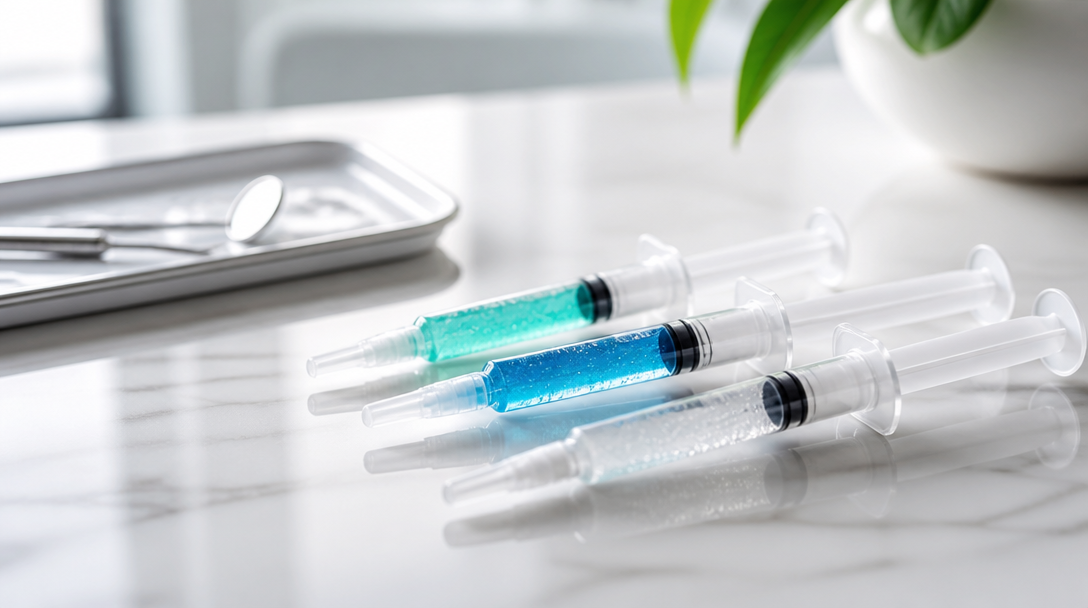
- Pre-filled syringes: Viscosity drop increases the risk of gel migration beyond the tray margin, raising mucosal contact risk in clinical settings.
- Bulk drums for in-clinic filling: Viscosity increase from cold-chain disruption makes accurate volumetric dispensing inconsistent across units.
- Pre-filled trays: Thin gel redistributes during storage, creating uneven active-agent distribution across the arch.
When reviewing a supplier's CoA, request the viscosity specification as a range with defined upper and lower limits — not a single target value. Confirm the measurement temperature and the rheometer method used. A CoA that reports viscosity without method detail is not a reliable quality document.
pH Drift: Acceptable Ranges and When to Reject
pH is a stability marker that professional buyers consistently underweight relative to viscosity. In whitening gel formulations, pH governs both the stability of the active agent and the safety profile at point of use. Peroxide-based gels are typically formulated within a controlled acidic to near-neutral range. PAP-based formulations operate under different pH conditions. In both cases, drift outside the intended window compounds clinical and regulatory risk.
Physicochemical stability reviews confirm that gel performance depends on environmental conditions — including temperature — that directly affect pH maintenance over time. A thermal excursion that accelerates peroxide decomposition also shifts the pH of the surrounding gel matrix as decomposition byproducts accumulate. The result: a product that reads within viscosity specification but sits outside pH specification — a combination easy to miss when incoming QC checks only one parameter.
Practical rejection thresholds belong in your purchase agreement before the first order ships:
- Request the supplier's validated pH range from their stability study, not just the nominal pH.
- Define a maximum allowable drift from nominal as a contractual acceptance criterion at point of receipt.
- Treat any lot arriving outside that window as non-conforming, regardless of the original CoA value.
A supplier unable to provide a validated pH stability range across their claimed shelf life is signaling that no formal stability study was conducted. That is a sourcing risk, not a negotiating point.
Active Concentration Degradation: Peroxide vs. PAP Stability Profiles
Active concentration determines whether a product performs as labeled — and it is the specification most sensitive to thermal history. The two primary active systems in professional whitening gel behave differently under stress.
Hydrogen Peroxide and Carbamide Peroxide
Peroxide-based actives are inherently unstable under heat and light exposure. FDA accelerated stability testing at 37°C to 40°C is specifically designed to model the stress that shipping conditions impose on these formulations. A product labeled at a given peroxide concentration can arrive meaningfully below that concentration after an uncontrolled transit — reducing clinical efficacy with no visible indication of degradation.
For buyers sourcing peroxide gels, the relevant contractual specification is not just the labeled concentration but a minimum acceptable concentration at point of receipt, verified by titration or an equivalent validated analytical method.
PAP (Phthalimidoperoxycaproic Acid)
PAP formulations are increasingly specified by buyers serving markets where peroxide concentration limits apply — the EU, for example — or by retail brands positioning around enamel-safe messaging. PAP carries a different degradation profile than peroxide, but it is not immune to temperature-driven instability. Gel physicochemical stability research confirms that the overall performance of gel delivery systems depends on maintaining the active agent within its stable concentration range across the product's full shelf life.
When co-developing a PAP-based private-label formula, require stability data specific to the PAP active — not generic gel stability data — at both long-term and accelerated storage conditions aligned with ICH guidelines.
Cold-Chain Requirements by Format: Syringes, Bulk Drums, and Pre-Filled Trays
Cold-chain requirements are not uniform across whitening gel formats. Buyers who apply a single shipping specification across all formats will either over-specify — increasing logistics cost — or under-specify, accepting avoidable degradation risk.
Research confirms that low-temperature storage increases viscosity in gel and dental adhesive products, and that equilibration after removal from refrigeration is not instantaneous. This has direct implications for how pre-filled syringes and trays should be conditioned before clinical use, and for how suppliers should document equilibration requirements on product labeling and technical data sheets.
| Format | Primary Stability Risk | Recommended Transit Condition | Key Incoming Check |
|---|---|---|---|
| Pre-filled syringes | Viscosity drop, active degradation | Controlled cool; avoid freeze | Viscosity, active concentration |
| Bulk drums | pH drift, stratification | Ambient with thermal monitoring | pH, homogeneity, viscosity |
| Pre-filled trays | Gel migration, active loss | Refrigerated or controlled cool | Visual distribution, active concentration |
For every format, require the supplier to include temperature indicator logs or calibrated data loggers with each shipment. A CoA without a corresponding transit temperature record is an incomplete quality document for a temperature-sensitive product.
What to Write Into a Purchase Agreement to Lock Specs at Point of Receipt
The single most actionable step a professional buyer can take is shifting the specification compliance point from dispatch to receipt. Most standard supplier agreements define conformance at the time of manufacture. That protects the supplier. A well-structured agreement protects the buyer.
A purchase agreement for bulk whitening gel should include:
- Point-of-receipt specification table: Define viscosity range, pH range, and minimum active concentration as acceptance criteria measured upon delivery — not at manufacture.
- Analytical method references: Specify the test methods for each parameter — rotational viscometry at a defined temperature, potentiometric pH measurement, iodometric or HPLC titration for peroxide concentration.
- Transit temperature documentation: Require calibrated data logger records for every shipment. Define the maximum allowable temperature excursion and duration before a lot is automatically placed on hold.
- Shelf life at receipt: Specify a minimum remaining shelf life at point of delivery — expressed as a percentage of total labeled shelf life — to ensure usable product life after import processing and distribution.
- Non-conforming lot protocol: Define the process for lot rejection, replacement, and cost allocation before a dispute arises, not during one.
- Stability study access: Require the supplier to provide ICH-aligned stability study data on request, confirming that the labeled shelf life is supported by real data at defined storage conditions.
Incoming QC Protocol: Four Tests Before Accepting Any Bulk Order
Regardless of supplier reputation or prior order history, incoming QC on bulk whitening gel should be standardized. A supplier's CoA confirms what left their facility. Your incoming protocol confirms what you are accepting into inventory — and what your customers or clinical staff will use.
1. Viscosity Measurement
Use a calibrated rotational viscometer at the temperature specified in your purchase agreement. Compare the result against the contracted range. Bulk whitening gel viscosity stability across consecutive lots is your baseline for detecting supply chain problems before they reach end users. Document and retain results by lot number.
2. pH Verification
Use a calibrated pH meter with an electrode appropriate for gel matrices. A single-point measurement is sufficient for incoming QC. Compare against the contracted pH range and flag any out-of-range lot for hold and immediate supplier notification.
3. Active Concentration Assay
For peroxide-based gels, iodometric titration is a well-established method accessible to most quality labs. For PAP formulations, confirm the appropriate analytical method with the supplier during onboarding. Do not accept a claim that active concentration cannot be independently verified — it can be, and any supplier resistant to that position warrants scrutiny.
4. Visual and Physical Inspection
Check for phase separation, color change, particulate matter, and — for pre-filled formats — gel distribution uniformity and packaging seal integrity. These indicators are low-cost, require no instrumentation, and catch the most severe degradation events before a lot enters inventory.
Buyers building or scaling a private-label whitening line can reference WhiteningBright's formulation and format options to understand how stability specifications are structured across different delivery systems before engaging a supplier.
The Takeaway
Bulk whitening gel viscosity stability is not a formulation problem that resolves itself after delivery. It is a supply chain management problem — one that requires contractual specificity, format-appropriate transit controls, and a non-negotiable incoming QC standard. The CoA at dispatch is a starting point, not a guarantee.
Buyers who define acceptance criteria at point of receipt, require transit temperature documentation, and run four basic incoming tests on every lot will catch specification drift before it becomes a clinical complaint, a regulatory notice, or a damaged retail relationship.
References
- FDA Guidance for Industry #5 — Drug Stability Guidelines. U.S. Food and Drug Administration.
- FDA Q1A(R2) — Stability Testing of New Drug Substances and Products. U.S. Food and Drug Administration.
- Viscosity decline over time at elevated storage temperatures in gel formulations — Table 7. PubMed Central.
- Gels as Promising Delivery Systems: Physicochemical Stability and Environmental Factors. PubMed Central.
- Controversies about refrigeration of dental adhesives: a review. Nature / British Dental Journal.
Disclaimer
This article is for general informational purposes only and does not constitute sourcing, legal, or regulatory advice. Always conduct your own due diligence and consult qualified legal or compliance professionals before making purchasing or compliance decisions. WhiteningBright makes no warranties as to the completeness or accuracy of the information, and any reliance is at your own risk.