FDA teeth whitening regulations 2026 shape every product on the shelf between you and a brighter smile—yet most consumers have never read a single line of them. Americans spend over $3.67 billion annually on whitening products, from drugstore strips to in-office laser treatments, but the regulatory framework governing these products remains one of the least understood corners of the oral care market. That gap creates real risk: mislabeled concentrations, unverified claims, and ingredients that could damage enamel permanently.
This guide breaks down exactly what the FDA says in 2026, what it does not say, and what that silence means for your teeth.
The Regulatory Gray Area: Why FDA Teeth Whitening Regulations 2026 Are So Complex
The U.S. Food and Drug Administration does not regulate teeth whitening through a single, unified rulebook. Instead, as The FDA Law Blog documented, the agency treats peroxide-containing tooth whiteners as occupying a "regulatory gray area"—products that are neither clearly drugs nor clearly cosmetics. This status has remained unchanged, requiring case-by-case evaluation for each formulation and its marketing claims.
In 2026, that ambiguity still governs the market. The core legal question is deceptively simple: does the product affect the structure or function of the body? If yes, the Federal Food, Drug, and Cosmetic Act classifies it as a drug. If it only alters appearance without physiological change, it qualifies as a cosmetic. Whitening agents using peroxide-based oxidation sit right on that boundary—because oxidation is a biochemical process that changes tooth color at a molecular level.
The American Dental Association has formally petitioned the FDA to establish clearer classification standards for bleaching agents, a step the agency has not yet taken. Until that petition is acted upon, manufacturers—and consumers—navigate a framework built on interpretation, not explicit rules.
For brands selling whitening products in 2026, the practical consequence is significant. A product claiming to "remove surface stains" may qualify as a cosmetic. The same formula marketed as "bleaching deeper discoloration" may trigger drug-level scrutiny, requiring premarket review, safety data, and establishment registration. The label wording drives the classification—not the chemistry alone.
Peroxide Concentration Limits Under FDA Teeth Whitening Regulations 2026
The single most common question consumers ask is: how much peroxide is actually legal? The honest answer is that the FDA does not publish a universal cap on hydrogen peroxide concentration for whitening products the way the European Union does.
The EU strictly limits hydrogen peroxide in OTC whitening products to 0.1%, with professional-grade products capped at 6%—and those are available only through licensed dental practitioners. The United States takes a fundamentally different approach. According to Teeth Whitening Smile, FDA compliance focuses on labeling accuracy, establishment registration, and safety data sheets rather than concentration thresholds. There is no federal rule that prohibits a 14% hydrogen peroxide strip from sitting on a drugstore shelf next to a 3% version.
In practice, the market has developed informal concentration tiers that align with FDA's classification logic:
OTC consumer products: Hydrogen peroxide from 3% to 14%, or carbamide peroxide from 10% to 22%—sold without a prescription, regulated primarily through labeling requirements
Professional in-office treatments: Hydrogen peroxide from 25% to 40%, or carbamide peroxide equivalents—applied under dentist supervision and frequently paired with light or heat activation
Cosmetic whitening products: PAP-based or low-peroxide formulas positioned as cosmetics, not subject to drug premarket approval
The ADA advises that carbamide peroxide below 10%—or hydrogen peroxide below 3%—is generally appropriate for unsupervised home use. Concentrations above those thresholds carry a documented risk of enamel erosion and pulpal sensitivity when used incorrectly or excessively.
The FDA has recognized the ISO 28399:2011 standard for external tooth bleaching products, as listed in FDA Recognized Consensus Standards. That standard defines requirements for professional and consumer products alike, covering packaging integrity, labeling clarity, and stability testing. Manufacturers who voluntarily comply with this standard signal a higher level of accountability—even when the FDA does not explicitly mandate it.
Photo by Marta Branco on Pexels
Cosmetic vs. Drug Classification: The Label Determines the Rules
Photo by www.kaboompics.com on Pexels
Whether a whitening product is classified as a cosmetic or a drug has sweeping implications for testing, safety, and what you can legally claim on the package. Under FDA teeth whitening regulations 2026, this classification hinges almost entirely on intended use as communicated through labeling and marketing.
A cosmetic product does not require premarket approval. The manufacturer is responsible for ensuring safety, but no independent federal review is required before the product reaches store shelves. A drug product, by contrast, must meet Current Good Manufacturing Practice (cGMP) standards, register the manufacturing establishment with the FDA, and in many cases submit safety and efficacy data for review.
The practical implication: two strips with identical hydrogen peroxide concentrations can be regulated completely differently based on how the company writes its product claims. "Brightens the appearance of teeth" is a cosmetic claim. "Whitens teeth by bleaching" crosses into drug territory. The FDA Law Blog has specifically flagged this wording sensitivity as a core driver of the gray area problem—and in 2026, enforcement action remains reactive rather than systematic.
For you as a consumer, the Drug Facts panel is your most reliable signal. If the product box includes a Drug Facts panel listing an active ingredient—typically hydrogen peroxide or carbamide peroxide with a specific percentage—the manufacturer has classified it as an OTC drug. If the label only displays a standard ingredient list in INCI format, the product is positioned as a cosmetic. Neither is inherently safer, but the drug classification means the company has accepted higher regulatory obligations.
How LED Whitening Devices Fit Into the Regulatory Framework
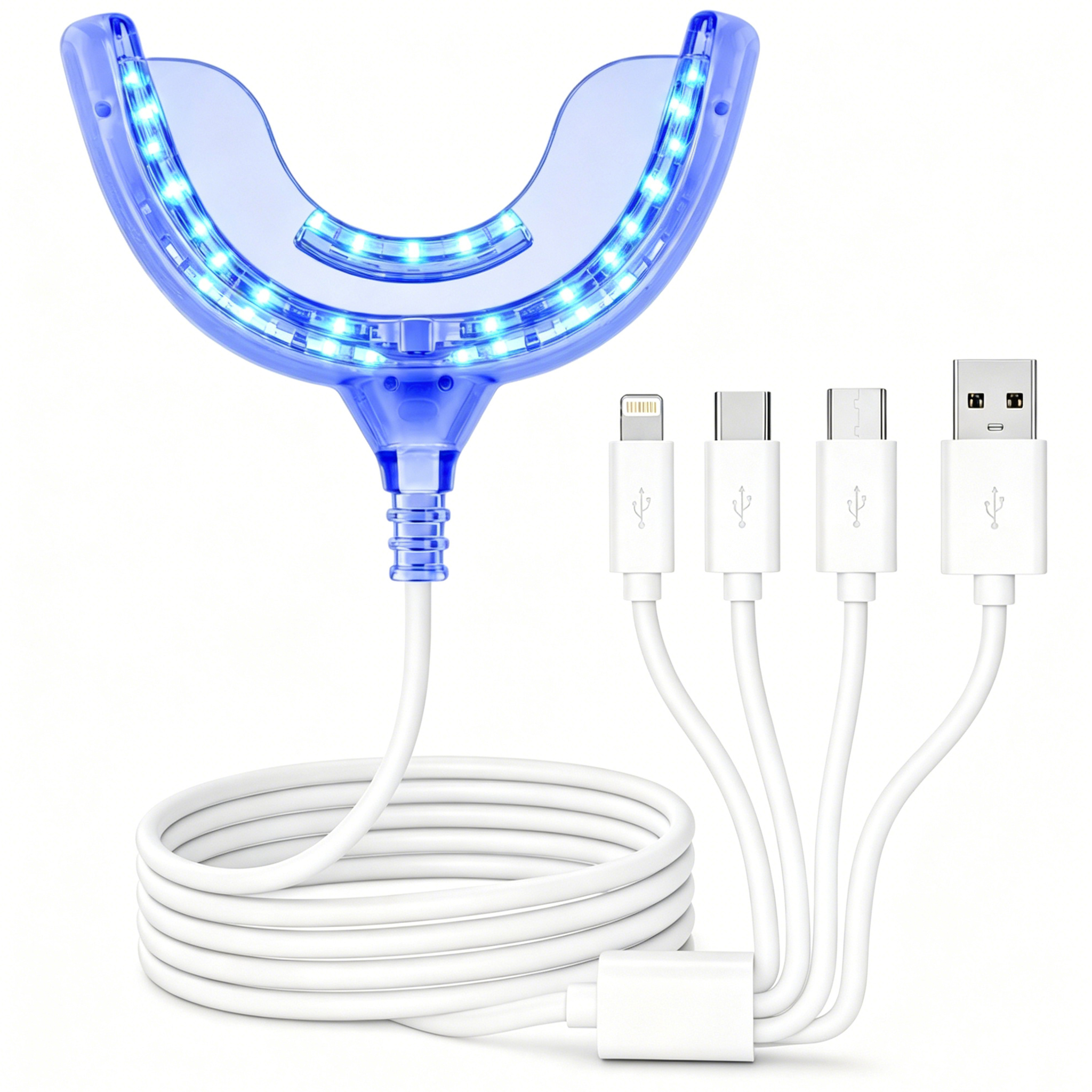
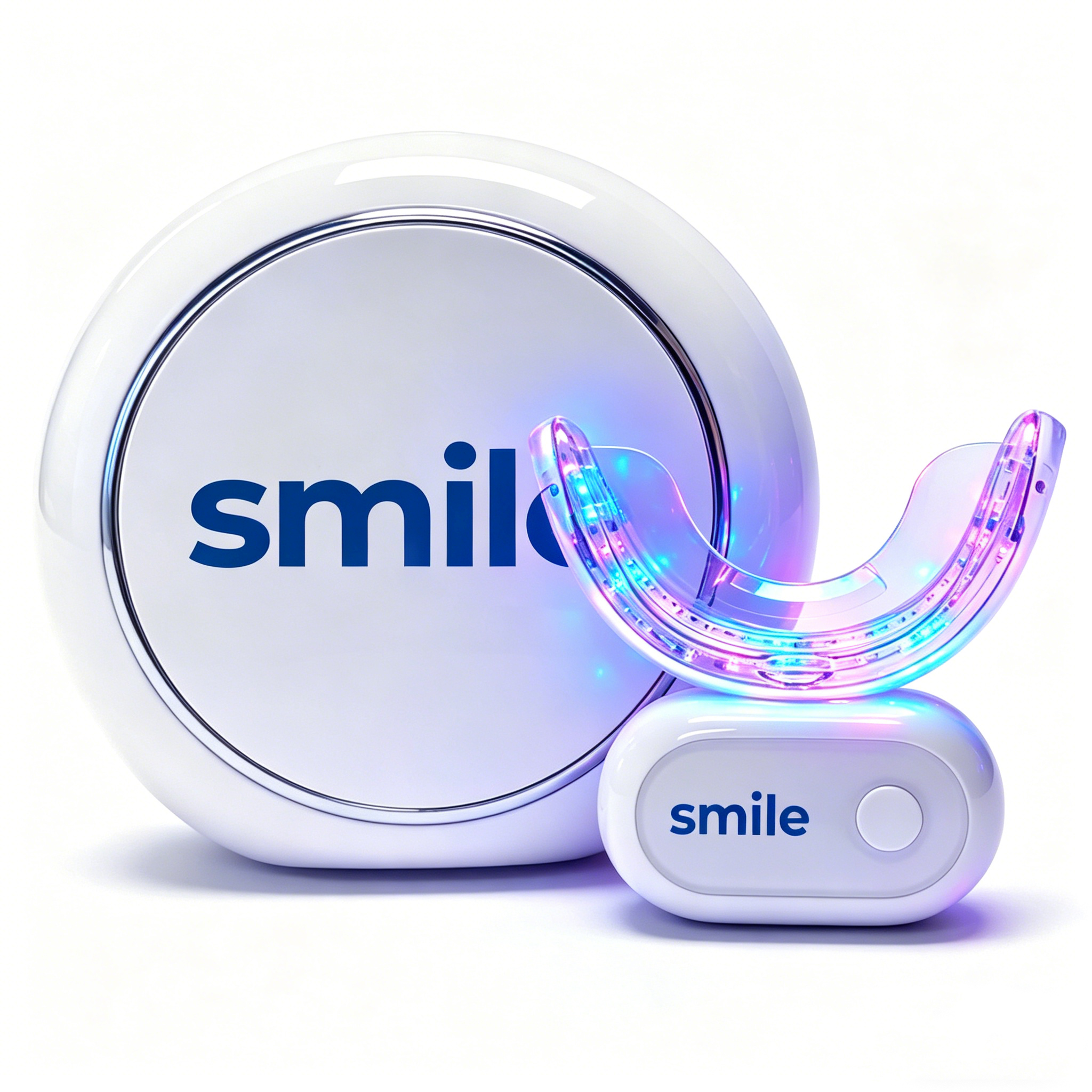
LED-activated whitening kits represent one of the fastest-growing segments of the whitening market in 2026. These devices combine a light-emitting mouthpiece with a peroxide or PAP gel, claiming to accelerate the whitening reaction. But the device component adds a separate regulatory layer entirely.
According to Registrar Corp, LED whitening devices may be classified as Class I or Class II medical devices under FDA regulations, depending on their design and intended use. Class I devices face the lightest regulatory burden—general controls like establishment registration and device listing. Class II devices require a 510(k) premarket notification, demonstrating substantial equivalence to a legally marketed predicate device.
The gel or whitening agent that accompanies the device carries its own separate classification as either a drug or cosmetic. This means a single LED whitening kit on the market may actually involve compliance under two distinct FDA regulatory pathways simultaneously. Brands that cut corners on either pathway create products that carry compounded risk. For a deeper look at how manufacturing standards intersect with device safety, see oral care production and quality control standards covered in our manufacturing series.
In-office LED and laser systems used by licensed dentists operate under professional supervision, which the FDA acknowledges as a meaningful safety control. Mainstreet Dental reports that professional whitening in 2026 achieves four to eight shades of improvement in a single session and results typically last six to twelve months—outcomes that reflect both higher-concentration chemistry and supervised application technique.
Non-Dentist Whitening Services: A Regulatory Loophole That Still Exists
Walk into a mall kiosk, a spa, or a teeth whitening bar in 2026, and you may be surprised to learn that the person holding the whitening tray near your mouth holds no dental license—and does not legally need one in many states.
As BleachBright notes, the FDA does not govern cosmetic teeth whitening services. Because services (as opposed to products) fall outside the FDA's product jurisdiction, and because dental boards regulate only licensed dental professionals, a significant service-level gap exists. Non-dentist whitening businesses operate legally in many jurisdictions by using cosmetic-classified products and avoiding any clinical claim about treating dental conditions.
This is not a new loophole—it has existed for years—but in 2026 the non-dentist whitening service sector has grown substantially, raising consumer safety questions. The concentration of peroxide available in these settings varies widely. Some operators use professional-strength gels without the clinical training to manage adverse reactions like chemical burns to soft tissue or acute pulpal pain.
State dental boards have moved at different speeds to address this gap. Several states have issued cease-and-desist orders to non-dentist whitening operators, while others have explicitly ruled that cosmetic whitening does not constitute the practice of dentistry. The FDA's position—that it does not regulate these services—leaves consumers exposed to variable standards depending entirely on geography.
For a broader view of how industry trends and regulatory developments intersect, our oral care industry news and regulatory updates section tracks these developments as they evolve.
Novel Ingredients: PAP, Hydroxyapatite, and How the FDA Evaluates Them
The whitening market in 2026 has moved well beyond simple peroxide strips. Phthalimidoperoxycaproic acid (PAP), nano-hydroxyapatite, and activated charcoal now appear in premium whitening products marketed as gentler, enamel-safe alternatives. But how does the FDA evaluate these newer ingredients?
PAP is a peracid that oxidizes chromogenic stain molecules without releasing free radicals the way hydrogen peroxide does. Because PAP does not penetrate the enamel in the same manner as peroxide, some manufacturers argue their PAP-based products do not affect tooth structure and therefore qualify as cosmetics. The FDA evaluates this argument case by case. If a brand claims "clinical-grade whitening" or "four shades lighter in 14 days," those outcome-based claims invite drug-level scrutiny regardless of the active ingredient used.
Hydroxyapatite is a biocompatible calcium phosphate mineral that constitutes roughly 97% of tooth enamel by weight. When used in whitening formulas, it is positioned as a remineralizing agent that fills microscopic enamel lesions and reduces post-whitening sensitivity. The FDA has not established a specific regulatory category for hydroxyapatite in whitening products, but when combined with peroxide, the total formulation's classification reflects its combined intended use.
Brands combining these ingredients must ensure that their labeling, safety data sheets, and establishment registration all comply with FDA expectations. According to Registrar Corp, any therapeutic claim—including "strengthens enamel" or "reduces sensitivity"—triggers drug-level compliance requirements, including adverse event reporting protocols. Understanding how ingredient science aligns with regulatory standards is explored further in our professional knowledge resources on whitening science and ingredient safety.
What Consumers Should Actually Check Before Buying a Whitening Product in 2026
Given the complexity of FDA teeth whitening regulations 2026, the most practical question is: what does a safe, compliant product actually look like on the shelf?
Start with the label. A product regulated as an OTC drug must display a Drug Facts panel. That panel will list the active ingredient, its concentration, directions for use, warnings, and inactive ingredients. If you do not see a Drug Facts panel on a product claiming to bleach or whiten teeth, that is a red flag worth investigating before purchase.
Check the concentration against established safety thresholds. The ADA's guidance supports unsupervised use of products containing up to 10% carbamide peroxide or 3.5% hydrogen peroxide. Products above those concentrations should include explicit sensitivity warnings and ideally pair the whitening agent with potassium nitrate or fluoride for enamel protection.
Look for ADA Seal of Acceptance or third-party testing certifications. The ADA Seal is awarded only after independent evaluation of safety and efficacy claims. While not every safe product carries the Seal—the application process is voluntary and carries a cost—its presence provides meaningful assurance.
Verify the manufacturer's establishment registration. The FDA maintains a public database of registered cosmetic and drug manufacturers. If a whitening brand has no establishment registration, it has bypassed a core compliance requirement under FDA teeth whitening regulations 2026.
When in doubt, consult a dentist before beginning any whitening regimen—especially if you have existing restorations, enamel erosion, active caries, or gingival recession. No regulatory framework substitutes for professional clinical judgment applied to your specific oral health profile.
This article is for informational purposes only. The content is based on publicly available information, industry research, and scientific studies. LLRNCARE makes no representations or warranties of any kind, express or implied, about the completeness, accuracy, reliability, suitability or availability of the information contained in this article. Any reliance you place on such information is strictly at your own risk.
For professional dental advice, please consult a qualified dental professional. For regulatory compliance questions, consult with legal experts familiar with dental product regulations in your target markets.