How Fast Does In-Office Whitening Actually Work
July 7, 2026
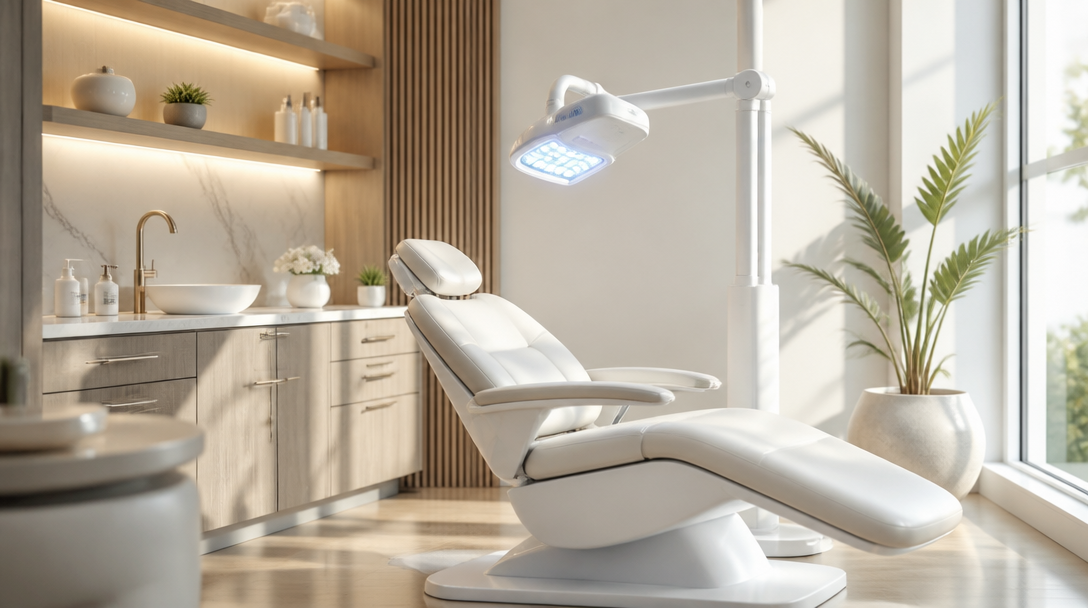
Understand in-office whitening results speed vs. at-home methods — how many shades, how fast, and when each approach makes sense for you.
In-Office Whitening Results Speed: What Actually Happens in the Chair
If you have an event in two days and want visibly whiter teeth, you need a straight answer on in-office whitening results speed — not a sales pitch. The short answer: yes, a single in-office session delivers genuinely different, measurably faster results than anything you can achieve at home. The fuller answer is about understanding why that speed exists, what it actually produces, and whether it matches your situation.
What Happens During an In-Office Session
A standard in-office whitening appointment runs roughly one hour from start to finish. Before any gel touches your teeth, your dentist isolates your gums with a protective barrier — either a rubber dam or a painted-on resin shield — to prevent high-concentration peroxide from contacting soft tissue.
The whitening gel itself contains hydrogen peroxide at concentrations that can reach 35–40% in professional formulations. Hydrogen peroxide penetrates enamel and dentin, breaking down chromogenic compounds — the colored molecules responsible for staining — through an oxidation reaction.
One structural detail matters here: hydrogen peroxide becomes chemically inactive relatively quickly. According to Dimensions of Dental Hygiene, the compound loses effectiveness after approximately 20 to 30 minutes. That is why dentists apply the gel in multiple short applications of 15 to 30 minutes rather than one extended coat. Some protocols incorporate a curing light or laser to accelerate the reaction, but the gel chemistry does the primary work.
How Much Whitening to Expect From One Visit
Expectations need to be grounded in evidence. The American Dental Association confirms that in-office procedures can achieve whitening in a single day — a timeline that over-the-counter products simply cannot match. Clinical research published via PubMed Central confirms that in-office bleaching produces significant, perceptible color change after one session, measured using ΔE values — a standardized color-difference scale used in dental research.
A color change registers as perceptible to the human eye when ΔE values cross a defined threshold. The PMC clinical study cited here confirmed that in-office sessions reliably cross that threshold after a single appointment.
There is one important nuance: the same PMC study found that low, medium, and high hydrogen peroxide concentrations produced no statistically significant difference in final color outcome or sensitivity intensity. Higher concentration drives a faster initial reaction — it does not necessarily raise the ceiling of how white your teeth can become.
Why At-Home Methods Take Longer
At-home whitening products — strips, trays, and paint-on gels — use much lower peroxide concentrations, or in some formulations, peroxide-free alternatives such as PAP (phthalimidoperoxycaproic acid). Lower concentrations are a safety requirement for unsupervised use, not a manufacturer shortcut. They mean the oxidation reaction proceeds more slowly.
The ADA notes that over-the-counter whitening methods typically take around 16 days to produce results comparable to what an in-office procedure achieves in a single appointment. That gap is a direct consequence of concentration limits and the absence of professional gum protection — which caps how aggressively an unsupervised formula can be designed.
Dentist-prescribed take-home trays occupy a middle ground. They use higher concentrations than retail products — but lower than in-office gels — and are worn over multiple sessions, usually nightly for one to two weeks. The cumulative result can be comparable to a professional session, but the timeline is measured in weeks, not hours.
Dimensions of Dental Hygiene also notes that hydrogen peroxide breaks down faster than carbamide peroxide — which is why most at-home products use carbamide peroxide. It releases hydrogen peroxide gradually over a longer contact time, making it better suited to extended wear in a tray or strip format.
When In-Office Whitening Results Speed Justifies the Cost
Speed is not the only variable, but it is the defining one in certain situations. In-office treatment is the stronger choice when:
- You have a fixed deadline. A wedding, graduation, job interview, or public appearance in the next few days makes a two-week at-home timeline impractical.
- You want a professionally monitored baseline. A dentist can assess whether your staining is extrinsic (surface-level) or intrinsic (within the tooth structure). The ADA confirms whitening is effective on both types, but intrinsic staining may require a different clinical approach.
- You have not whitened before. An in-office session gives you a fast, accurate read on how your teeth respond — useful data before committing to a longer at-home regimen.
- You want predictable, supervised results. The dentist controls gel concentration, application time, and gum protection. There is significantly less room for user error than with self-applied products.
In-office treatment costs meaningfully more than at-home alternatives. Whether that cost is justified depends on your timeline and priorities — not on the treatment being universally superior in every scenario.
When At-Home Whitening Is the Smarter Call
For a large share of people, at-home whitening is not the compromise option — it is the right option. It makes more sense when:
- You have a flexible timeline. With two to four weeks before you want results, a well-formulated at-home system can reach a comparable endpoint at a fraction of the cost.
- You want to maintain results between professional visits. At-home products are purpose-built for ongoing maintenance and touch-ups after an in-office session.
- Sensitivity is a concern. Lower concentrations at home allow you to control exposure time and frequency more precisely than a single clinical session permits.
- Budget is a primary factor. At-home whitening delivers real, evidence-backed results. The ADA recognizes both in-office and at-home peroxide-based treatments as effective approaches.
The key is choosing a product formulated with appropriate active concentrations and using it consistently. A good at-home system used sporadically will underperform relative to its potential.
Sensitivity After Treatment: What to Expect
Tooth sensitivity is the most commonly reported side effect of professional whitening. The ADA notes that sensitivity affects up to two-thirds of whitening users and is generally mild and transient — resolving on its own, typically by the fourth day after treatment.
The PMC clinical study reinforces this: sensitivity after in-office bleaching resolved fully within days in most cases. Critically, the study found no significant difference in sensitivity intensity between low, medium, and high hydrogen peroxide concentrations. Choosing a lower-concentration in-office protocol does not guarantee a more comfortable experience than a higher-concentration one.
Practically, post-treatment sensitivity often presents as a brief sharp sensation when teeth are exposed to cold air or liquids — not ongoing pain, and not an indicator of structural damage when treatment is performed correctly.
If you already experience sensitivity to cold foods or drinks before whitening, tell your dentist. They may recommend a desensitizing treatment before or after the session, or suggest splitting the protocol across two appointments rather than one.
How to Protect In-Office Whitening Results Speed Gains Over Time
In-office whitening results are not permanent. The ADA indicates results typically hold for several months to over a year depending on lifestyle habits, though individual variation is significant. What you do after treatment has a direct impact on longevity.
These fundamentals apply whether you whitened in-office or at home:
- Limit staining foods and drinks. Coffee, tea, red wine, and dark berries are the primary culprits. Rinsing with water immediately after consuming them reduces contact time with enamel.
- Do not smoke. Tobacco is one of the fastest routes back to stained teeth after whitening.
- Use a whitening toothpaste for maintenance. These typically contain mild abrasives or low-level peroxide to address surface staining before it accumulates.
- Schedule periodic touch-ups. A short at-home whitening session every few months is far more effective than starting from scratch after significant re-staining.
- Keep up with professional cleanings. Tartar and surface deposits dull the appearance of teeth and reduce the effectiveness of any whitening treatment. A clean baseline matters.
One practical note: the 48 hours immediately after whitening — in-office or at-home — are when enamel is most porous and most susceptible to re-staining. Treating that window carefully makes a measurable difference in how long your results last.
The Bottom Line on In-Office Whitening Results Speed
In-office whitening delivers perceptible, clinically confirmed results in a single session. That is its defining advantage, and it is a real one. The speed of in-office whitening results comes from high-concentration hydrogen peroxide applied under controlled professional conditions — not from proprietary technology or marketing claims.
At-home methods work through the same chemistry at lower concentrations. They take longer, cost less, and suit a wider range of situations. Neither approach is universally superior.
The right choice depends on your timeline, sensitivity history, budget, and what you are trying to achieve. Understanding the mechanism puts you in a far better position to make that decision than any before-and-after photo ever could.
References
- PubMed Central — Clinical evaluation of in-office bleaching with low, medium, and high concentrations of hydrogen peroxide
- American Dental Association — Oral Health Topics: Whitening
- Dimensions of Dental Hygiene — Exploring the Evolving Landscape of Tooth Whitening
Disclaimer
This article is for general informational purposes only and is not a substitute for professional dental or medical advice. Always consult a qualified dental professional before starting any teeth-whitening or oral-care regimen. WhiteningBright makes no warranties as to the completeness or accuracy of the information, and any reliance is at your own risk.