Canada Cosmetic Labeling Requirements for Oral Care Products
1. Mai 2026
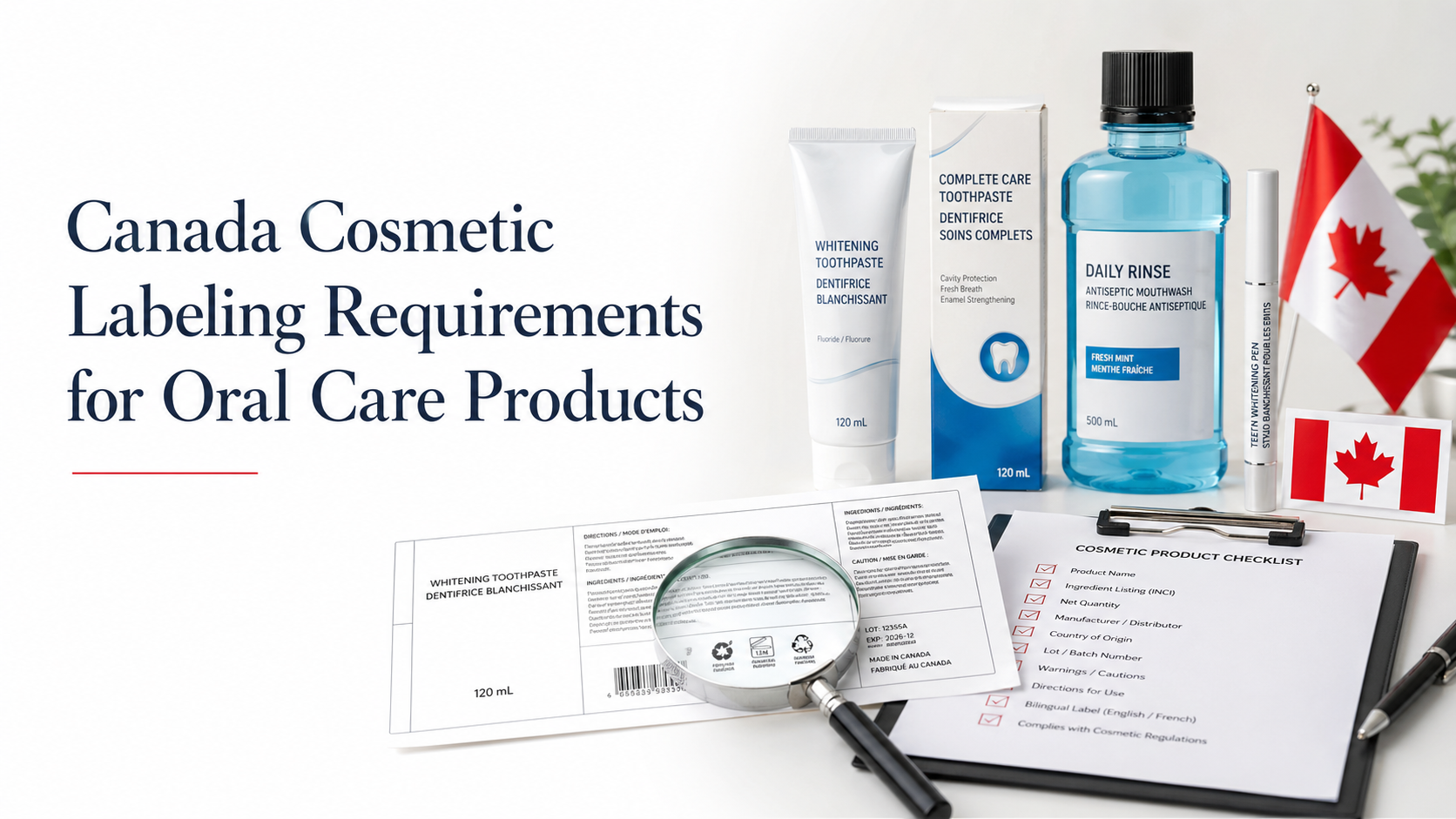
Canada Cosmetic Labeling Requirements: What Oral Care Brands Must Know in 2026
Canada cosmetic labeling requirements have become one of the most consequential compliance hurdles for oral care brands entering the Canadian market — and getting them wrong means product seizures, import bans, and costly relabeling campaigns. Health Canada enforces a layered regulatory framework under the Food and Drugs Act, the Cosmetic Regulations (CRC, c. 869), and the Consumer Packaging and Labelling Act that governs everything from fluoride-free toothpastes to whitening strips. For B2B suppliers, distributors, and private-label manufacturers, understanding these rules before a product ships is not optional — it is the baseline for market access. This guide breaks down every critical requirement, including the April 2026 fragrance allergen disclosure updates, bilingual obligations, INCI ingredient standards, and the cosmetic notification process, so your oral care line is shelf-ready from day one.How Health Canada Classifies Oral Care Products
Classification determines everything. Health Canada separates oral care products into three regulatory categories: cosmetics, natural health products (NHPs), and drugs. The category a product falls into dictates which labeling rules apply and what pre-market steps are required. Fluoride-free toothpastes, cosmetic mouthwashes, and whitening products making only aesthetic claims are classified as cosmetics. They do not require pre-market licensing but must be submitted via a Cosmetic Notification Form within 10 days of first sale in Canada. Fluoride-containing toothpastes are classified as NHPs and carry their own product license requirements — a separate regulatory pathway altogether. Products claiming to prevent disease, treat gum conditions, or deliver therapeutic outcomes are classified as drugs, triggering the most demanding pre-market review process. A simple label claim can shift a product from one category to another, which is why every word on an oral care label requires deliberate regulatory review. For a deeper look at how product classification affects formulation decisions, see oral care ingredient science and regulatory classification on LLRNCARE's professional knowledge hub.Core Canada Cosmetic Labeling Requirements: Mandatory Label Elements
Every cosmetic oral care product sold in Canada must display a defined set of mandatory elements on its label. Missing even one of these can trigger a compliance action at the border or a market withdrawal order.Product Identity
The product's common name or function must appear on the principal display panel in both English and French. The identity statement must be prominent, clearly legible, and free from misleading descriptors. Terms like "professional strength" or "clinically proven" require substantiation and can attract enforcement scrutiny.Net Quantity Declaration
Net quantity must be expressed in metric units — grams (g) for solid and semi-solid products like toothpaste, milliliters (mL) for liquids like mouthwash. The declaration must appear on the principal display panel and meet minimum type size standards proportional to the display panel area.Responsible Party Information
A Canadian name and address must appear on the label — typically the importer, distributor, or brand owner registered in Canada. This address must be current and functional, as Health Canada uses it for regulatory correspondence, recall notices, and enforcement actions. A P.O. box alone does not satisfy this requirement.Lot Number and Traceability
A lot or batch number is mandatory and must remain legible throughout the product's entire shelf life. This enables targeted recalls without withdrawing entire product lines from the market. The lot code must be permanent — ink-stamped or laser-etched — not a removable sticker.Expiry Dating
Oral care products with a shelf life under 30 months must carry an expiry date. Products with a shelf life of 30 months or longer may instead display a Period After Opening (PAO) symbol showing how many months the product is safe to use after first opening. Many brands voluntarily include both for consumer clarity.INCI Ingredient List Standards for Oral Care Products
The ingredient disclosure rules under the Cosmetic Regulations are among the most technically demanding aspects of Canada cosmetic labeling requirements. Every ingredient must be listed in descending order of concentration at the time of manufacture, using International Nomenclature of Cosmetic Ingredients (INCI) names where standardized names exist. The ingredient list must appear on the outer label — not just the inner container — and must remain legible throughout the product's shelf life. Font size must be sufficient for a consumer to read without magnification under normal conditions.INCI Name Rules and Exceptions
INCI names are considered internationally standardized and are exempt from the bilingual requirement that governs all other mandatory label text. A single INCI name satisfies both English and French obligations. However, the header preceding the list — "Ingredients" — must appear as "Ingredients/Ingrédients" in both official languages. Ingredients present at concentrations of 1% or less may be listed in any order after all higher-concentration ingredients are listed. Many manufacturers maintain strict descending order throughout the full list to simplify compliance and avoid audit questions.Colorants and Fragrance Components
Colorants must be identified using their Color Index (CI) numbers or approved INCI names. This applies to both synthetic and naturally derived colorants. Titanium dioxide, widely used in whitening toothpastes for its opacifying effect, must be listed as "Titanium Dioxide" per INCI standards. Fragrance and flavor components have historically been permitted to be listed simply as "Fragrance/Parfum" or "Flavor/Arôme." That is changing significantly in 2026.April 2026 Fragrance Allergen Disclosure Updates
Effective April 2026, Health Canada mandates the individual disclosure of 24 specific fragrance allergens when they appear above defined concentration thresholds. This regulatory change aligns Canada with European Union cosmetic standards and represents the most significant update to Canada cosmetic labeling requirements in over a decade. The thresholds are product-type specific. For leave-on products, any of the 24 listed allergens present at or above 0.001% must be individually named in the ingredient list. For rinse-off products — a category that includes most mouthwashes and toothpastes — the threshold is 0.01%. Oral care brands using mint oils, citrus extracts, eugenol, or synthetic flavor systems must audit their formulations against all 24 allergen identities before April 2026 compliance deadlines. Products already on market shelves are not automatically exempt — reformulated labels must be applied as existing inventory turns over. Suppliers managing fragrance-heavy SKUs across multiple markets will find alignment with EU standards helpful, but the specific Canadian thresholds and listed substances should be verified independently against Health Canada's official allergen schedule rather than assumed identical to EU Regulation 1223/2009. For insights into how fragrance allergen rules are reshaping oral care formulation strategy, visit the latest industry news on oral care regulatory trends.Bilingual Labeling Obligations
Canada's Official Languages Act and the Consumer Packaging and Labelling Act together create one of the world's most rigorous bilingual labeling mandates. For oral care products, every piece of mandatory label information must appear in both English and French with equal prominence. Equal prominence means that neither language version may be subordinated in font size, color contrast, or placement relative to the other. A French translation printed in a lighter color or smaller font than the English version violates the equal prominence standard even if the text itself is accurate.What Must Be Bilingual
- Product identity and common name
- Directions for use and warnings
- Cautions (e.g., "Keep out of reach of children")
- Net quantity declaration
- Dealer/responsible party name and address
- Any claims appearing on the label
What Is Exempt from Bilingual Requirements
- INCI ingredient names (standardized internationally, single language accepted)
- Lot/batch codes
- Brand names and trademarks
Tooth Whitener Labeling: Special Category Rules
Tooth whiteners receive specific regulatory attention under Health Canada's labeling guidelines. Products containing hydrogen peroxide or carbamide peroxide as active whitening agents occupy a complex regulatory space — their classification as cosmetics, NHPs, or drugs depends on concentration levels and the nature of their label claims. Whitening products classified as cosmetics must not claim to alter tooth structure, treat sensitivity, or produce outcomes that imply a clinical intervention. Labels for whitening strips, whitening pens, and whitening toothpastes must include appropriate cautions about use in children, contact with gum tissue, and duration of use. Peroxide-based whitening products above certain concentration thresholds may be reclassified as NHPs, requiring a product license number to appear on the label. Brands operating in the whitening segment should confirm concentration boundaries with a Canadian regulatory consultant before finalizing label design.Cosmetic Notification: The Pre-Market Filing Requirement
Unlike drugs and NHPs, cosmetic oral care products do not require pre-market approval from Health Canada. They do, however, require a Cosmetic Notification — a formal filing that must be submitted within 10 days of the product's first sale in Canada. The notification package includes the product name, the name and address of the notifier, a complete list of ingredients with concentrations, and the product function. Health Canada uses this database to monitor ingredient safety trends and identify formulations of concern across the market. Failure to file a Cosmetic Notification is a violation of the Food and Drugs Act and can result in significant penalties. Importers and brand owners — not foreign manufacturers — bear responsibility for ensuring notification is filed for products they bring to market in Canada.Compliance Violations and Enforcement Actions
Health Canada's enforcement data consistently identifies bilingual labeling failures as the leading cause of cosmetic compliance actions against oral care products. Incomplete French translations, unequal language prominence, and missing bilingual warnings account for the majority of product detentions at the Canadian border. Ingredient list violations represent the second most common compliance failure. These include incomplete INCI disclosure, incorrect concentration ordering, missing allergen declarations, and improper colorant identification. For oral care brands, surfactant naming errors and flavor component disclosures generate the most frequent audit flags. Misleading claims trigger the most severe enforcement responses. An oral care product claiming to "kill bacteria that cause gum disease" without NHP or drug status is making an unauthorized health claim — one that can result in immediate product seizure, mandatory recall, and prohibition orders blocking future imports. Administrative monetary penalties under the Canada Consumer Product Safety Act reach up to $25,000 per violation for standard infractions and escalate significantly for repeat violations or those involving demonstrated safety risk. Criminal prosecution remains a tool available to Health Canada for the most serious non-compliance cases.Best Practices for Meeting Canada Cosmetic Labeling Requirements
The most effective compliance programs treat Canada cosmetic labeling requirements as a design constraint from the earliest stage of product development, not a post-formulation checklist. Labels built around compliance from day one consistently outperform those retrofitted to meet regulatory demands after artwork is finalized. Implement a staged label review process with clearly defined checkpoints: formulation sign-off, regulatory review, bilingual translation review, artwork proofing against regulatory checklist, and final pre-shipment verification. Each stage should have a documented sign-off authority. Engage a Canadian regulatory consultant who specializes in cosmetics — not a generalist compliance firm — for any product entering the Canadian market for the first time. The investment in pre-market regulatory review is a fraction of the cost of a single border detention or product recall. Audit your fragrance and flavor supplier documentation against the April 2026 allergen schedule now. Waiting until products are ready to ship is too late. Suppliers who cannot provide quantified allergen data for their flavor systems represent a compliance liability that should be resolved at the procurement stage. For guidance on quality control systems that support label compliance across multiple markets, explore oral care production and quality control best practices from LLRNCARE's manufacturing resource library. Monitor Health Canada's Cosmetic Ingredient Hotlist regularly. This list identifies substances prohibited or restricted in cosmetics and is updated as new safety data emerges. An ingredient acceptable today may be restricted or banned in a future update, requiring reformulation and relabeling across affected SKUs.Frequently Asked Questions
Do fluoride-free toothpastes require a Health Canada license?
No. Fluoride-free toothpastes classified as cosmetics do not require a pre-market license. They require only a Cosmetic Notification filed within 10 days of first sale in Canada.Are INCI ingredient names required to be translated into French?
No. INCI names are internationally standardized and are exempt from bilingual translation requirements. The word "Ingredients/Ingrédients" preceding the list must appear in both languages, but the ingredient names themselves may appear once in INCI format.What is the deadline for the new fragrance allergen disclosure rules?
Health Canada's requirement to individually disclose 24 fragrance allergens above defined concentration thresholds takes effect in April 2026.Can a Canadian P.O. box satisfy the responsible party address requirement?
No. A full street address — not a P.O. box — is required to satisfy the responsible party contact information requirement under Canadian cosmetic labeling law.What happens if a cosmetic oral care product makes a drug claim on its label?
Health Canada may reclassify the product as a drug or NHP, requiring pre-market authorization. Products already on market shelves may be seized or recalled until compliant labeling and appropriate authorization are obtained.References
- Health Canada – Labelling of Cosmetics (2026)
- Health Canada – Cosmetic Advertising, Labelling and Ingredients (2026)
- Government of Canada – Cosmetic Regulations (CRC, c. 869), Justice Laws Website (2026)
- NPC Corp – Toothpaste Registration and Licensing in Canada (2026)
- CEway News – Labelling Requirements for Cosmetics Sold in Canada (2026)
- Health Canada – Guidelines for Cosmetic Advertising and Labelling Claims (2026)