Formulating Whitening Kits for Sensitive-Tooth Markets
30. August 2026
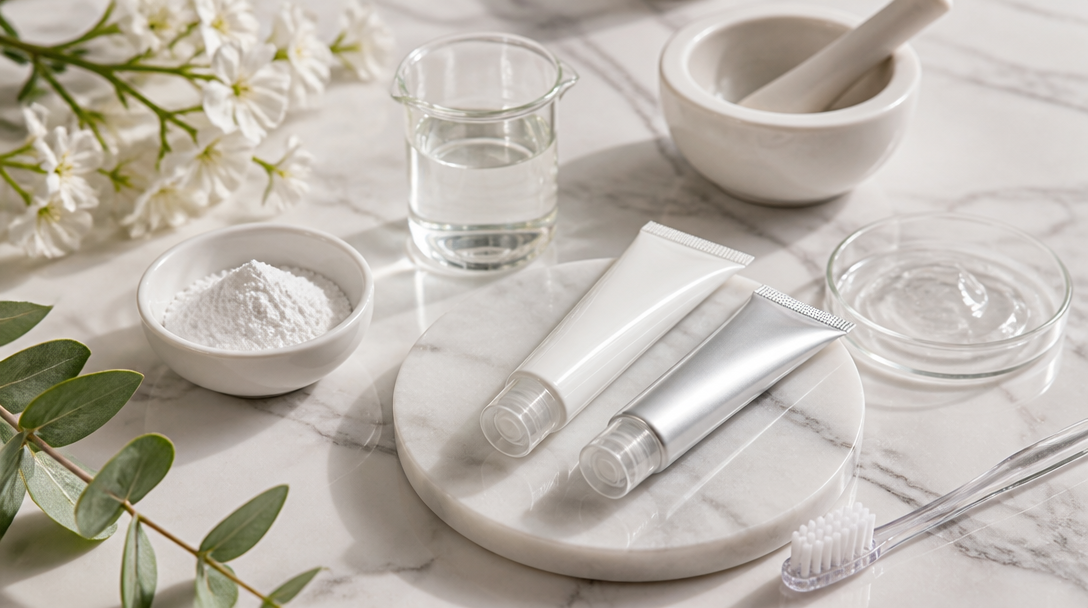
A trade sourcing guide on whitening kit sensitive formulation — covering PAP vs peroxide, adjunct chemistry, regulatory limits, and CoA requirements for clinic and private-label buyers.
Why Sensitive-Tooth Segments Demand a Distinct Sourcing Decision
Specifying a whitening kit sensitive formulation is not a decision about selecting a gentler product. It is a clinical and commercial decision that shapes patient retention, liability exposure, and how your entire whitening line is positioned. Sensitivity is the primary reason patients abandon whitening protocols — and the primary driver of clinic complaints. Getting the formulation right starts upstream, before a single unit is ordered.
The sourcing decision lives at the formulation level. Concentration, active ingredient class, buffering chemistry, and adjunct agents interact to determine whether a patient experiences brief discomfort or exits the protocol entirely. Buyers who treat sensitive-tooth kits as a diluted version of their standard kit are leaving clinical performance on the table and misreading the market.
This guide is structured for clinic owners, spa operators, and private-label brand founders who need to specify whitening kit formulations with documented sensitivity management — without accepting reduced whitening outcomes as a necessary compromise.
Active Ingredient Selection for Whitening Kit Sensitive Formulation: PAP, Low-Dose Peroxide, and Hybrid Systems
Three active ingredient categories are currently viable for sensitive-tooth whitening kits: phthalimidoperoxycaproic acid (PAP), low-concentration hydrogen peroxide, low-concentration carbamide peroxide, and hybrid systems combining PAP with a low-dose peroxide component. Each carries distinct clinical trade-offs.
PAP-Based Systems
PAP oxidizes chromogens without generating free radicals at the same rate as peroxide — which is the primary mechanism behind peroxide-induced pulpal sensitivity. For patients with documented dentin hypersensitivity, PAP-only formulations reduce the probability of sensitivity events. The trade-off is whitening speed: PAP systems typically require longer cumulative contact time to reach shade results comparable to peroxide-based protocols.
Low-Concentration Peroxide Systems
Clinical evidence directly supports low-concentration peroxide as a sensitivity management strategy. Published research comparing whitening efficacy and tooth sensitivity across concentrations found that lower-concentration peroxide formulations achieved whitening outcomes comparable to higher-concentration groups while producing measurably less bleaching-related sensitivity [2]. For buyers, this finding is actionable: properly calibrated concentration reduces sensitivity risk without sacrificing efficacy. The concentration decision is a specification choice, not a quality compromise.
Hybrid Systems
Hybrid formulations pair PAP with a low-dose peroxide component to capture faster whitening kinetics while moderating sensitivity through PAP's radical-scavenging properties. These systems are increasingly specified by private-label buyers building premium sensitive-tooth SKUs. When co-developing a hybrid formula, request stability data at both accelerated and real-time conditions — PAP and peroxide interact under specific pH and temperature thresholds, and an unstable formulation will not perform consistently across shelf life.
Adjunct Chemistry: Potassium Nitrate, Nano-HAp, and Fluoride in Sensitive-Tooth Whitening Kit Formulation
Active ingredient selection addresses the source of sensitivity. Adjunct chemistry addresses the nerve and tissue response. These are separate formulation decisions, and both matter when specifying a kit for sensitive-tooth markets.
Potassium Nitrate
Potassium nitrate depolarizes sensory nerve fibers in the pulp, reducing the transmission of pain signals triggered by bleaching activity. A randomized, double-blind controlled trial on whitening strips found that a formulation combining 3% hydrogen peroxide with 1.5% potassium nitrate reduced dentin hypersensitivity risk without compromising whitening efficacy [3]. When specifying a sensitive-tooth kit, potassium nitrate at clinically relevant concentrations should be a standard inclusion — not an optional upgrade listed in the marketing copy but absent from the CoA.
Nano-Hydroxyapatite (Nano-HAp)
Nano-HAp operates through a different mechanism: it partially occludes dentinal tubules, physically reducing the hydrodynamic fluid movement that triggers sensitivity. It also supports enamel remineralization during and after bleaching. Nano-HAp is particularly relevant for take-home kits where patients self-apply without clinical supervision, because it provides a passive protective effect throughout the wear period without requiring patient compliance with a separate desensitizing step.
Buffering Agents and Fluoride
pH management is an underspecified variable in many whitening gel formulations. Highly acidic bleaching gels accelerate enamel demineralization and elevate sensitivity risk. Buffering agents maintain gel pH within a range that preserves enamel integrity during the bleaching window — and gel pH should be confirmed on the CoA at both manufacture and end of shelf life.
Fluoride inclusion has demonstrated clinical utility as an adjunct. A randomized triple-blind clinical trial found that adding 2% sodium fluoride to a bleaching gel significantly reduced cold sensitivity after 90 days without compromising whitening effectiveness [4]. For take-home kit formulations, fluoride inclusion — or a fluoride post-treatment gel supplied as part of the kit — is a defensible specification for sensitive-tooth positioning.
Concentration Ceilings by Regulatory Market
Regulatory limits on peroxide concentration determine which formulations are legally distributable in each market. Buyers sourcing for multi-market distribution need to specify formulations that comply with the most restrictive market in their footprint — or maintain separate SKUs per region.
| Market | OTC / Consumer Limit | Professional / Clinic Limit | Notes |
|---|---|---|---|
| European Union | 0.1% H₂O₂ (consumer access) | Up to 6% H₂O₂ (dentist-only) | Cosmetic Products Regulation (EC) No 1223/2009 |
| United States | No federal OTC cap; FDA oversight applies | Professional-use products not subject to same OTC constraints | State dental board rules may apply |
| United Kingdom | 0.1% H₂O₂ (consumer) | Up to 6% H₂O₂ (registered dental professionals) | Post-Brexit retained EU framework |
| Australia | Restricted; Schedule 4 drug classification applies to higher concentrations | Dentist-dispensed above threshold | TGA scheduling governs |
For sensitive-tooth formulations, regulatory ceilings frequently align with clinical best practice. Lower-concentration products that comply with consumer-access rules in the EU and UK often fall within the same concentration range that clinical evidence supports for reduced sensitivity outcomes [2]. A single low-concentration formulation can serve compliant consumer channels and sensitive-patient clinic protocols simultaneously — a meaningful product architecture advantage for multi-market buyers.
PAP-based formulations, which contain no hydrogen peroxide, currently sit outside peroxide-specific concentration regulations in most markets. This makes them attractive for multi-market private-label programs. Buyers should confirm cosmetic versus medical device classification requirements in each target market before finalizing the regulatory submission strategy.
Tray Design, Contact Time, and Protocol Variables
Formulation chemistry does not operate in isolation. Tray design and wear protocol interact with gel chemistry to determine the actual sensitivity burden a patient experiences — and both are specifiable at the product design stage.
Tray Fit and Gel Volume
Poorly fitting trays allow gel to contact gingival tissue, increasing soft-tissue irritation and the risk of inadvertent ingestion. For sensitive-tooth kits, close-fitting stock trays or custom-fit trays with reservoir space precisely controlled for gel volume are preferable to generic one-size options. Define the tray material (EVA gauge), reservoir geometry, and recommended gel fill volume in your product brief — these are not defaults to leave to a supplier's discretion.
Contact Time and Wear Frequency
Reducing contact time per session is a direct lever for managing sensitivity. Research into combined in-office and take-home whitening approaches found that efficacy gains from combined protocols did not require increased sensitivity, suggesting that distributing total bleaching exposure across sessions can maintain results while managing cumulative sensitivity load [1]. For take-home sensitive kits, shorter daily wear windows — 30 to 60 minutes rather than overnight — with a longer overall treatment course represent a clinically supportable protocol specification.
Pre-Treatment and Post-Treatment Adjuncts
Protocol design can include pre-treatment and post-treatment steps that reduce sensitivity without altering the core gel formulation. Published JADA research found that preemptive administration of ibuprofen combined with potassium fluoride reduced post-bleaching sensitivity significantly more than placebo, with placebo patients showing approximately four times higher risk of moderate or severe sensitivity [6]. While ibuprofen is a clinical intervention rather than a kit component, potassium fluoride can be incorporated as a post-treatment gel or remineralizing serum supplied within the kit — a tangible differentiator for premium sensitive-tooth packaging.
What to Request on a Certificate of Analysis for Sensitive-Tooth Formulations
A standard whitening gel CoA confirms active ingredient concentration and basic stability. A CoA for a sensitive-tooth whitening kit formulation should confirm considerably more. Request the following before approving any batch for distribution.
- Active ingredient concentration: Confirmed H₂O₂, carbamide peroxide, or PAP at batch level, with acceptable variance range specified.
- pH at manufacture and end of shelf life: Gel pH affects both sensitivity risk and regulatory classification in some markets. Both values are required.
- Potassium nitrate or fluoride concentration: Adjunct desensitizing agents must be confirmed at specified levels — not simply listed as ingredients on a label.
- Nano-HAp particle size and dispersion data: Particle size affects both tubule occlusion efficacy and gel texture consistency. Request this if nano-HAp is part of the specification.
- Stability testing protocol: Confirm real-time and accelerated stability data, including peroxide degradation rate over shelf life. A gel that begins at 6% H₂O₂ and degrades to 3% by month six is not a consistent or compliant product.
- Microbial testing results: Confirm the testing standard used — ISO 17516 or equivalent — for any cosmetic or quasi-drug classification.
- Regulatory compliance declaration: EU Cosmetic Products Regulation, FDA facility registration, CE marking where applicable — confirm which framework applies to each target market before placing an order.
Building a Two-Tier Product Line: Standard and Sensitive SKUs
A two-tier whitening kit line — one standard formulation and one sensitive-tooth formulation — is a defensible and commercially practical product architecture for clinic owners and private-label brand founders. It allows practitioners to match product to patient profile at the point of recommendation, rather than defaulting to a single SKU for all patients and absorbing the complaint rate that follows.
Differentiating the SKUs Without Cannibalizing the Standard Line
The sensitive SKU should be positioned on clinical specificity, not as a weaker version of the standard product. Differentiation points include documented adjunct chemistry (potassium nitrate, nano-HAp, fluoride), shorter recommended wear time per session, and a protocol card that explains the sensitivity management rationale to the patient. These elements signal clinical credibility — to the practitioner recommending the kit and to the patient using it.
Private-label buyers co-developing both SKUs have an opportunity to establish the sensitive formulation as the premium tier: longer protocol duration, more adjunct chemistry, and more detailed patient guidance all support a higher retail price point without requiring a fundamentally different gel chemistry platform. The architecture rewards buyers who invest in specification detail at the sourcing stage rather than treating it as a packaging exercise.
References
- [1] Whitening efficacy and tooth sensitivity in a combined in-office and take-home whitening approach — PubMed
- [2] Clinical comparison of whitening efficacy and tooth sensitivity across concentrations and formulations — PubMed
- [3] Evaluating the efficiency and tooth sensitivity of a novel whitening strip: a randomized, double-blind controlled trial — PubMed
- [4] Tooth sensitivity and whitening effect of an in-office bleaching gel containing 2% sodium fluoride: a randomized triple-blind clinical trial — PubMed
- [6] Administering ibuprofen and potassium fluoride before bleaching reduces sensitivity — ADA News / JADA
Disclaimer
This article is for general informational purposes only and does not constitute sourcing, legal, or regulatory advice. Always conduct your own due diligence and consult qualified legal or compliance professionals before making purchasing or compliance decisions. WhiteningBright makes no warranties as to the completeness or accuracy of the information, and any reliance is at your own risk.