How Long Before Whitening Results Show Up
26. Juli 2026
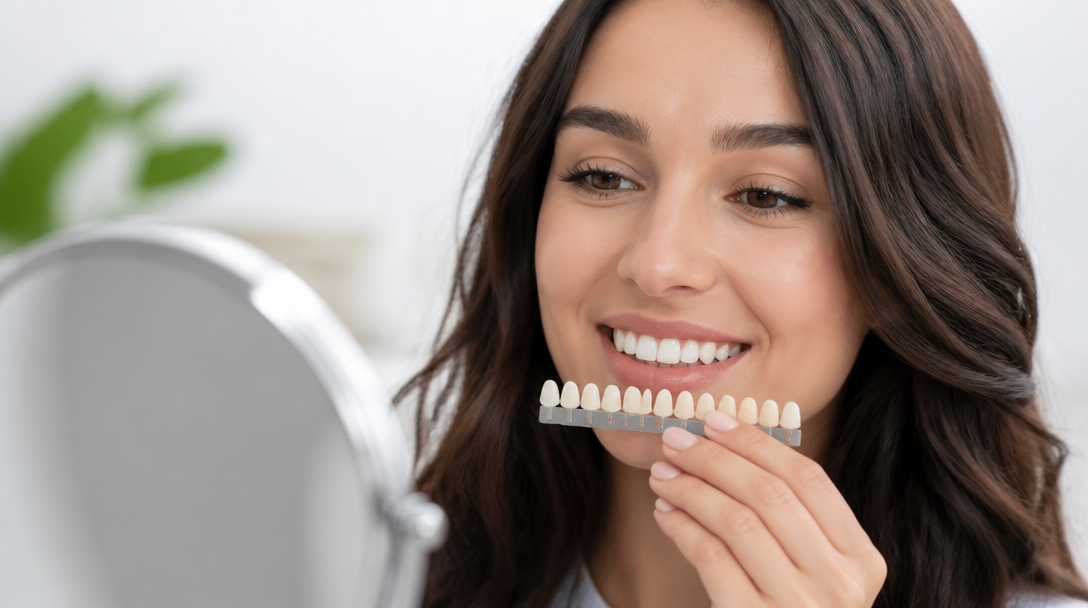
Wondering how long whitening takes to show results? See what clinical research says about timelines by method, stain type, and when to reassess.
How Long Whitening Takes: A Realistic Timeline by Method and Stain Type
If you started a whitening treatment this week and are already checking your smile in the mirror every morning, you are not alone. How long whitening takes is one of the most common — and most misunderstood — questions in oral care. The honest answer depends on three things: the delivery method you are using, the type of stain on your teeth, and your natural baseline shade. There is no universal countdown, but clinical research gives us a reliable framework for setting accurate expectations before frustration sets in.
How Long Whitening Takes Depends on the Method First
The delivery format shapes the timeline more than almost any other variable. In-office professional treatments use higher-concentration peroxide gels applied under controlled conditions. For some patients, a visible lightening effect appears after a single 30–60 minute appointment. That speed reflects concentration and direct contact time — not a superior formula.
Take-home systems using custom trays and peroxide gels work more gradually. Peer-reviewed research confirms that take-home whitening can ultimately achieve better shade outcomes than in-office treatment, but the cumulative application time required is dramatically longer — in some study comparisons, anywhere from 14 to 280 times as long. That is not a product flaw. It reflects a deliberate trade-off between concentration, safety, and sustained contact with the tooth surface over multiple sessions.
Over-the-counter options add another layer of variability. A randomized controlled clinical trial found that conventional at-home whitening systems produced significantly better shade change than paint-on gels and ready-to-use tray products. The paint-on gel group in that study never reached the threshold considered clinically detectable. The format of a product defines the ceiling of what it can realistically deliver.
Whitening toothpastes sit in a separate category. They work primarily by removing surface deposits rather than altering the internal color of the tooth. When visible change occurs, it tends to take longer than peroxide-based methods and is limited to extrinsic staining. Some approaches may require up to three months to produce even a modest one to two shade improvement.
Stain Type Changes How Quickly — or Whether — Results Appear
No whitening product works equally well on every type of discoloration. Matching your expectations to your actual stain type is the most important step most first-time users skip.
- Extrinsic stains sit on or just below the outer enamel surface. Coffee, tea, red wine, and tobacco are the primary causes. These respond fastest to whitening agents and are the first to show improvement.
- Intrinsic stains originate inside the tooth structure — from tetracycline use during development, fluorosis, trauma, or the natural thinning of enamel that exposes darker dentin beneath. They respond slowly, partially, or sometimes not at all to standard whitening treatments.
- Age-related yellowing combines both mechanisms — surface accumulation and structural change over time. Results are achievable but tend to take longer and may plateau before reaching the shade a younger patient might see.
A literature review on bleaching effectiveness confirms that gel type, concentration, and application time all interact with stain origin to determine outcomes. A product that clears coffee staining efficiently may produce minimal visible change on deep intrinsic discoloration, regardless of how long it is used.
What a Realistic Progress Curve Actually Looks Like
For most people using a standard peroxide-based take-home system correctly, the first detectable change appears somewhere between day three and day seven. That initial shift is often subtle — a slight reduction in yellow tone rather than a dramatic brightness jump. It is easy to miss if you are comparing against memory rather than a photograph taken on day one.
By the end of a standard two-week course, most users with extrinsic or moderate staining will see a measurable shade improvement. Progress is rarely linear. Many people notice a more visible shift in the second week than the first, as the whitening agent has had successive sessions to work through layers of staining.
Expecting a dramatic change in the first few days — and abandoning the product when it does not arrive — is one of the most common reasons people underestimate what a treatment can do over its full recommended duration.
How to track progress accurately at home
Take a photograph in consistent lighting before you start, with your mouth open and teeth visible against a neutral background. Repeat it every five to seven days. Subjective mirror checks are unreliable — the eye adapts quickly to gradual change. A side-by-side photo comparison shows shifts that daily observation will miss.
When Slow Results Are Normal and When They Are Not
Slow progress is not automatically a problem. If you are using a lower-concentration OTC product on moderate staining, seeing little change in week one is expected. The research-documented timeline — up to three months for some OTC approaches — means patience is built into the process.
Certain situations do warrant a closer look:
- You have completed the full recommended course with no perceptible change at all.
- Sensitivity is preventing you from completing sessions consistently, which disrupts the cumulative exposure the product depends on.
- The whitening is uneven — some teeth responding and others not — which can indicate underlying restorations, decay, or structural differences that whitening cannot address.
- Your teeth are gray or blue-toned rather than yellow or brown, which often signals intrinsic staining that responds poorly to standard peroxide-based products.
Professional guidance is particularly important if you have not had a recent dental examination. Starting whitening without knowing the underlying condition of your teeth is one of the most reliable reasons results fall short of what a product is capable of delivering.
Three Reliable Indicators That a Product Is Actually Working
Mild, temporary sensitivity during or shortly after treatment is a common sign that the active ingredient is penetrating the enamel. It is not comfortable, but it confirms contact. Sensitivity that persists beyond 24–48 hours after a session, or that is severe enough to disrupt daily life, signals the need to reduce frequency or concentration — not to push through.
Shade comparison against a fixed reference is more reliable than mirror checks. Some dentists use a physical shade guide. At home, holding your teeth next to a white reference object that does not change — a white card, for example — reveals subtle shifts that are otherwise easy to dismiss as lighting variation.
Consistency of application is often the variable that separates visible results from none. Skipping sessions, under-filling trays, or cutting strip contact time short all reduce cumulative exposure. A product that works reliably in clinical conditions can appear ineffective when used inconsistently at home.
What to Do If Two Weeks Pass With No Visible Change
Two weeks of consistent use with no visible change is the point at which reassessment is more productive than simply continuing.
- Identify the stain type. If your discoloration is intrinsic — from medication, fluorosis, or structural change — standard whitening products are unlikely to produce the result you expect. A dentist can identify this quickly and discuss alternatives such as microabrasion, veneers, or professional-strength in-office treatment.
- Review your application method. Are you using the product for the full recommended duration each session? Are trays fitting well enough to keep gel in contact with the tooth surface throughout? Poor tray fit is a frequent and underappreciated reason for weak results.
- Reconsider the product format. Clinical evidence shows that not all OTC formats are equally effective. If you have been using a paint-on gel or a non-custom-fit system, switching to a properly fitted tray with a peroxide or PAP-based formula may produce the change you have not yet seen.
- Book a dental appointment. A professional can assess whether underlying issues — decay, old restorations with different optical properties, or gum recession — are affecting your tooth appearance in ways no whitening product can correct.
It is also worth knowing that results, once achieved, are not permanent. Research tracking home bleaching outcomes found that results generally remained stable for one to two and a half years, with more severe discoloration showing greater tendency to relapse. Maintenance sessions — shorter and less frequent — are typically what keeps results consistent over time.
How Long Whitening Takes: The Honest Summary
In-office treatments can show visible change in a single session. Take-home peroxide systems typically show early results within a week and meaningful improvement over two to four weeks of consistent use. Some OTC products — particularly paint-on formats — may not reach a clinically detectable threshold at all. And certain stain types will not respond regardless of the product used or the patience applied.
Before starting any whitening treatment, identify the type of staining you have, choose a method with clinical evidence behind it, and track progress with photographs rather than daily mirror checks. If two weeks pass without any visible shift, that is information — and it points toward a specific next step rather than simply trying harder with the same approach.
References
- Treatment Durations and Whitening Outcomes of Different Tooth Whitening Systems — PMC / National Library of Medicine
- Evaluating the Efficiency of Two Different Over-the-Counter Tooth Whitening Systems: A Randomised Controlled Clinical Trial — Nature / British Dental Journal
- Evaluation of the Effectiveness of Different Types of Dental Bleaching: A Review of the Literature — PMC / National Library of Medicine
- Tooth Whitening: What We Now Know — PMC / National Library of Medicine
- Prognosis in Home Dental Bleaching: A Systematic Review — Clinical Oral Investigations, Springer
Disclaimer
This article is for general informational purposes only and is not a substitute for professional dental or medical advice. Always consult a qualified dental professional before starting any teeth-whitening or oral-care regimen. WhiteningBright makes no warranties as to the completeness or accuracy of the information, and any reliance is at your own risk.