How to Navigate Your First Whitening Product Order
11. Juni 2026
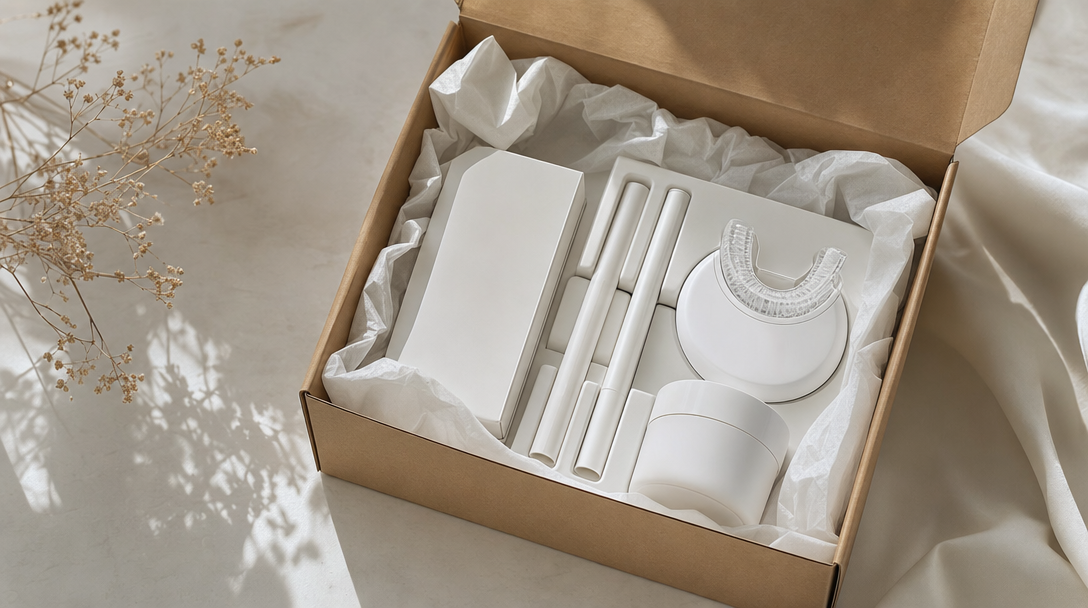
Plan your first whitening product order with confidence. Avoid MOQ traps, FDA delays, and hidden costs that push budgets 40% over target.
MOQ Reality Check: What Your First Whitening Product Order Actually Costs
Most first-time buyers anchor on unit price and miss the full picture. A first whitening product order at 1,000 units carries predictable cost layers — and buyers who ignore those layers routinely land 3–6 months behind schedule and 40% over initial budget.
Product cost runs $3–12 per unit depending on formulation complexity. A carbamide peroxide gel sits toward the lower end. A PAP-based system with desensitizing agents and premium flavor masking sits toward the higher end. Custom packaging adds $0.50–2.00 per unit for private-label ready solutions.
Beyond unit cost, three categories will determine your true landed investment:
| Cost Category | Budget Range | When It Hits |
|---|---|---|
| Product + packaging | $4,000–14,000 | 50% deposit, 50% before shipping |
| Regulatory prep | $500–2,500 | Before production starts |
| Freight + customs | $400–1,800 | At delivery |
| Sample rounds | $200–800 | Upfront |
Plan for $6,000–20,000 total investment on a first run. Brands entering regulated markets — Germany, Canada, Australia — should budget toward the upper end. Additional compliance requirements in those jurisdictions add testing costs and documentation rounds that buyers sourcing only for the US market rarely anticipate.
Co-Development vs. Private-Label Ready: Choose Your Path Early
Every first whitening product order follows one of two development paths. The choice affects timeline, upfront cost, and how much differentiation your brand can credibly claim at retail or in clinical settings.
Co-development means building a formulation engineered for your specific market position. You control active ingredient percentages, gel viscosity, flavor profile, and delivery format. Timeline runs 8–16 weeks from brief to approved samples. Formulation development typically adds $2,000–4,000 above production costs — a justified spend for brands targeting dental clinics or premium specialty retail where the formula itself is a selling point.
Private-label ready formulations use validated bases with custom packaging and labeling applied. Your development partner has already completed clinical testing and regulatory review on the base formula. Timeline compresses to 4–8 weeks. Upfront investment runs 40–60% lower, which matters when speed to market outweighs exclusivity.
Decision Framework
- Timeline pressure: Private-label ready is the only viable path for Q4 launches decided in August
- Budget at first order: Private-label ready preserves capital for marketing and retail placement
- Channel positioning: Co-development is essential for professional dental or premium clinic channels demanding a unique clinical profile
- Regulatory complexity: Private-label ready typically includes pre-validated compliance documentation, reducing your regulatory prep burden
A 35% carbamide peroxide professional-strength gel intended for dental clinic resale requires co-development and clinical validation. A consumer-facing PAP strip system launching on DTC channels can use a proven private-label ready base and reach market in under two months.
Packaging Design Timeline That Protects Your Launch Date
Packaging delays are responsible for more missed launch windows than formulation issues. The rule most first-time buyers learn too late: start packaging concepts before finalizing formulation specs, not after.
Design-to-production spans 6–10 weeks when managed correctly. Concept development takes 2–3 weeks. Regulatory review of label claims adds another 2–3 weeks. Tooling and first physical samples require a minimum of 3–4 weeks. These phases overlap only when briefed in parallel.
FDA labeling requirements directly compress your design window. Products making whitening claims may require Drug Facts panels depending on active ingredient and claim language. Your design team needs those specifications at the start of the project — not during artwork revisions.
Critical Packaging Milestones
- Week 1–2: Lock product positioning and claims strategy
- Week 3–4: Complete initial design concepts; submit to regulatory review simultaneously
- Week 5–6: Approve final artwork; submit for tooling
- Week 7–8: Review physical packaging samples; approve for production
- Week 9–10: Production begins with approved, compliant packaging
European distribution adds 1–2 weeks to this timeline. CE marking requirements and multilingual labeling across EU member states demand a separate review cycle. Brands planning simultaneous US and EU launches should treat these as two distinct compliance workstreams running in parallel, not sequentially.
FDA Registration Steps You Can Start Before Production
FDA compliance preparation does not need to wait for production scheduling. Several steps run independently and, when started early, meaningfully compress your path to market entry on your first whitening product order.
Facility verification is the first action item. Your manufacturing partner must hold current FDA facility registration. Verify this during partner selection — before any agreements are signed. Unregistered facilities create compliance gaps that can delay US market entry by months, with no clean resolution short of switching manufacturers.
Product classification determines your entire regulatory pathway. Whitening products occupy a cosmetic-drug gray area. Classification depends heavily on labeling language and the active ingredient used. A product claiming to "whiten teeth" using hydrogen peroxide above threshold concentrations may require drug registration, cGMP compliance, and a Drug Facts panel. A product using PAP with cosmetic-only claims follows a different pathway entirely.
| Registration Step | Timeline | Can Start Before Production |
|---|---|---|
| Facility verification | 1–2 days | Yes — during partner selection |
| Product classification review | 1–2 weeks | Yes — during formulation planning |
| Ingredient safety documentation | 2–4 weeks | Yes — request from your development partner |
| Label compliance review | 1–3 weeks | Partially — after packaging design is drafted |
| Adverse event reporting setup | 1 week | Yes — establish procedures during development |
Adverse event reporting procedures must be in place before the first unit sells. FDA requires serious adverse event reports within 15 business days for applicable product categories. Build the monitoring workflow during development — not after your first consumer complaint arrives.
A Sample Strategy That Actually Saves Budget
Most first-time buyers request too few samples, too late. The result: reformulations after packaging is already in tooling, or production runs that fail to match the approved sample. A three-phase sampling approach eliminates both problems.
Formulation validation is the first phase. Order 20–30 units to evaluate active ingredient performance, flavor acceptance, and gel consistency across your internal team and any focus group participants. Budget $200–400. This phase catches misalignment between brief and output before any packaging investment is made.
Packaging integration is the second phase. Gel viscosity directly affects applicator performance. A syringe-based delivery system requires different rheology than a brush-on or strip format. Packaging integration samples confirm the formulation and the delivery format work correctly together — before tooling costs are locked.
Production verification is the final phase. These samples come directly from your production run using approved materials, equipment settings, and batch sizes. Scale-up manufacturing does not always replicate lab or pilot conditions. Production verification confirms it does.
Sample Evaluation Framework
- Performance: Measure whitening efficacy using standardized dental shade guides across multiple applications
- User experience: Assess application ease, taste, and post-use sensitivity — especially relevant for PAP formulations marketed to sensitive-tooth demographics
- Packaging function: Verify dispensing accuracy, seal integrity, and child-resistance where required
- Stability: Monitor gel consistency and color across a 30-day accelerated stability window before approving full production
Document all sample feedback on standardized evaluation forms. Consistent scoring across stakeholders produces defensible quality specifications — and that documentation carries direct value in regulatory submissions.
Hidden Costs First-Time Buyers Consistently Miss
Experienced buyers budget 25–40% above quoted unit costs. First-time buyers rarely do. The gap appears across compliance, logistics, and market entry activities that only become visible after the initial purchase order is signed.
Regulatory compliance extends well beyond basic federal registration. California Proposition 65 warnings may apply to certain peroxide-based formulations. International markets — including Canada, the UK post-Brexit, and Gulf Cooperation Council markets — each carry separate certification requirements and testing protocols that add cost and time.
Quality control testing runs at multiple production stages. Incoming raw material verification, in-process monitoring, and finished-product testing carry separate fees. Microbiological testing for water-based gel formulations adds $150–300 per batch and is non-negotiable for regulated market entry.
| Hidden Cost Category | Typical Range | When It Appears |
|---|---|---|
| Additional regulatory testing | $500–2,000 | Before market entry |
| Restricted shipping surcharges | $200–800 | At delivery |
| Quality control testing | $300–1,200 | During production |
| Trademark and IP searches | $400–1,500 | Before packaging finalization |
| Product liability insurance | $800–3,000 annually | Before first sale |
Product liability insurance surprises many first-time buyers. Whitening products carry higher coverage premiums than standard cosmetics because sensitivity incidents and misuse claims are documented risks in the category. Secure a coverage quote before finalizing your order — not after it ships.
Peroxide-containing formulations face freight classification as restricted materials. Air freight surcharges for hazardous or restricted goods run 15–25% above standard rates. Sea freight avoids most surcharges but adds 3–6 weeks to delivery. Build this into your launch timeline from day one.
Currency movement affects any order priced in a foreign currency with extended payment terms. A 3–5% buffer covers typical fluctuation on orders under $15,000. Larger initial orders benefit from locked exchange rate agreements where your banking relationship allows.
Intellectual property clearance is the final item buyers skip and later regret. Trademark searches for your brand name, packaging trade dress, and product positioning should complete before artwork is finalized. Patent searches for novel delivery formats or formulation claims prevent infringement disputes that can halt sales after launch — a far more expensive problem than the search itself.
References
- FDA Teeth Whitening Regulations 2026: Essential Guide — LLRN Care. Covers cosmetic-drug classification, labeling requirements, and cGMP implications for whitening products.
- Future Market Insights — Skin Lightening Product Market. Highlights regulatory pressure toward safer actives and retail-led distribution growth.
- Straits Research — Skin Lightening Products Market Size, Share, Growth, Analysis, 2034. Documents online channel growth and natural-ingredient sourcing trends relevant to B2B assortment planning.
- PMC — Skin-Lightening Products: Consumer Preferences and Costs. Peer-reviewed analysis of top-selling product ingredients and the importance of active-ingredient verification in supplier vetting.
- Fortune Business Insights — Skin Lightening Products Market Size, Share. Covers plant-based active demand, product-form diversification, and category expansion signals.