Strip vs Gel: Which Format Wins in Clinic Resale
28. August 2026
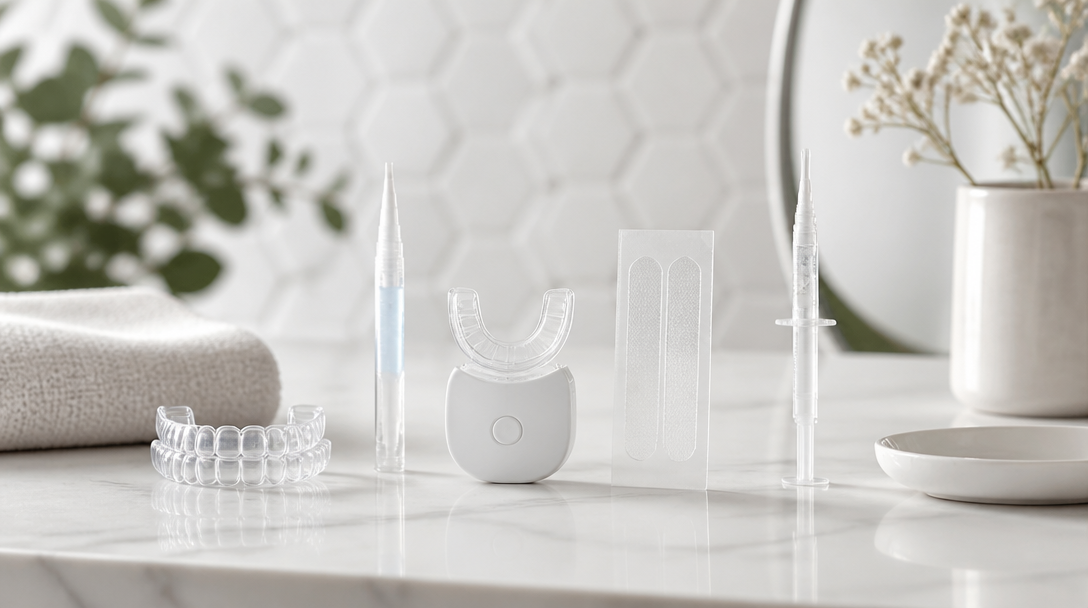
Compare whitening strips vs gel sourcing across formulation stability, margin structure, compliance requirements, and clinic channel fit. A professional buyer's framework.
Strip vs Gel: Which Format Wins in Clinic Resale — A Whitening Strips vs Gel Sourcing Guide
When dental clinic owners and distributors evaluate whitening strips vs gel sourcing options, the decision rarely comes down to patient preference. It comes down to formulation stability, margin per unit, private-label flexibility, regulatory pathway, and whether the format fits the clinic's dispensing workflow. Getting this wrong means stocking a product that sits on shelves, triggers returns, or fails a compliance audit. This guide works through both formats across the variables that matter to professional buyers.
Formulation Specs: How Strips and Gel Syringes Differ at the Chemistry Level
The core active ingredients — hydrogen peroxide (HP), carbamide peroxide (CP), or PAP-based compounds — can appear in both formats. How that chemistry is delivered changes everything about stability, dosing precision, and patient-side risk.
Gel syringes support a wider active-ingredient concentration range. Professional take-home gels commonly use carbamide peroxide or hydrogen peroxide at concentrations appropriate to the target market's regulatory ceiling. The viscosity is engineered to retain contact with enamel inside a custom tray, maximizing dwell time and enamel penetration. A 2025 PubMed study found that whitening gels produced greater color change compared to strips — though both formats altered enamel surface roughness and reduced microhardness. That enamel-surface finding belongs in your patient briefing materials and private-label sensitivity disclaimers, not just in a clinical file.
Whitening strips operate within tighter concentration ceilings, typically formulated at or below 6% hydrogen peroxide to meet OTC thresholds in regulated markets. A 2025 randomized clinical trial comparing in-office HP gel with 6% HP whitening strips found that the gel produced stronger immediate brightness, while strips contributed to maintaining lightness over a four-week follow-up period. For a clinic resale model, this distinction matters: gel positions as the acute-result format, strips as the maintenance format. Stocking both with that narrative is a stronger commercial strategy than defaulting to one.
Before committing to volume, confirm these specs from any supplier:
- Active ingredient type and verified concentration — request a Certificate of Analysis, not a nominal spec sheet
- pH range of the finished formula, relevant to enamel safety claims
- Film substrate for strips: PVP-based, PEG-based, or dissolvable matrix
- Viscosity grade and syringe fill weight for gels
- PAP concentration if a peroxide-free positioning is required for your market
Shelf Life, Storage, and Cold-Chain Risk by Format
Format choice directly affects logistics cost and inventory spoilage risk — two variables that never appear in a supplier's product brochure but will appear in your P&L.
Gel syringes are sensitive to temperature fluctuation. Hydrogen peroxide degrades faster at elevated temperatures, so gel products often require cool-storage shipping and climate-controlled warehousing. For distributors moving volume across warm-climate regions, this adds cold-chain cost and increases the risk of receiving stock that has already degraded in transit. Request stability data tested at both ambient and elevated temperature conditions — not just the headline shelf-life figure on the carton.
Whitening strips carry a more stable shelf-life profile in most distribution scenarios. The active ingredient is embedded in a polymer matrix that buffers against minor temperature variation, making strips more practical for distributors operating without refrigerated logistics. That said, strips are not immune to humidity degradation. Packaging integrity — sealed foil pouches, desiccant inclusion, seal-strength testing — is a critical spec to verify before approving a private-label design.
A clear operational rule: if your distribution network includes pharmacies, spas, or clinics without dedicated cold storage, strips carry lower inventory spoilage risk. If your channel is dental clinics with dispensary infrastructure, gel syringes are operationally viable and support stronger clinical positioning at the point of sale.
Private-Label Flexibility: Packaging, Tooling, and MOQ Differences
Both formats support private-label development, but the tooling requirements, minimum quantities, and customization depth differ in ways that affect your launch timeline and upfront cost.
Gel syringes offer straightforward label customization. The syringe barrel accepts custom printed labels or sleeves, and the outer carton can be fully co-developed with your brand architecture. Syringe fill weight, cap color, and kit configuration — number of syringes per box, tray inclusion, instruction leaflet design — are all adjustable at reasonable minimums with an established supplier. This format is well-suited to dental clinic brands that want a clinical, dispensary-grade aesthetic.
Whitening strips require more upfront investment in packaging development. Each strip pouch is typically foil-sealed and printed individually, which means artwork setup costs are higher and minimum print runs are larger. The trade-off: a well-designed strip box delivers strong retail-shelf visual impact. Strips are the format patients recognize from premium pharmacy shelving, which matters if your distribution channel includes retail pharmacies or direct-to-consumer e-commerce.
A format worth evaluating for professional channels is the dissolvable whitening strip. A commentary published in the British Dental Journal highlighted professional dissolving strips as a format gaining traction in clinical and professional whitening workflows, with the advantage of eliminating the strip-removal step and reducing patient compliance errors. If your supplier offers this format, it represents a meaningful product differentiation angle for clinic resale — particularly for aesthetic clinics and med-spas where patient experience is part of the value proposition.
Resolve these questions before signing any private-label agreement:
- Who owns the artwork files — you or the supplier?
- What is the minimum print run for custom foil pouches (strips) or custom cartons (gel)?
- Can the supplier accommodate regulatory text variations across different market SKUs?
- Is child-resistant packaging available and independently certified?
Margin Structure and Whitening Strips vs Gel Sourcing Economics
Neither format is categorically more profitable. Margin outcome depends on how you configure the product, the channel it enters, and the price your patient base will support.
Gel syringes typically carry a higher unit cost due to the syringe component, fill precision requirements, and cold-chain handling. They also command a higher retail price in clinic settings, because patients associate the format with professional-grade treatment. A multi-syringe kit with a tray can be positioned as a premium dispensed product, supporting stronger margin per transaction even at lower unit volumes.
Whitening strips have lower unit production costs and are easier to fulfill in smaller quantities, making them practical for clinics testing a retail add-on without committing to large inventory. The trade-off is that strips face more price compression in retail-adjacent channels — patients can reference pharmacy shelf pricing, which limits your ceiling.
A direct comparison for clinic buyers:
- Gel syringes: higher unit cost, higher retail price point, lower volume needed to hit revenue targets, stronger clinical credibility narrative at the point of dispensing
- Whitening strips: lower unit cost, faster inventory turnover, broader patient accessibility, more price-sensitive ceiling in pharmacy-adjacent channels
When ordering at scale for a distributor network, negotiate on kit configuration rather than base unit price alone. Adjusting syringe count per kit or removing tray inclusion can shift your landed cost meaningfully without requiring the supplier to move on their underlying price.
CE, FDA, and ISO Compliance: What Each Format Requires
Regulatory compliance is not interchangeable between formats. Sourcing errors here carry direct legal consequences — not just a difficult conversation with a buyer.
In the European Union, whitening products containing more than 0.1% hydrogen peroxide are classified as medical devices under EU MDR. This applies to both strips and gels, but the documentation burden differs by concentration. Gel syringes formulated above certain HP thresholds require a more extensive technical file, a full clinical evaluation, and in some cases notified body involvement. Strips at lower concentrations may qualify for a shorter regulatory pathway, but classification must be confirmed per product — never assumed by format alone.
For CE-marked products, require the following documentation from any supplier before placing an order:
- Declaration of Conformity specific to the product SKU, not a generic template
- Technical file summary or reference to the notified body involved
- Confirmed HP concentration in the finished product, not the raw material
- ISO 22716 (cosmetic GMP) or ISO 13485 (medical device QMS) certification, depending on product classification
In the US market, OTC whitening products are regulated under the FDA monograph system. Strips and gels at consumer-grade concentrations generally fall under OTC drug status, requiring compliant labeling, Drug Facts panels, and NDC registration in applicable cases. Professional-dispensed gels above OTC thresholds require a different compliance pathway — confirm this with qualified regulatory counsel before sourcing for US distribution.
Clinical evidence can support your compliance documentation. A 2025 randomized controlled trial on low-concentration whitening strips confirmed that adverse events were comparable to placebo at compliant concentration levels. That safety data belongs in your product technical file, not just a marketing deck.
Matching Format to Channel: A Sourcing Decision Framework
The clinical evidence does not support a universal winner. A systematic review and meta-analysis found no clear superiority of gel over strips when comparing whitening outcomes and sensitivity profiles across the reviewed trials — a finding that shifts the sourcing decision away from efficacy alone and toward operational fit.
Use this framework to match format to context:
| Clinic or Channel Type | Recommended Format | Rationale |
|---|---|---|
| General dental clinic with tray protocol | Gel syringes | Integrates with existing tray workflow; supports higher retail price point |
| Aesthetic clinic or med-spa without tray infrastructure | Whitening strips | No custom tray required; simpler patient self-administration |
| Premium pharmacy or retail channel | Whitening strips | Shelf-stable, consumer-recognizable format; supports retail velocity |
| DTC wellness or beauty brand | Strips or dissolvable strips | Strong unboxing presentation; compliance-friendly at lower HP concentrations |
| Distributor serving mixed clinic types | Both formats as separate SKUs | Covers professional and retail-adjacent demand without format compromise |
The most defensible sourcing strategy treats format as a channel decision. A distributor serving dental clinics and premium pharmacies within the same network should carry both SKUs — not because they want to offer variety, but because each format is engineered for a different compliance tier, price ceiling, and clinical use case. Stocking both, with clear positioning for each, is how you avoid margin dilution and compliance exposure at the same time.
For private-label buyers ready to move from format selection to supplier qualification, WhiteningBright's product range covers both gel and strip formats with full co-developed packaging options built for clinic resale and retail-channel distribution.
References
- Comparative Analysis Between Strip and Gels Indicated for at Home Bleaching: Analysis of Color Alteration, Roughness and Microhardness of Dental Enamel — PubMed, 2025
- Randomised Clinical Trial to Compare the Efficacy of Dental Whitening with 37.5% Hydrogen Peroxide Gel and 6% Hydrogen Peroxide Whitening Strips — PubMed, 2025
- Efficacy and Safety of Low-Concentration Whitestrips for Extrinsic Tooth Whitening: A Randomized Controlled Clinical Trial — PMC, 2025
- Efficacy and Safety of Over-the-Counter Whitening Strips Compared to Home Whitening with 10% Carbamide Peroxide Gel — Systematic Review and Meta-Analysis, Clinical Oral Investigations
- Professional Dissolving Whitening Strips — British Dental Journal Commentary
Disclaimer
This article is for general informational purposes only and does not constitute sourcing, legal, or regulatory advice. Always conduct your own due diligence and consult qualified legal or compliance professionals before making purchasing or compliance decisions. WhiteningBright makes no warranties as to the completeness or accuracy of the information, and any reliance is at your own risk.