What Whitening Actually Cannot Fix on Your Teeth
2 juillet 2026
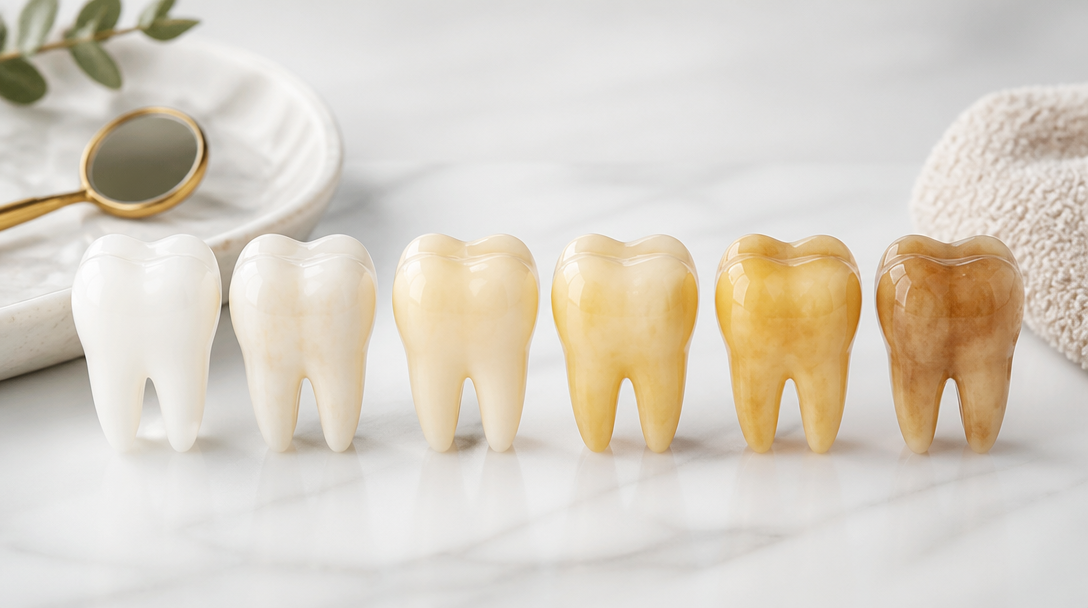
Learn which stains whitening cannot remove — tetracycline, fluorosis, restorations — and what realistic alternatives exist for each type of discoloration.
Why Some Discoloration Stays, No Matter What You Try
Finishing a whitening treatment and finding certain spots completely unchanged is one of the most common sources of frustration in oral care. In most cases, the product worked exactly as designed — it simply cannot reach the kind of discoloration you have. Knowing which stains whitening cannot remove is the clearest path to choosing the right solution from the start, rather than repeating a treatment that was never going to work.
The Core Distinction: Extrinsic vs. Intrinsic Discoloration
Not all tooth discoloration is the same thing. The word "stain" implies something applied from the outside — coffee residue, tobacco pigment, red wine compounds settling onto enamel. These are extrinsic stains, and they sit exactly where whitening agents are designed to act. Peroxide-based formulas and PAP (phthalimidoperoxy caproic acid) systems break down the chromogen molecules that have accumulated on or just inside the enamel surface.
Intrinsic discoloration is a different category entirely. It originates inside the tooth structure — within the dentin, the pulp, or the mineral composition of the enamel itself. No topical agent, regardless of concentration or contact time, can reliably reach and reverse those changes. Identifying which category applies to your teeth is the first decision that matters.
Stains Whitening Cannot Remove: Discoloration Inside the Tooth
Intrinsic discoloration is embedded within the dentin — the dense layer sitting beneath the enamel. According to peer-reviewed dental literature, removal of intrinsic stains within the dentin is considered near impossible through external whitening procedures. Bleaching agents cannot penetrate to the depth required to affect them in any meaningful way.
The most common causes of intrinsic discoloration include:
- Trauma to the tooth. A knocked or damaged tooth can cause internal bleeding that deposits iron compounds within the dentin, darkening the tooth progressively from the inside out.
- A non-vital (dead) tooth. When the pulp dies, the tooth gradually darkens. External whitening has no pathway into the pulp chamber where that process originates.
- Developmental changes during tooth formation. Certain medications or systemic conditions during the years when teeth are forming can permanently alter dentin color before the tooth even erupts.
For a dead or trauma-darkened tooth, the most effective clinical option is internal bleaching — a procedure where a dentist places a bleaching agent directly inside the tooth after removing the affected pulp tissue. Even then, results vary and professional oversight is required throughout. A veneer placed over the tooth is the more predictable long-term option when internal bleaching does not achieve sufficient improvement.
Tetracycline Staining and Fluorosis: Two Conditions That Resist Standard Whitening
Both of these conditions represent categories of stains whitening cannot remove through standard at-home or in-office methods, and both are frequently misunderstood.
Tetracycline staining occurs when the antibiotic tetracycline is taken during the years when teeth are forming. The drug binds to calcium ions in developing dentin and becomes permanently incorporated into the mineralized tissue. The result is gray, brown, or banded discoloration that runs through the dentin itself — not on the surface. Because the pigment is chemically bonded within the tooth structure, topical bleaching agents have very limited effect. Some prolonged professional bleaching protocols show partial improvement in mild cases. Moderate to severe tetracycline staining does not respond well to whitening alone.
Dental fluorosis follows a different mechanism. Caused by excessive fluoride intake during enamel development, it presents as white spots, streaks, or in more severe cases, brown pitting on the enamel surface. Those white spots are areas of hypomineralization — not pigment deposits — which is why standard whitening cannot correct them. Whitening the surrounding enamel can actually make the contrast between healthy enamel and fluorosis areas more noticeable, not less.
For both conditions, the appropriate clinical response depends on severity. Dentists typically recommend veneers, composite bonding, or microabrasion. These approaches mask or physically alter the surface rather than attempting to bleach through it.
Crowns, Veneers, and Fillings: Why They Stay the Same Shade
This is one of the most common sources of post-whitening disappointment — and it is entirely preventable with the right information upfront.
The American Dental Association states clearly that only natural teeth can be whitened. Tooth-colored restorations — crowns, veneers, composite bonding, and implant crowns — do not change color when exposed to whitening agents. If you whiten your natural teeth after restorations are already in place, a visible shade mismatch can develop between your natural teeth and the restored ones.
The science behind this is direct. Whitening agents work by oxidizing organic pigment molecules within natural tooth structure. Dental ceramics, porcelain, and composite resins do not contain the same organic chromogens. There is nothing for the peroxide to act on.
Peer-reviewed research published in PubMed Central adds a further caution: bleaching agents can cause unacceptable color change and reduced stability in composite restorations, glass ionomer cements, and certain ceramic surfaces. The chemical interaction does not whiten these materials — it can degrade their surface integrity over time.
The standard clinical approach is to whiten natural teeth first, allow the shade to stabilize for a few weeks, and then replace or adjust restorations to match the new lighter shade. Discuss that sequence with your dentist before starting any whitening treatment if you have visible restorations.
What Whitening Can Realistically Do for Age-Related Yellowing
Age-related yellowing is one of the most responsive forms of discoloration, and understanding why helps set accurate expectations.
Two processes happen simultaneously as teeth age. Enamel gradually thins from years of use, making the naturally yellow dentin beneath more visible. Dentin itself also darkens slightly as secondary dentin forms over time. Layered on top of this are years of dietary exposure — coffee, tea, wine — that allow extrinsic staining compounds to accumulate within the outer enamel layer.
Whitening agents address this combination well. They lighten the extrinsic component effectively and, to a degree, reach and lighten the color of the outer dentin layer through the enamel. For most people with age-related yellowing, the result is a meaningful, visible improvement.
What whitening cannot do, even here, is reverse the structural thinning of enamel or fully counteract deep dentin darkening. Results are real but have a ceiling, and that ceiling differs for every person depending on their natural tooth color, enamel thickness, and the extent of staining present.
Stains Whitening Cannot Remove: A Clear Reference Table
A useful way to assess any discoloration is to ask where it actually lives in the tooth structure. That single question determines whether whitening is the right tool.
| Type of Discoloration | Location | Whitening Effective? | Realistic Alternative |
|---|---|---|---|
| Coffee, tea, tobacco staining | Enamel surface / outer enamel | Yes | Whitening and consistent oral hygiene |
| Age-related yellowing | Enamel and outer dentin | Largely yes | Whitening; results vary by individual |
| Tetracycline staining | Deep within dentin | Minimal to none | Veneers or composite bonding |
| Fluorosis white spots | Enamel hypomineralization | No — may worsen contrast | Microabrasion, bonding, or veneers |
| Trauma-darkened or dead tooth | Pulp chamber and dentin | No (external whitening) | Internal bleaching or veneer |
| Crowns, veneers, composite fillings | Restoration material | No | Replacement matched to new shade |
Whitening is the right tool for natural tooth structure carrying extrinsic or mild surface-level discoloration. For anything embedded deeper in the dentin or structural in origin, a restorative approach is almost always the more appropriate choice.
Having an Honest Conversation With Your Dentist
Many people skip a dental consultation before whitening because they assume it is unnecessary for an over-the-counter product. That assumption is where mismatched expectations begin.
Go in with specific questions rather than a general request for whiter teeth:
- Ask your dentist to identify the type of discoloration you have. Extrinsic staining, intrinsic discoloration, or a combination? That single answer determines whether whitening is the right starting point.
- Disclose all existing restorations. Crowns, bonding, veneers, and tooth-colored fillings will not change shade. Your dentist can map where they are and help you anticipate any mismatch before it happens.
- Ask about the realistic ceiling for your specific teeth. Natural tooth color varies significantly between individuals. Someone with naturally gray-toned teeth will not reach the same result as someone with yellow-toned teeth, even using identical treatment.
- Ask directly whether any discoloration you have is known to be resistant to whitening — specifically fluorosis spots, tetracycline banding, or any sign of a non-vital tooth.
- Discuss sequencing if restorative work is planned. Whitening first and then color-matching the restoration to the new lighter shade is the standard recommended order.
A dentist who tells you clearly when whitening is unlikely to help is giving you the most valuable guidance available. The goal is a result you are satisfied with — not a treatment completed for its own sake.
Whitening is a genuinely effective tool for the right type of discoloration. Knowing precisely where its limits are is not a reason to avoid it — it is a reason to use it with confidence when it is the correct choice.
References
- American Dental Association — Oral Health Topics: Whitening
- Tooth Whitening: What We Now Know — PubMed Central, peer-reviewed dental literature
Note: The research base for this article draws on two authoritative sources — the American Dental Association and a peer-reviewed article published in PubMed Central. Additional supporting context comes from dental clinical summaries consistent with ADA consensus. No proprietary product claims or unverified statistics are presented.
Disclaimer
This article is for general informational purposes only and is not a substitute for professional dental or medical advice. Always consult a qualified dental professional before starting any teeth-whitening or oral-care regimen. WhiteningBright makes no warranties as to the completeness or accuracy of the information, and any reliance is at your own risk.