Whitening With Sensitive Teeth: What Actually Works
20 juin 2026
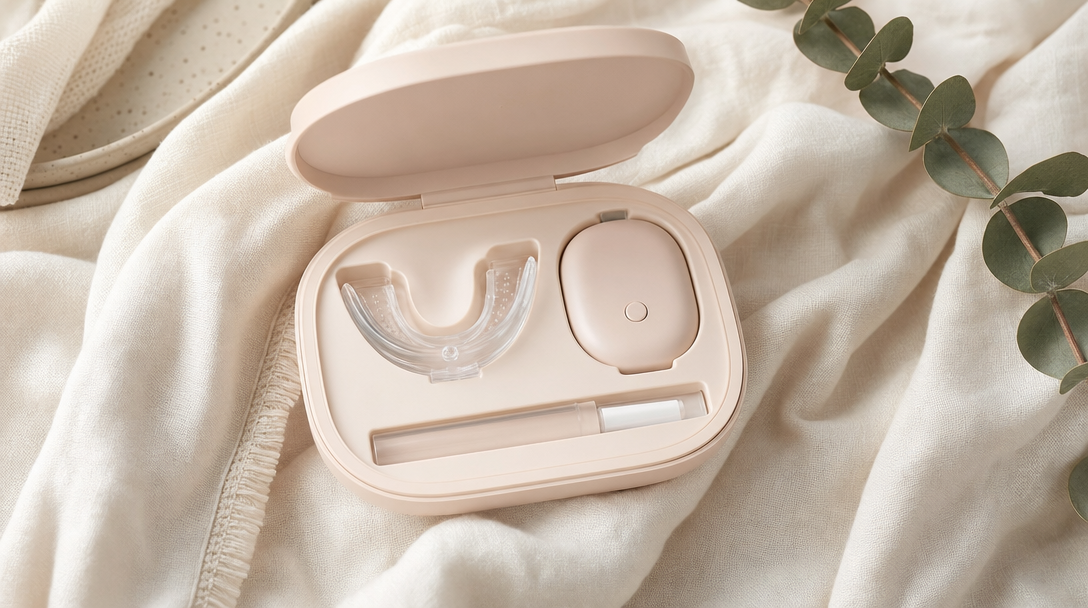
Discover which ingredients, formats, and protocols make whitening for sensitive teeth safe and effective — and when to skip whitening altogether.
Why Sensitive Teeth React Badly to Standard Whitening
Whitening for sensitive teeth is possible — but it requires understanding why discomfort happens before choosing any product or protocol. That distinction matters more than the brand on the box.
Beneath the outer enamel layer sits dentin, a porous tissue threaded with microscopic tubules that run toward the nerve. When enamel is thin, worn, or when gum recession exposes the root surface, those tubules lose their protective covering. According to the National Institute of Dental and Craniofacial Research, sensitivity occurs when stimuli — temperature, pressure, or certain chemicals — reach the nerve through these open pathways.
Standard whitening agents, particularly higher-concentration hydrogen peroxide, temporarily increase fluid movement through dentinal tubules. That fluid shift triggers the nerve, producing the sharp, shooting discomfort many people associate with whitening. For teeth that are already reactive, even brief exposure can feel significant.
The practical takeaway: sensitivity during whitening is largely manageable. The right outcome depends on which active ingredient you select, how long it contacts your teeth, and how you structure the treatment cycle.
How PAP Works Differently for Whitening Sensitive Teeth
Phthalimidoperoxy caproic acid — PAP — has become the leading non-peroxide alternative for people who find peroxide difficult to tolerate. PAP whitens through a targeted oxidation process that acts directly on chromogen molecules, the compounds responsible for staining, without generating free radicals in the same way hydrogen peroxide does.
That difference matters for sensitivity. Free radicals from peroxide are believed to contribute to pulpal irritation and the nerve response behind post-whitening discomfort. PAP's mechanism is more selective, which is why PAP-based formulations are generally associated with a lower sensitivity profile.
PAP is not a replacement for every situation. It tends to work more gradually than higher-concentration peroxide treatments, and its whitening ceiling is lower for deeply stained teeth. For someone with genuinely sensitive enamel, though, a PAP-based strip, tray gel, or pen used consistently over several weeks can deliver meaningful shade improvement without the nerve response.
Many current PAP formulations also include hydroxyapatite, a mineral compound that remineralizes enamel and partially occludes open dentinal tubules. This dual action — whitening and remineralizing in the same session — makes PAP-plus-hydroxyapatite combinations a practical first choice for sensitive patients.
Peroxide Protocols That Reduce Sensitivity Without Losing Results
Peroxide-based whitening remains the most clinically studied approach. A peer-reviewed review published via PubMed confirms that peroxide whitening is effective, and that home-based regimens generally cause less sensitivity than in-office bleaching — a meaningful distinction for anyone concerned about discomfort.
Concentration and contact time are the two variables that matter most. Lower concentrations of hydrogen peroxide, in the range used in over-the-counter strips and take-home trays, applied for shorter durations produce less pulpal irritation than the high-concentration gels used in professional chair-side treatments. The same review notes that light-activation devices offer no clear benefit for reducing sensitivity, so LED-enhanced treatments carry no special advantage on that front.
Carbamide peroxide is a slower-releasing alternative. It breaks down into hydrogen peroxide gradually, which can mean a gentler experience for some users — though total peroxide exposure still needs careful management.
Practical strategies supported by peer-reviewed dental literature include:
- Shorter wear time: Using strips or trays for less than the maximum recommended duration, especially during the first few applications
- Lower frequency: Starting every other day rather than daily
- Desensitizing pre-treatment: Applying a potassium nitrate toothpaste or gel before whitening sessions to calm the nerve response
- Spaced treatment cycles: Taking deliberate breaks between whitening rounds rather than running consecutive cycles back to back
The American Dental Association specifically notes that desensitizing toothpaste containing potassium nitrate may help before and after whitening, and that short pre-treatment tray use may be appropriate for sensitive patients. This is a clinical recommendation, not a marketing position.
Formats Suited to Whitening for Sensitive Teeth
The format determines how much whitening agent contacts your teeth, for how long, and how precisely it's applied. For sensitive teeth, these details carry real consequences.
Whitening Strips
Strips deliver a controlled gel amount in a thin, flexible format. Because the gel layer is thin and contact time is fixed, they're relatively straightforward to manage. Look for strips with lower peroxide concentrations or PAP formulations. Avoid products advertising extended wear times if your teeth are already reactive.
Custom-Fitted Trays
Custom trays fabricated by a dentist hold gel precisely against the tooth surface with minimal contact with the gums — a genuine advantage, since gum irritation compounds overall oral discomfort during whitening. The ADA recommends custom trays for patients who need more controlled exposure. Over-the-counter universal trays can allow gel to pool against soft tissue, increasing irritation risk.
Whitening Pens
Pens apply a thin, targeted layer of gel and are typically used for touch-ups rather than full treatment cycles. Because the application is precise and the gel layer minimal, pens tend to cause less sensitivity than full-mouth strip or tray protocols. They serve well as a maintenance tool between cycles without re-exposing all teeth to a complete whitening regimen.
Whitening Toothpastes
Most whitening toothpastes work primarily through mild abrasives rather than peroxide chemistry. They carry the lowest risk for sensitive teeth but also the most limited shade-change potential. Use them to maintain results, not as a primary whitening method.
Timing and Habits That Lower Post-Whitening Discomfort
Even a well-formulated product can cause temporary discomfort when used carelessly. A few consistent habits make a measurable difference.
Start desensitizing toothpaste two weeks before your whitening cycle. Potassium nitrate works by calming the nerve gradually — it is not an instant fix. Building up that protective effect before treatment starts is a strategy the ADA supports for sensitive patients.
Whiten at night. Post-whitening sensitivity tends to peak in the hours immediately after treatment. Whitening before bed reduces exposure to cold drinks, temperature changes, and other triggers during the most reactive window.
Avoid acidic food and drinks for at least an hour after whitening. Acidic beverages temporarily soften enamel. Combining that effect with an already-stimulated nerve reliably worsens discomfort.
Treat each whitening session as an isolated event. Using a whitening strip and then immediately brushing with a whitening toothpaste does not compound results — it compounds exposure. The two should not be layered in the same session.
Take structured breaks between cycles. Rest periods allow enamel to remineralize and the nerve to settle. Continuous back-to-back whitening is the most consistent driver of persistent sensitivity.
When Sensitivity Means You Should Pause or Skip Whitening Entirely
Temporary sensitivity during whitening is common. Some situations, though, make whitening genuinely contraindicated — not just uncomfortable, but potentially harmful.
Pause or avoid whitening if any of the following apply:
- Pain persisting beyond 48 hours after a session — this can indicate pulpal inflammation requiring professional evaluation
- Sharp, spontaneous pain unrelated to eating or drinking, which may signal nerve damage or an undiagnosed dental condition
- Visible cracks or chips in enamel — whitening agents can penetrate through damaged enamel more aggressively, reaching the pulp
- Active gum disease or untreated cavities — the FDA advises consulting a dental professional before using whitening products if existing oral health concerns are present
- Severely receded gums exposing large areas of root surface, which lacks enamel entirely and has no protective barrier against whitening agents
- Known peroxide intolerance — some individuals have a genuine physiological response, not simply mild discomfort
Sensitivity that existed before whitening and worsens significantly during treatment is a signal worth acting on. Pushing through escalating discomfort is not a strategy — it is a risk to the underlying tissue.
Questions to Ask Your Dentist Before Starting a Whitening Routine
A dental visit before whitening provides accurate information about enamel thickness, gum health, and how existing restorations — crowns, veneers, bonding — will respond. Restorations do not whiten the same way natural enamel does, and knowing that in advance prevents uneven results and wasted effort.
Bring these specific questions to your appointment:
- Is my enamel thick enough to tolerate whitening? Your dentist can assess wear and advise on appropriate concentration levels.
- Do I have active decay or gum issues that need treatment first? Whitening on compromised teeth can worsen existing problems.
- Would a custom tray serve me better than an over-the-counter option? For sensitive patients, the precision of a custom tray often matters significantly.
- How long should I use a desensitizing treatment before I start? Your dentist can design a specific pre-treatment protocol based on your sensitivity level.
- Are any restorations in visible areas that won't respond to whitening? Identifying these beforehand manages expectations and prevents frustration.
The FDA recommends that consumers consult a dental professional if they have concerns about sensitivity or oral health before using whitening products. A short consultation can prevent weeks of discomfort and wasted product — it is practical advice, not a formality.
Whitening for sensitive teeth is achievable for most people. The right ingredient, the right format, the right timing, and an honest assessment of your current oral health are what separate a comfortable, effective result from a frustrating one.
References
- Tooth Whitening: What We Now Know — PMC / Peer-Reviewed Review (PubMed Central)
- Tooth Whitening/Bleaching: Treatment Considerations — American Dental Association
- Teeth Whitening Products — U.S. Food and Drug Administration
Disclaimer
This article is for general informational purposes only and is not a substitute for professional dental or medical advice. Always consult a qualified dental professional before starting any teeth-whitening or oral-care regimen. WhiteningBright makes no warranties as to the completeness or accuracy of the information, and any reliance is at your own risk.
---