Why Your Teeth Won't Whiten Past a Certain Shade
24 juin 2026
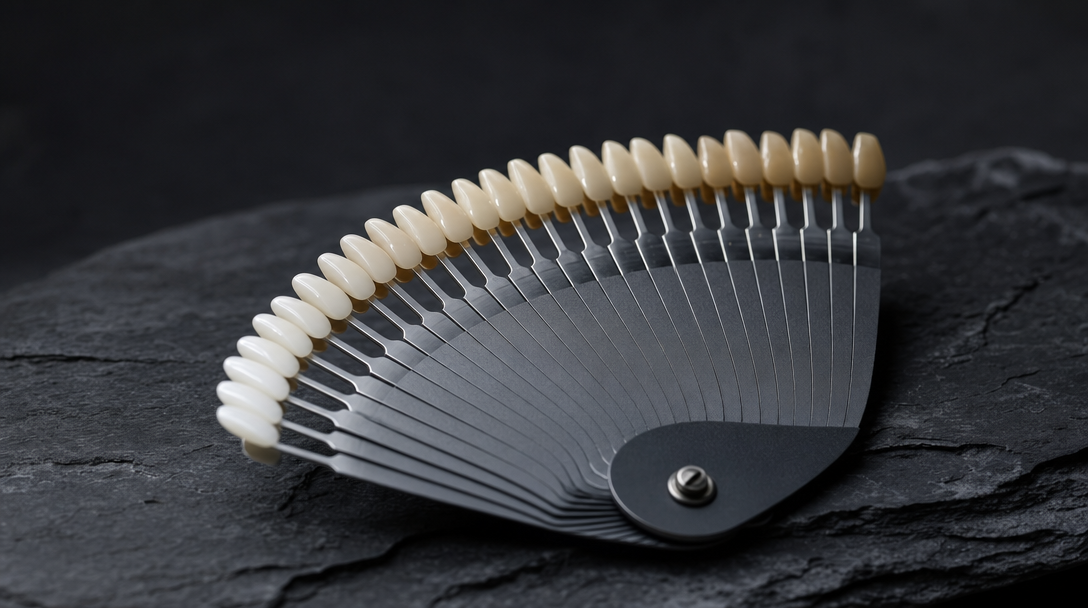
Learn why a teeth whitening results plateau happens, the biological limits behind it, and what you can realistically do once you've reached your ceiling.
Why Your Teeth Won't Whiten Past a Certain Shade
If you have been whitening consistently and your results have stalled, you are not imagining it. A teeth whitening results plateau is a real, biologically predictable event — not a sign that your product has failed or that a stronger formula is the answer. Understanding why it happens can save you from unnecessary expense, avoidable sensitivity, and the frustration of chasing a shade your teeth structurally cannot reach.
This article explains the biological and structural reasons whitening hits a ceiling, why that ceiling sits at a different shade for every person, and what realistic options exist once you have reached it.
Your Natural Tooth Color Has a Genetic Baseline
The visible shade of your teeth is set primarily by dentin — the dense inner layer beneath the translucent outer enamel. Dentin ranges from pale yellow to deep gray-brown depending on genetics, and no whitening treatment changes the underlying hue your dentin was built with.
Enamel is semi-transparent. As it thins with age or wear, more dentin shows through — which is why older teeth often look more yellow even without significant staining. Whitening agents penetrate enamel and oxidize stain molecules within the dentin, but they cannot recolor dentin beyond its natural bleachable range.
Think of it like bleaching fabric. A cream-colored cloth can go lighter, but it will never become bright white because the fiber itself has a base tone. Your teeth work the same way.
Surface Stains vs. Intrinsic Discoloration: Why the Difference Matters
Not all tooth discoloration responds to whitening. Confusing the two types is one of the most common reasons people feel their results have plateaued when whitening was never the right tool to begin with.
Extrinsic (Surface) Stains
These sit on or just below the enamel surface, caused by coffee, tea, red wine, tobacco, and certain foods. Hydrogen peroxide and carbamide peroxide are effective at breaking them down. A professional cleaning followed by a whitening course typically removes the majority of extrinsic staining.
Intrinsic Discoloration
This originates inside the tooth structure. Common causes include:
- Tetracycline antibiotic exposure during tooth development, which binds gray or brown pigment directly into dentin
- Dental fluorosis, which creates white spots or brown streaking within the enamel
- Trauma, which can cause internal bleeding that stains dentin from within
- Natural aging, which gradually darkens dentin over time
The American Dental Association confirms that the degree of whitening depends heavily on the type of intrinsic stain present. Brown stains from tetracycline or fluorosis may respond to bleaching over extended treatment periods. White fluorosis spots, however, can become more visible as the surrounding tooth lightens — an outcome that makes whitening counterproductive in those cases.
What a Teeth Whitening Results Plateau Actually Means
A teeth whitening results plateau occurs when the oxidizing agents in your whitening product have broken down all the stain molecules that are accessible and chemically reactive. Continuing to apply peroxide at that point does not produce further lightening — it exposes tooth structure to unnecessary chemical stress.
Research published on PubMed Central confirms that aggressive bleaching causes enamel softening and microstructural changes, and that sensitivity increases with higher concentrations. This is the biological threshold: the point beyond which further whitening damages the tooth rather than improving it.
Reaching for a stronger formula once you have plateaued is a predictable but mistaken response. More concentration does not equal more whiteness past this point — it means more risk.
The Factors That Set Your Personal Whitening Ceiling
Several variables interact to determine how light your teeth can safely go. None are fully within your control, but understanding them helps you set accurate expectations.
Genetics and Baseline Dentin Shade
Your inherited dentin color is the single largest factor. Two people using the same product for the same duration will often finish at noticeably different shades — not because one product worked and the other did not, but because their starting biology differs.
Age and Enamel Thickness
Enamel thins gradually throughout life. Thinner enamel means greater dentin visibility and a harder ceiling to push against. Younger teeth with thicker enamel typically respond more dramatically to whitening treatment.
Existing Dental Restorations
This is a hard limit that no whitening product can overcome. The American Dental Association is explicit on this point: tooth-colored restorations — fillings, crowns, veneers, and bonding — do not whiten. As the natural teeth around them lighten, restorations stay the same shade, creating visible contrast.
If your front teeth include bonding or crowns, your effective whitening ceiling may be set by the shade of those restorations, not by your natural enamel. That is a structural fact, not a product limitation.
Concentration and Treatment Duration
The ADA advises that unsupervised home use should stay at or below 3% hydrogen peroxide or 10% carbamide peroxide. Higher concentrations carry documented risks of enamel erosion and pulpal sensitivity.
Hydrogen peroxide whitens faster than carbamide peroxide but causes transient dentinal hypersensitivity — the most common side effect of whitening — which limits how long treatment can safely continue. In the United States, the FDA does not set a universal hydrogen peroxide cap for over-the-counter whitening products, which means some OTC products exceed concentrations that carry documented clinical risk. ADA guidelines are the more reliable benchmark for safe home use.
Stain Type and Chemistry
Some stain molecules oxidize readily; others are chemically resistant. Tetracycline-related discoloration, for example, is among the most resistant forms of intrinsic staining and may require prolonged supervised protocols with only partial improvement even then.
Maintenance Once You Have Reached Your Limit
Reaching your plateau does not mean your results will hold automatically. Extrinsic staining from diet and lifestyle continues to accumulate, so without maintenance, teeth gradually drift back toward a darker shade.
Practical strategies at this stage:
- Low-concentration maintenance whitening — periodic use of a lower-strength product at ADA-recommended concentrations to clear new surface staining before it builds
- Whitening toothpaste — formulas with mild abrasives or low-dose peroxide help manage day-to-day extrinsic staining without the intensity of a full treatment course
- Dietary adjustments — reducing high-stain beverages or rinsing with water after consuming them slows re-staining significantly
- Regular professional cleaning — hygienist polishing removes surface deposits that home products cannot fully address
The goal at this stage is preservation, not further lightening. Attempting to push past your plateau with more frequent or more concentrated treatments does not produce a brighter result. It increases the risk of sensitivity, enamel damage, and — in serious cases — internal or external root resorption, an irreversible structural complication documented in the clinical literature on over-whitening.
When Whitening Is the Wrong Tool Entirely
Certain clinical situations mean whitening will not meaningfully improve tooth appearance, regardless of product strength or treatment length. Recognizing these early prevents wasted effort and potential harm.
Severe Tetracycline Staining
Deep gray or banded discoloration from tetracycline use during tooth development is among the most resistant forms of intrinsic staining. Bleaching may produce limited improvement over extended supervised treatment, but it rarely achieves the outcome patients are hoping for. Cosmetic options such as porcelain veneers are typically more effective in these cases.
White Spot Fluorosis
If fluorosis has created white spots on your enamel, whitening the surrounding tooth may make those spots more prominent by increasing contrast. This is a situation where whitening can make the aesthetic outcome worse, not better.
Significant Restoration Coverage
If a large portion of your visible tooth surface is covered by crowns, veneers, or bonding, whitening the remaining natural tooth may create mismatched shading rather than an improvement. A dentist can assess whether whitening makes practical sense given your specific restoration coverage.
Gray Undertones From Trauma or Aging
Gray discoloration — particularly from internal bleeding after trauma — originates deep within the tooth and is largely inaccessible to standard peroxide treatments. Internal bleaching performed by a dentist is sometimes an option, but it is a clinical procedure, not a home treatment.
Realistic Expectations: What a Good Result Looks Like
A successful whitening outcome is not necessarily the lightest shade on a dental shade guide. It is the lightest shade your teeth can safely reach, with natural structure intact and sensitivity managed.
For most people with healthy enamel and primarily extrinsic staining, whitening produces a meaningful, visible improvement that can be maintained with consistent low-intensity upkeep. For people with significant intrinsic discoloration, existing restorations, or thinner enamel, the realistic outcome is more modest — and the honest conversation is about what whitening can and cannot do for their specific situation.
If you have reached a teeth whitening results plateau and are wondering whether more treatment is worthwhile, the most useful step is a conversation with a dentist who can assess your stain type, restoration coverage, and enamel condition. That clinical picture will tell you more than any product claim can.
Whitening is a genuinely effective tool within its biological limits. Understanding those limits — rather than trying to push past them — is what separates a good outcome from an expensive and potentially damaging one. If you want to explore formulations designed with those limits in mind, browse the WhiteningBright product range for options built around evidence-based concentrations and responsible treatment protocols.
References
- American Dental Association — Oral Health Topics: Whitening
- PubMed Central — Bleaching effects on enamel microstructure and sensitivity (PMC4058574)
- FDA Law Blog — OTC Whitening Regulation and Hydrogen Peroxide Concentrations
Note: The FDA Law Blog is cited here solely for its documented summary of FDA regulatory practice regarding OTC hydrogen peroxide concentrations. Readers seeking primary regulatory guidance should consult FDA.gov directly.
Disclaimer
This article is for general informational purposes only and is not a substitute for professional dental or medical advice. Always consult a qualified dental professional before starting any teeth-whitening or oral-care regimen. WhiteningBright makes no warranties as to the completeness or accuracy of the information, and any reliance is at your own risk.