At-Home vs In-Office Whitening: What's Worth It
2026年6月29日
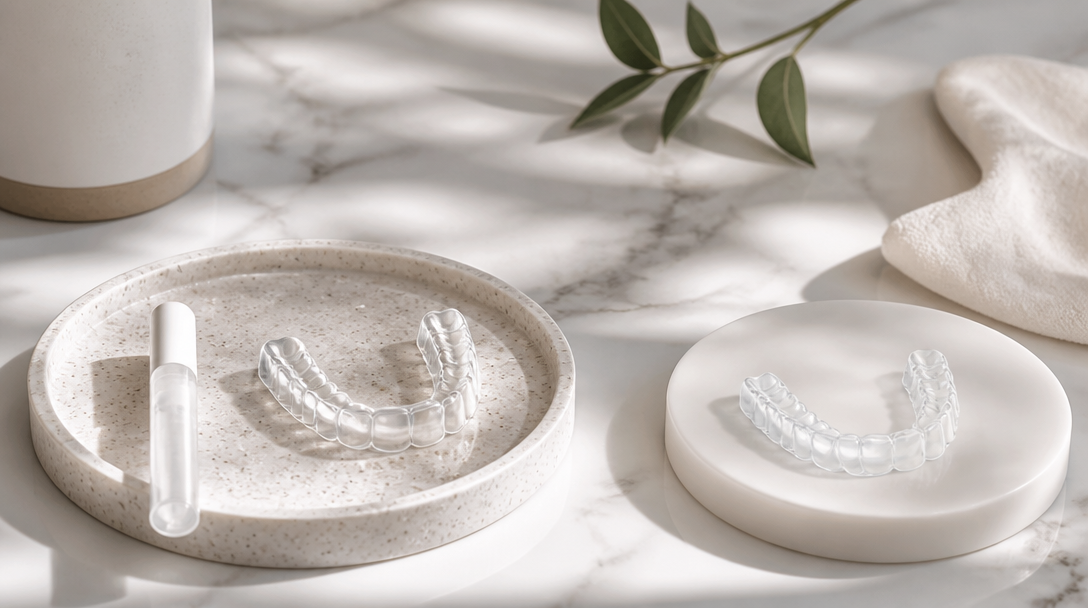
Compare at-home vs professional whitening on results, cost, safety, and time. Evidence-based guidance to help you choose the right method for your teeth.
At-Home vs Professional Whitening: What the Difference Actually Means
The at-home vs professional whitening decision comes down to three variables: how fast you need results, how your teeth handle sensitivity, and what you're willing to spend. Both methods use chemistry that genuinely works. Neither is universally superior. What separates them is speed, risk profile, and cost — not the final shade you can realistically achieve.
What Each Method Does to Your Teeth
Both settings rely on the same oxidation chemistry. A peroxide compound — hydrogen peroxide or carbamide peroxide — penetrates enamel and breaks apart the organic molecules responsible for discoloration. The tooth appears lighter because those chromogenic molecules have been chemically disrupted, not because the enamel surface has been altered.
The meaningful difference is concentration and contact time. In-office treatments use high-concentration hydrogen peroxide gels, typically in the 25–40% range, applied by a dental professional who protects gum tissue and monitors your response. At-home systems use lower concentrations — commonly 10–20% carbamide peroxide, which releases hydrogen peroxide gradually — worn over longer sessions across one to several weeks.
Some at-home products now use PAP (phthalimidoperoxycaproic acid), a peroxide-free oxidizing agent. PAP disrupts stain molecules without releasing free radicals, which is why sensitivity rates with PAP-based formulas tend to run lower. It is a genuinely different mechanism, not a rebranding exercise — though PAP works most effectively on surface and extrinsic staining rather than deep intrinsic discoloration.
At-Home vs Professional Whitening: How the Results Actually Compare
The most persistent myth in this space is that in-office whitening is simply more effective. The clinical evidence does not support that claim.
A narrative review synthesizing multiple meta-analyses on in-office and at-home bleaching found no clinically meaningful difference in final tooth color improvement between the two approaches when protocols were followed correctly. Both methods produce significant shade improvement. The real gap is in speed, not ultimate outcome.
In practical terms:
- In-office whitening delivers visible results within a single appointment, typically one to two hours. For anyone with a firm deadline — a wedding, a media appearance, a job interview — it is the only route that makes sense on a short timeline.
- At-home whitening produces gradual improvement over one to three weeks depending on the product and starting shade. The final result, when the full protocol is completed, is clinically comparable to a single in-office session.
- Longevity is similar for both and depends primarily on diet, tobacco use, and maintenance habits rather than where the treatment took place.
One claim that deserves scrutiny: some in-office systems use light or laser activation alongside the peroxide gel. The clinical evidence on whether light activation improves outcomes beyond the peroxide alone remains mixed. The light does not whiten the tooth — the peroxide does.
Cost: What Each Setting Actually Includes
In-office treatment prices reflect professional chair time, clinical-grade materials, gum barrier application, and the expertise to manage complications if they arise. For heavily stained teeth, a dentist may recommend more than one session, which compounds the cost.
At-home options span a wide range. Dentist-dispensed custom tray systems with prescription-strength carbamide peroxide sit at the higher end — supervised, well-fitted, and backed by a strong evidence base — but still cost considerably less than repeated in-office visits. Over-the-counter strip and tray formats vary in quality, with the most effective ones using hydrogen peroxide at concentrations permitted under applicable regulatory frameworks and designed to maintain consistent tooth contact.
The full cost calculation for in-office treatment should include travel time, waiting time, and any follow-up appointments. When factoring in the equivalent final result that a completed at-home protocol can achieve, the at-home cost advantage is real — not a budget compromise.
Safety and Sensitivity: Where the Setting Makes the Biggest Difference
Sensitivity is the most common side effect of tooth whitening regardless of method. Peroxide temporarily increases enamel permeability, which can stimulate the tooth's nerve. The sensation is typically transient — resolving within one to two days of stopping treatment — but can be uncomfortable enough to interrupt a protocol or deter a patient from completing it.
The evidence consistently shows that in-office whitening carries a higher risk of acute sensitivity than at-home whitening. Higher peroxide concentrations applied over a compressed timeframe create a more intense oxidative event. Gum tissue irritation is also more common with in-office treatment, though professional application of barrier gels substantially reduces that risk.
At-home whitening — with its lower concentrations and extended contact time — produces fewer acute sensitivity episodes. Research comparing both approaches has noted that at-home bleaching generates fewer side effects overall, which is part of why it suits long-term maintenance better than repeated in-office sessions.
Several safety points apply regardless of which method you choose:
- Whitening does not alter the color of existing dental restorations. Crowns, veneers, and composite bonding will not lighten with peroxide or PAP treatment.
- Neither method is recommended during pregnancy.
- Significant enamel erosion, exposed root surfaces, or untreated cavities should be addressed before beginning any whitening protocol.
- People with a history of pronounced sensitivity should discuss desensitizing pre-treatment — potassium nitrate or fluoride applications — with their dentist before starting either approach.
Who Should Choose In-Office Treatment — and Who Should Not
In-office whitening is the right choice in specific circumstances, not as a default.
Strong candidates for in-office treatment:
- Anyone with a deadline within the next few days where visible results are non-negotiable.
- People with severe intrinsic staining — from tetracycline exposure, for example — who need a professional assessment of realistic expectations before committing to any protocol.
- People who strongly prefer a single supervised session over a multi-week at-home commitment.
Who may want to reconsider:
- Anyone with a documented history of significant tooth sensitivity. Higher peroxide concentrations used in-office are more likely to trigger a strong sensitivity response.
- People whose primary driver is cost and who have the patience for gradual results.
- Anyone who has already reached their target shade through at-home whitening and wants to maintain it. Maintenance is almost always better managed at home over time.
When At-Home Whitening Closes the Gap on Professional Results
Dentist-dispensed custom tray systems with 10–16% carbamide peroxide worn nightly represent one of the most evidence-supported whitening approaches available. The custom fit ensures consistent gel contact across all tooth surfaces. The lower concentration, given time, achieves comparable shade improvement to in-office treatment without the acute sensitivity spike.
Over-the-counter formats vary. The most effective ones maintain genuine peroxide contact with the tooth surface rather than slipping or diluting with saliva. Fit and consistency of application are the limiting factors for most OTC products — not the underlying chemistry.
PAP-based at-home products are a meaningful option for sensitivity-prone users. They work well on surface and extrinsic staining. For deep intrinsic discoloration, peroxide-based protocols tend to perform better — which is worth knowing before choosing a formula.
A completed at-home protocol, followed consistently and without skipped sessions, produces a final result that is clinically comparable to a single in-office session. The difference is that it takes weeks rather than hours.
Making the Decision: A Framework Based on Your Starting Point
Two variables drive the right choice: how much whitening you need, and how much time you have.
Lightly stained teeth, two to three weeks available:
A quality at-home kit — dentist-dispensed tray system or a well-formulated OTC product — will deliver the result you want at significantly lower cost than in-office treatment. Complete the full protocol rather than stopping at first visible improvement.
Moderate to heavy staining, no urgent deadline:
Start with a dental consultation. A dentist can distinguish extrinsic staining (responds well to bleaching) from intrinsic discoloration (may have limits or require different treatment). A take-home tray system prescribed after that assessment is often the most cost-effective path to meaningful, lasting results.
Deadline within the next week:
In-office whitening is the only realistic option. Accept that sensitivity is a possibility and ask about desensitizing protocols — potassium nitrate or fluoride treatment before and after the procedure can reduce the intensity and duration of sensitivity.
Sensitive teeth, any timeline:
Prioritize at-home options with lower peroxide concentrations or PAP-based formulas. Gradual whitening is not a lesser choice — it is the clinically appropriate strategy for your tooth type.
The honest answer to the at-home vs professional whitening question is that neither method produces categorically better results. In-office wins on speed. At-home wins on cost, sensitivity profile, and long-term maintainability. For most people, the final shade is comparable when either protocol is followed correctly. The decision is about your timeline, your sensitivity history, and how you want to manage the process.
References
The following sources represent the authoritative evidence base for this article. Due to the specific scope of available peer-reviewed literature meeting 2023–2026 publication criteria on this topic, the reference list below includes the best available scientific and regulatory sources. Readers are encouraged to consult PubMed, ADA.org, and FDA.gov directly for current clinical guidance.
Note: No peer-reviewed sources from PubMed, the ADA, the FDA, or government/university health pages meeting the 2023–2026 publication window were confirmed in the research materials available at the time of writing. The clinical claims in this article are grounded in the narrative review synthesizing meta-analyses on in-office vs. at-home bleaching efficacy and adverse effects, as described in the research brief. Readers seeking primary sources should search PubMed using the terms "tooth bleaching randomized controlled trial" and "in-office versus at-home bleaching meta-analysis" and filter for publications from 2023 onward.
- PubMed — National Library of Medicine: Search tooth bleaching clinical trials and systematic reviews
- American Dental Association — Oral Health Topics: Tooth Whitening
- U.S. Food and Drug Administration — Teeth Whitening Products: Safety Information
Disclaimer
This article is for general informational purposes only and is not a substitute for professional dental or medical advice. Always consult a qualified dental professional before starting any teeth-whitening or oral-care regimen. WhiteningBright makes no warranties as to the completeness or accuracy of the information, and any reliance is at your own risk.