How Teeth Whitening Strips Are Made in 2026
2026年4月23日
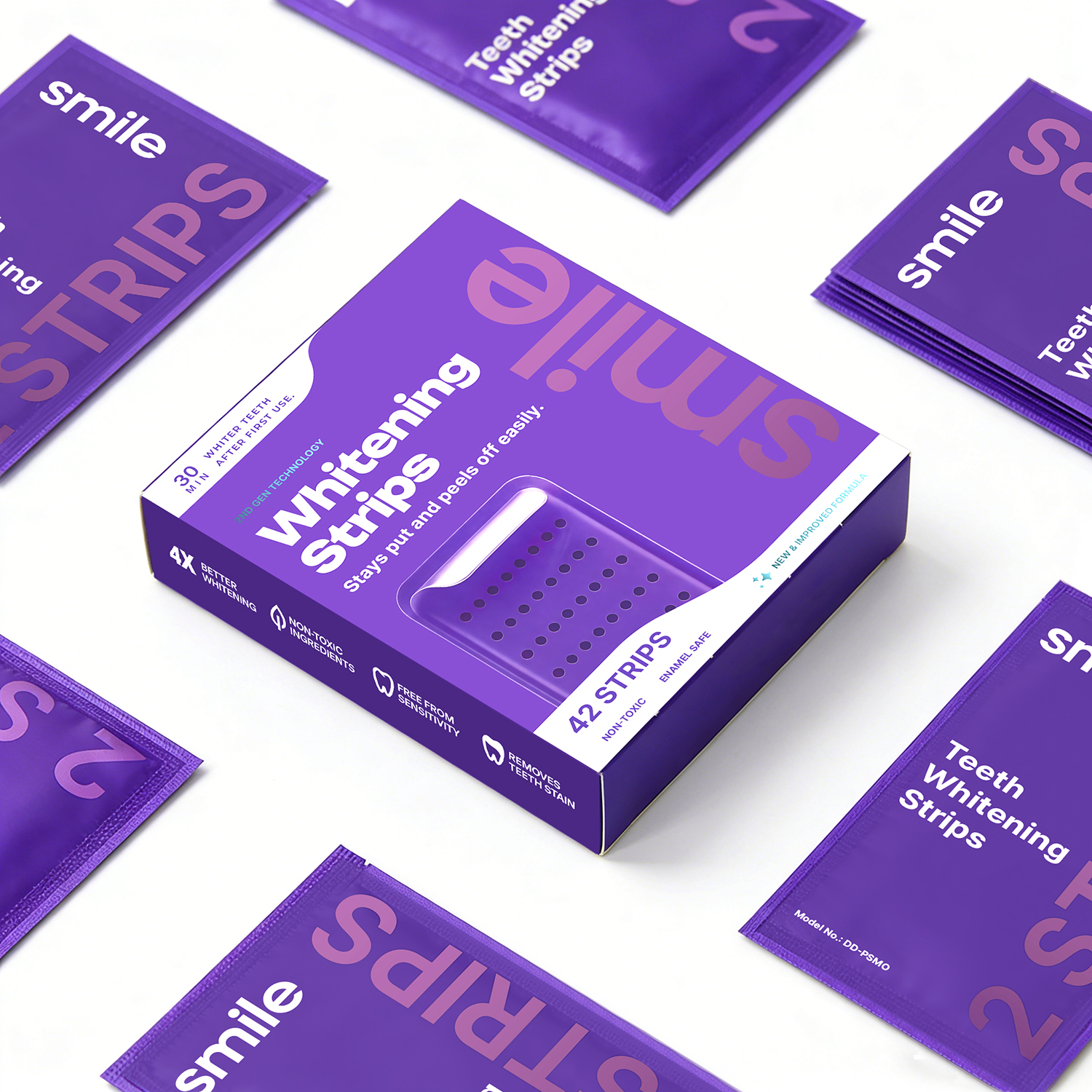
Teeth whitening strips manufacturing has transformed into one of the most precise and science-driven processes in consumer oral care — and in 2026, what goes into that thin, flexible strip is far more sophisticated than most users realize. That familiar pouch holds the result of clean-room chemistry, pharmaceutical-grade coating technology, and years of clinical validation. Understanding how these strips are made explains why the best ones work so reliably, and why cutting corners in production carries real consequences for your enamel and gums.
The 2026 Blueprint: How Teeth Whitening Strips Manufacturing Works From Lab to Shelf
The production process no longer starts on a factory floor. It begins months earlier inside R&D laboratories, where dental researchers and chemical engineers collaborate on formulation design. Their two non-negotiable targets are consistent whitening efficacy and a safety profile that survives contact with living oral tissue. According to the IMARC Group's manufacturing plant project report, a modern Teeth Whitening kit production facility must account for raw material sourcing, machinery specifications, gel chemistry, and packaging in a single integrated framework. Every decision at the design stage flows directly into what the consumer experiences during application. The market rewards this investment. Grand View Research values the global Teeth Whitening strips and gels market at USD 1.15 billion in 2026, with a projected reach of USD 1.83 billion by 2033 at a compound annual growth rate of 6.05%. That growth is driven specifically by innovations in low-sensitivity formulas, peroxide-free agents, and dissolvable formats — all outcomes of more rigorous manufacturing thinking. For a deeper look at how oral care science shapes product development, explore oral care research and whitening science across our professional knowledge resources.Ingredient Sourcing: Purity Determines Performance
The active ingredient defines the strip. Hydrogen peroxide remains the benchmark whitening agent because it penetrates enamel and breaks apart chromogen molecules — the compounds responsible for staining. In 2026, over-the-counter formulations are optimized around concentrations the American Dental Association identifies as safe for consumer use, with 6.5% hydrogen peroxide among the most studied OTC concentrations. Purity at the sourcing stage is non-negotiable. Even trace contaminants in peroxide can destabilize the entire gel matrix, accelerating decomposition before the strip ever reaches the consumer. Manufacturers source pharmaceutical-grade peroxide and subject each incoming batch to independent assay testing before it enters production.Peroxide-Free and Hybrid Formulations
A significant share of 2026 production now incorporates Phthalimidoperoxycaproic Acid (PAP) as the primary bleaching agent. PAP oxidizes stain molecules without generating free radicals, which is the mechanism behind hydrogen peroxide sensitivity. This makes it a preferred choice in low-sensitivity product lines that Grand View Research identifies as one of the strongest growth segments in the current market. Remineralizing agents — particularly hydroxyapatite and fluoride — are routinely blended into the gel to offset any transient mineral loss during the whitening cycle. These are not marketing additions; they are chemically functional components that the manufacturing process must incorporate without destabilizing the active bleaching agent.The Gel Matrix: More Than a Carrier
The gel surrounding the active ingredient does critical work. A properly engineered gel matrix contains humectants such as glycerin to prevent premature drying, polymer-based thickeners that control viscosity so the gel stays on enamel rather than migrating to soft tissue, desensitizing agents like potassium nitrate, and flavor compounds derived from non-staining sources. Each component is tested for chemical compatibility with the active ingredient before inclusion in the final formula. pH stability across the gel matrix is a manufacturing priority with direct clinical implications. Research published via PMC/NIH confirms that OTC strips formulated at 6.5% hydrogen peroxide caused no measurable enamel erosion in vitro when manufactured to maintain a stable, controlled pH. Deviation from that pH window — even slightly — opens the door to demineralization.Inside the Clean Room: Precision Teeth Whitening Strips Manufacturing
Production takes place inside ISO-certified clean rooms where particulate matter, temperature, and humidity are continuously controlled. These environments are standard in pharmaceutical manufacturing and reflect how seriously leading brands treat gel integrity.Slot-Die Coating: The Core of Consistent Dosing
The film substrate — typically a medical-grade clear polymer or flexible non-woven material — feeds through precision rollers at controlled speed. A slot-die coating head deposits the whitening gel in a microscopically even layer across the film surface. Thickness is measured in microns. This matters because the dose delivered to enamel is a direct function of gel volume per unit area, and inconsistent coating means inconsistent results across a single strip, let alone across a production batch. Slot-die technology, borrowed directly from pharmaceutical patch manufacturing, gives Teeth Whitening strips production its most significant quality advantage over earlier spreading or dipping methods. Automated vision systems monitor the coating layer in real time, flagging deviations before they propagate through thousands of units.Curing, Sealing, and the Adhesion Breakthrough
After coating, the film passes through a curing chamber that sets the gel without degrading the active ingredient. This step locks moisture content and active ingredient concentration in a stable matrix. Dimensions of Dental Hygiene highlights that advances in seal technology now allow the gel layer to maintain better coverage and penetrate toward dentin more reliably — a significant upgrade from earlier strip generations that lost contact at tooth curves and interproximal spaces. The cured film is then die-cut into anatomically shaped strips sized for upper and lower arches. Robotic handling systems transfer individual strips to blister packs or single-use foil pouches without human contact, eliminating contamination risk at the most vulnerable stage.Packaging as an Ingredient
Packaging is not a cosmetic decision in Teeth Whitening strips manufacturing — it is a functional one. Each sealed pouch is flushed with nitrogen before closure, displacing the oxygen that degrades hydrogen peroxide. This inert atmosphere preservation ensures the strip you open on day 28 of a treatment cycle has the same active concentration as the strip you opened on day one. Foil laminate construction creates an additional barrier against moisture ingress, which can dilute the gel and compromise adhesion on application.Quality Control: Every Batch Must Earn Its Release
No batch ships without passing a structured quality control sequence. QC laboratories operate in parallel with production, pulling samples at defined intervals throughout each run.- Potency Assay: Titration or spectrophotometric analysis confirms that active ingredient concentration falls within the specified range — no batch ships over or under the stated formulation.
- Adhesion and Coverage Testing: Strips are applied to standardized dental arch models and evaluated for contact coverage, gel migration toward the gumline, and repositioning resistance.
- pH Verification: Every batch is tested at multiple points to confirm pH stability, the critical parameter linking manufacturing quality to enamel safety.
- Stability Testing: Accelerated aging protocols expose production samples to elevated temperature and humidity to project real-world shelf life performance, typically targeting 24-month stability.
- Clinical Validation: Leading manufacturers support formulations with peer-reviewed data. A 2026 study in Frontiers in Oral Health confirmed that low-concentration strips at 3% hydrogen peroxide were effective for extrinsic discoloration on incisors with a strong safety profile — the kind of independent validation that separates credible production programs from generic supply chain products.
Sustainability Practices Reshaping Production in 2026
Environmental accountability now sits alongside efficacy as a production design criterion. The 2026 consumer expects both a whiter smile and a smaller footprint from the brands they choose.- Biodegradable Film Substrates: Several manufacturers have advanced plant-based polymer research to the point of limited commercial deployment, targeting film backings that maintain mechanical performance while degrading more responsibly at end of life.
- Mono-Material Packaging: The shift from complex multi-laminate foil structures toward single-material pouches makes recycling tractable for the first time in this product category.
- Closed-Loop Water Systems: Clean room cooling and equipment washing operations increasingly use recirculated water, dramatically cutting facility water consumption per unit produced.
- Renewable Energy Integration: Facilities in major production hubs across North America and Europe are transitioning to renewable power procurement, reducing scope 2 emissions per batch.
Why Teeth Whitening Strips Manufacturing Standards Directly Protect Your Oral Health
Manufacturing quality is not an abstraction — it has direct, measurable effects on what happens inside your mouth. Precise gel dosing eliminates the risk of accidentally exposing your enamel to excess peroxide. Advanced adhesion engineering, a core priority in modern Teeth Whitening strips manufacturing, creates the clean gingival seal that prevents gel from pooling at the gum margin — the primary mechanism behind soft tissue irritation that the American Dental Association identifies as the most common strip-related complaint. pH-stable formulations, verified batch by batch through QC protocols, are the reason peer-reviewed in vitro research can confirm no enamel erosion under normal use conditions. When you select a strip backed by clinical data, ADA Seal pursuit, and a production program built around pharmaceutical-grade standards, you are not just choosing a cosmetic product. You are choosing a tool built with the same rigor applied to over-the-counter therapeutic oral care. Learn more about what separates premium production from commodity manufacturing in our production and quality control resource section.Frequently Asked Questions
Are the peroxide levels in whitening strips safe for enamel?
Yes, when manufactured to documented standards. OTC strips use lower peroxide concentrations than professional treatments — typically 3% to 10% hydrogen peroxide equivalent. The critical manufacturing variable is pH. Research published via PMC/NIH confirmed that 6.5% hydrogen peroxide strips caused no enamel erosion in vitro when the manufacturing process maintained a stable, controlled pH throughout the gel matrix.What separates premium strips from budget alternatives?
The difference is almost entirely in process precision. Premium manufacturers invest in slot-die coating for even gel distribution, advanced polymer adhesive engineering for better fit, nitrogen-flushed packaging to preserve potency, and independent clinical studies validating their specific formulation. Budget alternatives frequently lack one or more of these, resulting in inconsistent dosing, poor gingival sealing, and degraded active ingredients by the time the strip is used.How do manufacturers prevent gum irritation?
Through two engineering controls: viscosity management and strip geometry. Gel viscosity is tuned so the matrix does not flow under oral temperature conditions during wear time. Strip shape and backing stiffness are designed to create a physical barrier at the gumline. The American Dental Association identifies poor strip fit as the primary cause of gingival irritation, which is why top-tier production programs dedicate substantial R&D resources to arch shape optimization and adhesive performance testing on anatomically representative models.Are peroxide-free strips as effective as hydrogen peroxide formulations?
For mild to moderate extrinsic staining, PAP-based peroxide-free strips demonstrate meaningful efficacy and carry a lower sensitivity burden for users with reactive dentin. Their performance ceiling is lower than higher-concentration peroxide strips for deep or intrinsic discoloration. Effectiveness in both cases is heavily dependent on manufacturing quality — specifically, the stability of the active agent in the gel matrix through its full shelf life.How long does it take to manufacture a batch of whitening strips?
The coating, cutting, and packaging sequence on a modern production line can process thousands of strips per hour. The full batch lifecycle, however, spans several weeks: raw material intake testing, formulation preparation, clean-room production, QC sampling, stability hold periods, and final release testing must all complete before any unit ships. Accelerated stability protocols have compressed this window compared to traditional methods, but the science of quality assurance cannot be rushed without consequence.References
- Dimensions of Dental Hygiene - Innovation in Tooth Whitening (2026)
- American Dental Association - Whitening: Oral Health Topics (2026)
- IMARC Group - Teeth Whitening Kit Manufacturing Plant Project Report (2026)
- Grand View Research - Teeth Whitening Strips and Gels Market Report, 2033 (2026)
- Frontiers in Oral Health - Efficacy and Safety of Low-Concentration Whitestrips (2026)
- PMC/NIH - Tooth Whitening: What We Now Know (2026)