Whitening Strip Carrier Film: Specs Buyers Must Lock In
2026年10月15日
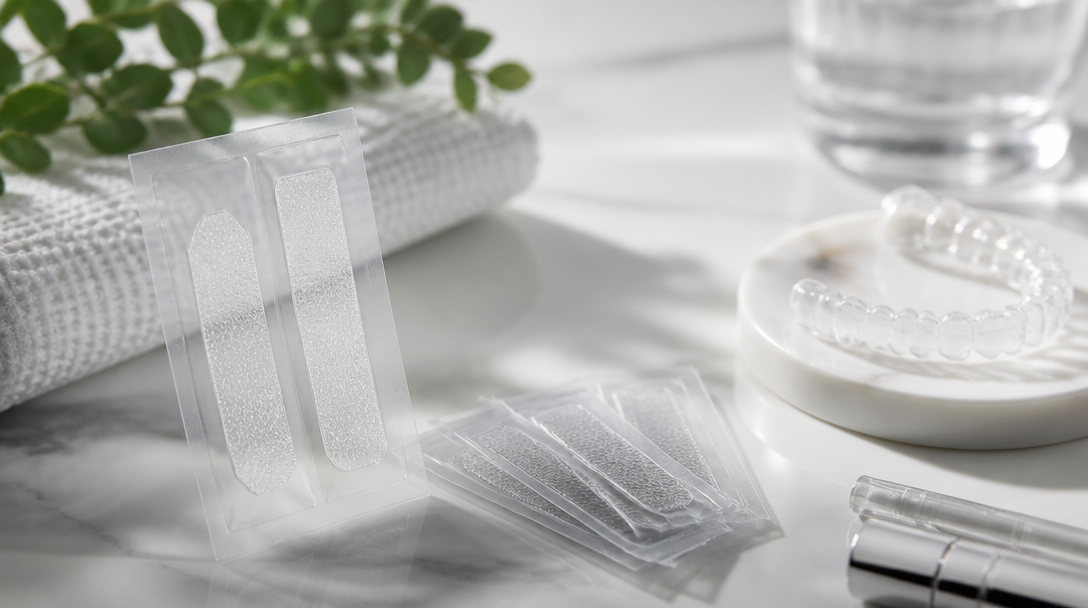
Learn which whitening strip carrier film specs to evaluate and contractually lock in when sourcing private-label strips — before film failures surface post-launch.
Whitening Strip Carrier Film Specs: What Buyers Must Lock In Before Production
When a private-label whitening strip launch fails, procurement teams investigate the gel first — peroxide concentration, PAP load, pH stability. The carrier film rarely receives the same scrutiny. That is a sourcing error with measurable commercial consequences. Whitening strip carrier film specs govern how the gel contacts the tooth surface, how long it stays there, and whether it migrates onto soft tissue during wear. A well-formulated gel on a poorly specified film will underperform in clinical use and generate returns that damage brand credibility.
Clinical evidence makes the delivery mechanism impossible to ignore. A 2023 study confirmed that a hydrogen-peroxide strip produced significant tooth whitening, while a peroxide-free strip regimen did not — a finding that isolates active-agent delivery as the primary efficacy variable. The film is that delivery mechanism. If it fails to conform, adhere, or retain the gel uniformly, concentration figures on a spec sheet mean nothing.
This article gives procurement leads, brand owners, and category buyers a structured framework for evaluating and contractually locking whitening strip carrier film specs before production begins.
Film Material Options: PET, PU, and Hydrogel Compared
Three polymer categories dominate commercial whitening strip construction. Each carries distinct trade-offs in flexibility, gel compatibility, and cost structure that directly affect finished-product positioning.
- PET (polyethylene terephthalate): A rigid, dimensionally stable substrate with well-characterized moisture barrier properties. PET films are straightforward to die-cut and cost-effective at volume, but their low elongation limits conformability on curved tooth surfaces. Suitable for entry-tier strips where fit precision is secondary to unit economics.
- PU (polyurethane): The material of choice for premium and professional positioning. PU films offer substantially higher elongation, enabling the strip to conform to tooth curvature and interdental edges without lifting at the margins. PU also tolerates a wider range of gel formulations, including higher-viscosity PAP gels. The per-unit film cost is higher — and justified for clinic-channel and professional-retail products.
- Hydrogel backings: Engineered for direct wet-contact adhesion without a separate pressure-sensitive adhesive layer. Hydrogel films are gaining traction in professional-grade strips because they eliminate the peel-residue complaint associated with adhesive systems. They require tighter moisture-control protocols in packaging and carry a narrower compatibility window with certain peroxide concentrations.
Specify polymer identity — not just a trade category — in your product brief. A supplier describing their film as "flexible plastic" without a material data sheet is a sourcing red flag that signals a lack of process control at the production level.
Thickness and Flexibility Tolerances That Affect Fit and Wear
Film thickness governs two performance variables: conformability during wear and structural integrity during application and removal. A film that is too thin tears on repositioning. A film that is too thick resists tooth curvature, creating air gaps between the gel layer and the enamel surface — gaps that reduce active-agent contact time and produce uneven whitening results across the arch.
Request thickness specifications in microns, not qualitative descriptors. More importantly, request the tolerance band — the acceptable deviation from nominal thickness across a production run. Narrow tolerance bands are a marker of controlled manufacturing. Wide or unspecified tolerances indicate that film consistency is not being actively managed, which translates directly to batch-to-batch variation in your finished product.
Flexibility is characterized by two values: elongation-at-break and tensile strength. For PU films targeting professional-channel strips, higher elongation supports the conformability claims your brand may be communicating to dental clinic buyers. For PET-based economy strips, tensile strength matters more than elongation. Request both values and confirm the test method — ASTM D882 is the standard most suppliers reference for thin plastic films, and it should be cited explicitly on any data sheet.
Validate film behavior under simulated oral conditions, not just ambient lab testing. A film that softens, stretches, or partially degrades before the intended wear period ends will compromise the clinical outcome and generate complaints that are difficult to trace back to the film without prior testing data.
Adhesion Load Specs: Holding Gel Without Leaving Residue
Adhesion in whitening strips operates across two interfaces simultaneously: the film-to-gel bond and the gel-to-enamel bond. Buyers frequently conflate these, but they require separate specification and separate testing protocols.
The film-to-gel bond determines whether the gel layer delaminates from the backing during application or wear. If the gel separates from the film when the strip is peeled from its liner, the product fails at the point of use. Request peel adhesion data for the film-gel interface, expressed as force per unit width, and confirm that testing was performed with your specific gel formulation — not a generic reference gel that may behave differently.
The gel-to-enamel bond determines retention during wear. This is partly a gel property — viscosity, bioadhesive polymer content — and partly a film property — backing stiffness and edge geometry. A stiffer backing applies more consistent pressure across the gel layer, improving enamel contact. A film with poorly defined edge geometry allows gel to migrate toward the gingival margin.
The ADA has identified gingival irritation as a recognized adverse effect of whitening strip use, with clinical evidence pointing to soft-tissue exposure to bleaching agents as a primary cause. Edge geometry and gel containment behavior are not cosmetic details — they are direct mitigation measures for a documented clinical risk. Specify both in your film data sheet.
For pressure-sensitive adhesive films, specify the adhesive chemistry and its residue profile on enamel post-removal. Request residue testing data. Hydrogel films generally present a lower residue risk but require their own adhesion-load documentation to confirm consistent enamel retention across wear time.
Moisture Vapor Transmission Rate and Shelf-Life Performance
Moisture vapor transmission rate (MVTR) is one of the most consequential whitening strip carrier film specs for shelf-life performance, and it is consistently underspecified in private-label sourcing briefs. MVTR measures how much water vapor passes through the film per unit area per unit time. A high MVTR means moisture enters the strip pouch and reaches the gel layer — accelerating peroxide degradation, reducing active-ingredient potency, and shortening usable shelf life before the product reaches the end customer.
For hydrogen-peroxide gel systems, moisture ingress is a particular concern. Peroxide is inherently unstable and degrades in the presence of water and heat. A film with an inadequately controlled MVTR will not protect the gel through a standard shelf-life claim, regardless of how well the outer packaging is sealed. The film is the last line of barrier defense before the gel.
Request MVTR values expressed in grams per square meter per day (g/m²/day), tested under defined temperature and humidity conditions. Accelerated testing is typically conducted at elevated temperature and high relative humidity — confirm that the supplier's reported values use conditions relevant to your target distribution environment and storage claim.
PAP-based gel systems are generally more stable than peroxide formulations. MVTR remains relevant, however, because moisture affects gel viscosity, adhesion performance, and the integrity of any sensitizing-reduction agents incorporated into the formulation.
What to Request in a Film Data Sheet Before Sampling
Do not proceed to physical sampling without a complete film data sheet. A supplier unable to provide documentation at the pre-sample stage will not be able to provide batch records at the production stage. The data sheet must include the following as a minimum:
- Polymer identity: Full chemical name and grade designation — not a trade name alone.
- Nominal thickness and tolerance band in microns, with test method cited.
- Tensile strength and elongation-at-break values, with test method (ASTM D882 or equivalent) explicitly stated.
- MVTR in g/m²/day, with test temperature and humidity conditions specified.
- Peel adhesion data for the film-liner interface and, where available, for the film-gel interface using your gel formulation.
- Biocompatibility documentation: ISO 10993 testing or equivalent, confirming suitability for oral contact. This is non-negotiable for any product entering dental clinic channels or markets requiring CE marking.
- Regulatory compliance confirmation: Applicable food-contact or medical-device material regulations for your target market — FDA 21 CFR, EU Regulation 10/2011, or equivalent.
- Shelf-life data for the film material under defined storage conditions.
A one-page certificate of conformance is not a data sheet. A certificate states that a product meets a specification. A data sheet defines what that specification is. Accepting one in place of the other is a gap in your sourcing process, not a documentation milestone.
Whitening Strip Carrier Film Specs to Lock Into Contract Language
Verbal agreements on film specifications do not survive supplier transitions, raw-material substitutions, or production-scale changes. Every whitening strip carrier film spec that matters to your finished product must appear in the supply agreement or product specification annex — with defined acceptable ranges, not point values alone.
Structure your specification annex to include:
- Material identity clause: The exact polymer grade is named. Any substitution requires written buyer approval before implementation. This prevents silent material changes that alter film behavior without triggering a change-control notification.
- Dimensional tolerances: Nominal thickness ± defined tolerance in microns. Strip dimensions ± defined tolerance in millimeters. Out-of-tolerance batches are subject to rejection.
- Mechanical property ranges: Minimum tensile strength and minimum elongation-at-break, with test method specified. These values define the performance floor — not a target.
- MVTR upper limit: Expressed in g/m²/day at defined test conditions. Batches exceeding this limit are rejected regardless of other passing criteria.
- Biocompatibility and regulatory compliance: Supplier warrants that the film material meets ISO 10993 oral-contact requirements and applicable regulations for named target markets, and provides updated documentation upon any material change.
- Batch record retention: Supplier retains film batch records for a defined period — typically five years — and provides them on request. This supports post-market surveillance and any regulatory inquiry.
- Change notification period: Supplier provides a minimum defined notice period — commonly 90 days — before implementing any change to film material, supplier, or process that could affect the specified performance parameters.
Brands co-developing private-label whitening strips for dental clinic channels or premium retail environments should treat the specification annex as a living document that is version-controlled alongside the product formula. Film and gel are co-dependent systems. Specifying one without the other introduces risk that surfaces after launch, not before.
References
- PubMed — Tooth color change and tolerability evaluation of a hydrogen peroxide whitening strip compared to a strip, paste, and rinse regimen containing plant-based oils and Dead Sea salt (2023)
- American Dental Association — Efficacy, risks of over-the-counter tooth-bleaching agents
- American Dental Association — Experts weigh in on teeth whitening
- American Dental Association — Do tooth-whitening products work?
Disclaimer
This article is for general informational purposes only and does not constitute sourcing, legal, or regulatory advice. Always conduct your own due diligence and consult qualified legal or compliance professionals before making purchasing or compliance decisions. WhiteningBright makes no warranties as to the completeness or accuracy of the information, and any reliance is at your own risk.