Whitening Pen vs Strip: Which One Actually Works
11. Juli 2026
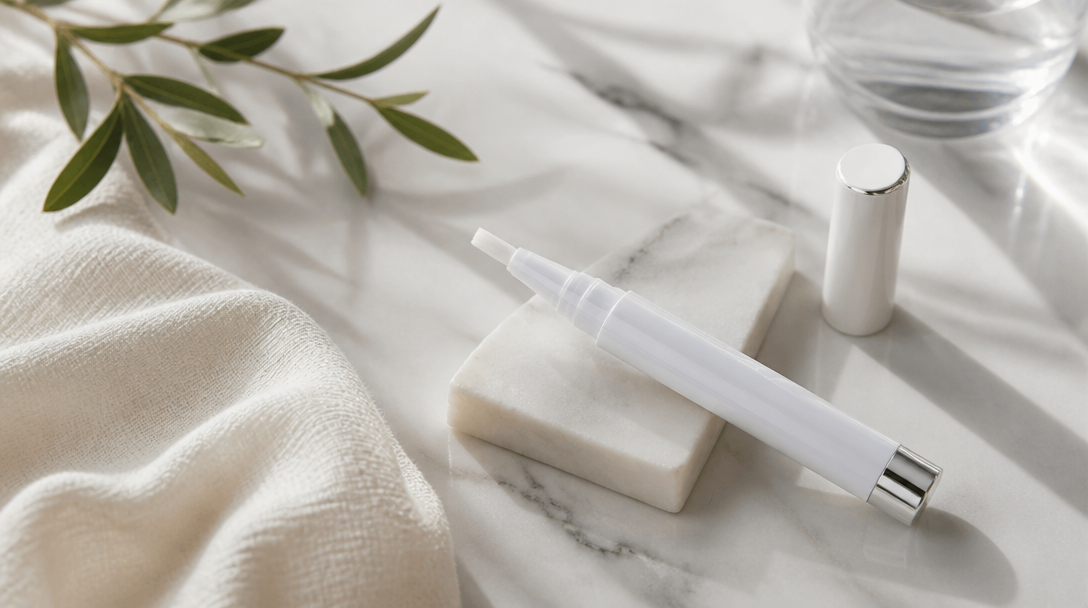
Whitening pen vs strip — compare how each delivers active ingredients, which stain types each handles best, and how to choose for your routine and sensitivity level.
Whitening Pen vs Strip: Which Format Actually Delivers
When you're weighing a whitening pen vs strip, you're not choosing between two versions of the same thing. You're choosing between two fundamentally different delivery systems — and that choice determines how much active ingredient reaches your enamel, how long it stays there, and whether your results match your expectations. Understanding the mechanics of each format is the fastest way to stop guessing and start choosing correctly.
How Whitening Strips Work
A whitening strip is a thin, flexible film coated on one side with a peroxide or PAP gel. When you press it against your teeth, the film acts as a reservoir — holding the gel in sustained, close contact with the enamel surface for the full wear period, typically somewhere between 15 and 60 minutes depending on the formulation.
The structural advantage is dwell time under controlled pressure. The strip holds the gel flat against the tooth, which limits dilution from saliva and keeps the active ingredient working across the full front-facing surface of each covered tooth. That sustained contact is what allows peroxide to move past the enamel surface and act on deeper, intrinsic staining — the kind that doesn't shift with a single application.
The limitation is geometry. Strips are flat; teeth are not. The gel may not reach the spaces between teeth, the edges of crowded or rotated teeth, or the gumline with any consistency. Any gap between the strip and the tooth surface is a gap in your results.
How a Whitening Pen Works Differently
A whitening pen uses a twist or click mechanism to push gel through a brush tip, which you paint directly onto each tooth surface. The gel is typically thinner in viscosity than strip gel — engineered to spread easily and dry into a light film on contact with air.
That thinness is the pen's precision advantage. You can target a single discolored tooth, work around a veneer or crown, or apply gel to a tooth that a standard strip simply won't reach because of its position in the arch. For spot treatment and post-whitening maintenance, that control is genuinely useful.
The trade-off is contact time. Once painted on, the thin film is vulnerable to saliva and tongue contact. Most instructions advise keeping your lips slightly open or avoiding food and drink for 20 to 30 minutes after application — but in practice, saliva dilutes the gel faster than a strip would allow. The active ingredient has less time to work at a meaningful concentration, which limits how much deeper staining it can address.
Pen formulations also tend to use lower peroxide concentrations than professional-grade strip formulas, partly because the open-application method brings gel closer to soft tissue, and higher concentrations at the gumline carry a greater irritation risk.
Sensitivity, Fit, and Coverage
Sensitivity
Tooth sensitivity is the most common side effect of peroxide-based whitening, regardless of format. The mechanism is the same in both cases: peroxide diffuses through enamel into the dentin, where it can temporarily stimulate the nerve. Concentration and contact duration are the two variables that drive sensitivity most directly.
Research published on PubMed Central indicates that home-based bleaching, when used according to manufacturer instructions, generally causes less sensitivity than in-office treatments. That finding applies to both strips and pens — but because strips hold higher-concentration gel against the tooth for a longer, more controlled period, they carry a somewhat higher sensitivity risk than most pen formulations.
If you already experience sensitivity to cold or pressure, a lower-concentration pen used less frequently is a more comfortable starting point than a full strip course.
Fit and Coverage
Strips are designed around an average tooth arch. If your teeth are smaller, larger, or significantly crowded, the strip may not lie flat — and any area where the gel loses contact with the enamel is an area that won't whiten evenly. That's a coverage problem you can't solve by pressing harder.
Pens solve the fit problem but introduce a consistency problem. Painting gel onto a curved surface by hand produces less even coverage than pressing a pre-loaded strip. You may apply more product to one area than another without realizing it, and uneven application over time leads to uneven results.
Gum Contact
With strips, gel can migrate toward the gumline if the strip is placed too high or shifts during wear. This causes temporary gum irritation in some users. Pens require careful hand control to avoid painting gel directly onto soft tissue — a realistic challenge without a well-lit mirror and a steady hand.
Whitening Pen vs Strip: Which Handles Which Stain Type
Not all staining responds the same way to whitening treatments. Matching the format to the stain type is how you set realistic expectations before you spend money on either product.
| Stain Type | Description | Better Format |
|---|---|---|
| Extrinsic (surface) | Deposits from coffee, tea, red wine, or tobacco sitting on or just below the enamel surface | Either format; pen useful for spot treatment |
| Intrinsic (deep) | Discoloration within the dentin layer from aging, past antibiotic use, or trauma | Strip — longer dwell time supports deeper peroxide penetration |
| Post-treatment maintenance | Sustaining results after completing a strip course or an in-office whitening session | Pen — convenient, low-concentration touch-up |
| Localized single-tooth staining | One or two teeth noticeably darker than surrounding teeth | Pen — precision application where a strip cannot target |
| Crowded or rotated teeth | Arch geometry that prevents a flat strip from lying flush against the tooth surface | Pen — reaches surfaces a flat strip misses |
For deep, longstanding intrinsic staining — the kind that shows no visible change after a consistent strip course — neither an OTC pen nor a strip is likely to be sufficient. That category of staining typically requires professional-grade treatment or a custom tray with a higher-concentration gel dispensed by a dental professional.
How to Choose Based on Your Actual Routine
The best whitening format is the one you'll use consistently. Both sides of the whitening pen vs strip comparison and the science behind them become irrelevant if the product sits unused after three applications.
Choose a strip if:
- You have moderate-to-significant staining across multiple teeth and want visible results within a defined treatment window
- You can commit to a daily 20–30 minute application — in the morning while getting ready, or in the evening before bed
- Your teeth are reasonably well-aligned and a standard strip fits your arch without bunching or lifting at the edges
- You don't have significant existing sensitivity that makes longer contact time uncomfortable
Choose a pen if:
- You want a maintenance tool after completing a strip course or an in-office treatment
- One or two teeth are noticeably darker than the rest and you want to target them specifically
- Your schedule makes a 30-minute seated application impractical — a pen can be applied in under two minutes
- Your teeth are crowded or rotated in ways that prevent a flat strip from achieving even coverage
- You're new to whitening and want to start with a lower-concentration format to gauge your sensitivity response before committing to a full strip regimen
Consider using both:
A practical and well-supported approach is to use strips for an initial whitening course — typically one to two weeks — then maintain results with a pen used a few times per week. This pairs the depth of treatment that strips can provide with the convenience and precision of a pen for ongoing upkeep.
The available evidence supports this staged approach. Research suggests the most effective long-term whitening strategy combines an initial treatment phase with periodic home-based maintenance — and a pen is well-matched to that maintenance role.
When Neither Format Is the Right Starting Point
There are situations where starting with an OTC whitening pen or strip is not the right first step. These products are effective when used in the right context — the conditions below change that context.
Speak with a dentist before beginning any whitening regimen if you have any of the following:
- Active cavities or cracked enamel: Peroxide can penetrate damaged enamel and reach the pulp, causing significant pain and potentially worsening the underlying damage.
- Gum disease or recession: Exposed root surfaces do not respond to peroxide the way enamel does, and contact with inflamed tissue can worsen irritation.
- Crowns, veneers, or bonding on visible front teeth: Restorative materials do not whiten. Treating the surrounding natural teeth creates a visible color mismatch.
- Severe intrinsic staining from tetracycline or fluorosis: These stains are resistant to OTC peroxide concentrations and typically require professional-grade treatment or cosmetic dentistry.
- Pregnancy: Most dental professionals advise postponing elective whitening until after delivery, out of an abundance of caution.
Whitening pens and strips are safe and effective when used appropriately — matched to the right stain type, at the right concentration, and applied to teeth that are healthy enough to benefit. If you're uncertain about any of those conditions, a brief consultation with your dentist before purchasing either format will save you time, money, and discomfort.
References
The research sources available for this article include one peer-reviewed publication retrieved from PubMed Central and general regulatory guidance from relevant health authorities. No recent peer-reviewed studies (2023–2026) directly comparing whitening pen and strip efficacy were available in the reviewed sources. The reference below reflects the only authoritative scientific source present in the research material.
- Tooth Whitening: What We Now Know — PubMed Central (PMC4058574): Reviews the evidence base for home-based and in-office bleaching, including sensitivity profiles and the rationale for staged whitening regimens combining initial treatment with periodic home maintenance.
For additional authoritative guidance on tooth whitening safety and active ingredient standards, refer to:
- U.S. Food and Drug Administration — Teeth Whitening Products (FDA.gov)
- American Dental Association — Tooth Whitening (ADA.org)
Note: Readers seeking recent clinical comparative data on pen versus strip efficacy are encouraged to search PubMed or Google Scholar using terms such as "hydrogen peroxide whitening pen strip efficacy" filtered to 2023–2026 publications in journals such as the Journal of Dental Research or Clinical Oral Investigations.
Disclaimer
This article is for general informational purposes only and is not a substitute for professional dental or medical advice. Always consult a qualified dental professional before starting any teeth-whitening or oral-care regimen. WhiteningBright makes no warranties as to the completeness or accuracy of the information, and any reliance is at your own risk.